JOYCE W CAIRNS – A Personal Odyssey

Royal Scottish Academy, Edinburgh 1 August – 2 September 2026
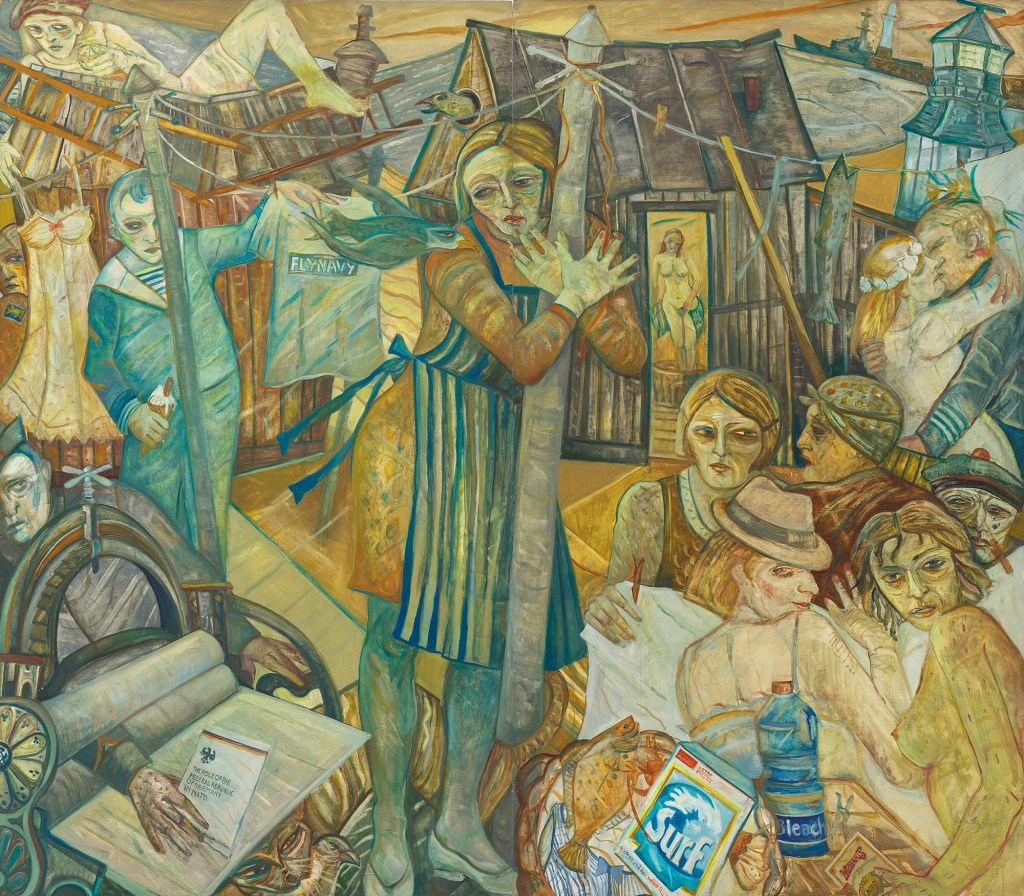
Joyce W Cairns The Drying Green (1990 Oil on panel, 213 x 244cm) Image courtesy of the artist.

Joyce W Cairns is a powerful storyteller with an unflinching eye on the human condition. Her epic memory paintings are among the most significant works in contemporary art, borne in the intimate study of objects and hidden histories. Her commitment to the human subject and to the discipline of painting transcend the autobiographical. Exhibiting since 1969, Cairns has walked her own path, choosing to situate herself for much of her career in the Northeast of Scotland. This unique vantage point, the village of Footdee, Aberdeen, has shaped the intense focus and characteristic edginess of her practice. The contemporary relevance and timeless significance of Cairns’ work is immediately striking, unlocking family history and illuminating multigenerational experiences of love, loss and trauma. Tackling difficult subject matter and addressing war on the home front, Cairns’ critical and empathic grasp of history could not be more pertinent. She brings the crafting of a painting and the visceral qualities of paint to the fore, tacit reminders of what human beings need to make sense of the world. In a ‘Post Truth’ age where we increasingly experience reality through screens, Cairns’ work is a reminder to dig deep where you stand.

Born in Edinburgh in 1947, Cairns studied at Gray’s School of Art, Aberdeen (1966-71), the Royal College of Art, London (1971-74), Gloucester College of Art and Design (1974-75) and Goldsmith’s College, University of London (1975-76). In 1976 she returned to Gray’s School of Art as a lecturer in drawing and painting. Throughout the 1980’s and 1990’s her mature style in large scale figurative composition emerged, with bodies of work inspired by her childhood in Edinburgh, the village of Footdee, the underbelly of life around Aberdeen harbour, WWI, the Gulf war and Bosnian war. The decade long research and development of her monumental War Tourist exhibition, held at Aberdeen Art Gallery in 2006, was a remarkable achievement. The discovery of a suitcase of her father’s wartime memorabilia in 1995 prompted Cairns to retrace her father’s journey through WWII in Normandy and Tunisia. She then visited Germany, Austria, the Czech Republic and Poland in wider exploration of WWII and in response to human suffering during the Holocaust. As she stated in a 2006 interview, ‘I’m not doing war paintings, its memory paintings.’ (1)  As she searched for her father, she became the ‘War Tourist’, combining past and present, and bringing female perspective to world conflicts. The War Tourist exhibition brought together Cairns’ paintings, drawings and prints from the 1980’s to the 2000’s, together with artefacts spanning her exploration of different theatres of war. Some of these paintings are included in A Personal Odyssey. After a long association with the RSA including awards, exhibiting and as a Royal Scottish Academician, in 2018 Cairns became the first female president in the Royal Scottish Academy’s history.

Cairns’ achievements are many and her influence on generations of Scottish artists profound. However, standing in front of her work it is the emotional connection to her subject, her intellect, humour and mastery of large-scale composition that consistently shines through decades of dedicated practice. Cairns’ work is confrontational and compassionate in equal measure, able to assimilate ‘memory, history and lived experience’ like nobody else. Although significant large-scale museum works such as Shadows of the Past, Liberation Ceremony, Rennes (1984), TV Dinners (1991) The Deadly Wars (1993) and other works from the War Tourist cycle are regretfully missing, A Personal Odyssey is an important survey of the artist’s work. The exhibition gives valuable insights into Cairns evolution from the late 1960’s to the present day and is a welcome opportunity for visitors to experience her work first hand.  
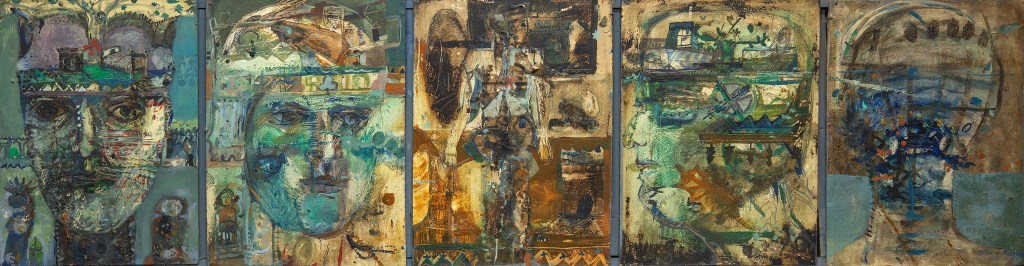
Joyce W Cairns Disintegration of Mankind (1970, oil on panel) Image courtesy of the artist.
Joyce W Cairns Pursued, Conquered and Assimilated (1971, oil on panel) Image courtesy of the artist.

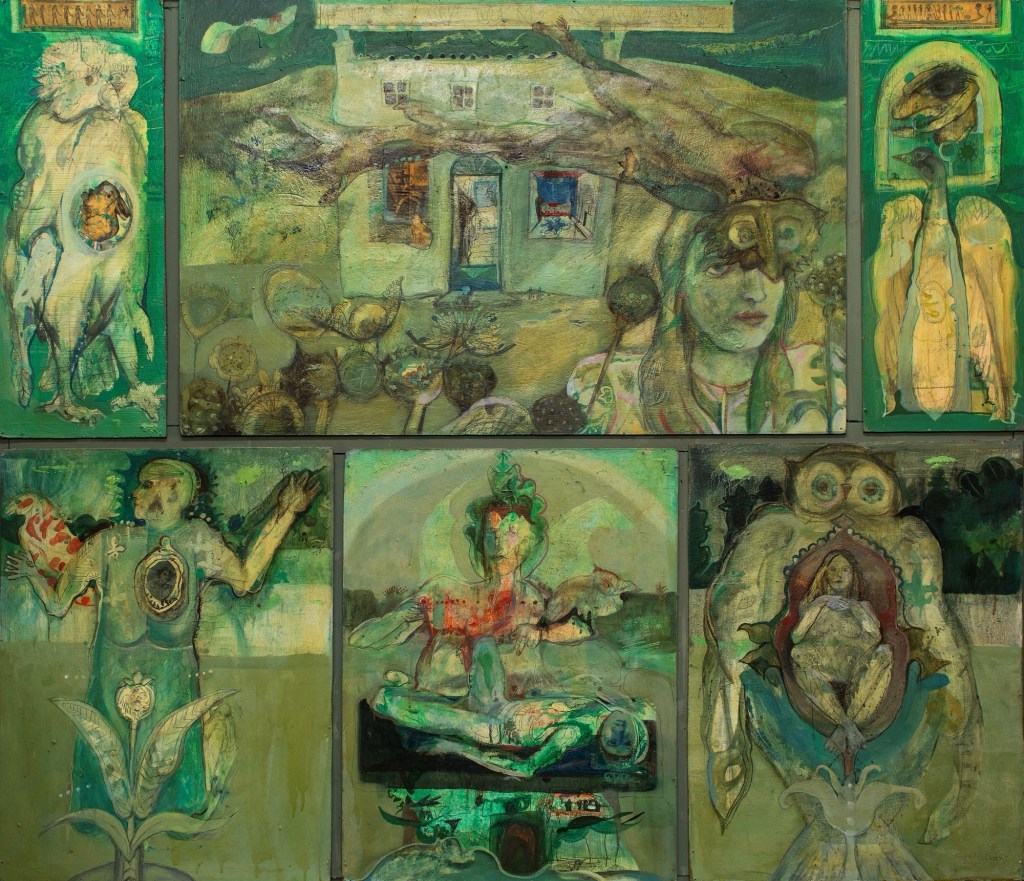
Cairns has always possessed the vision and indomitable spirit that enables an artist to transcend themselves, evidenced here in her earliest work. Pastel Self Portrait (1969/70, pastel on paper, 31 x 20cm) brings a sense of self possession and enquiry as the artist resolutely meets the viewer’s gaze. The powerful lyricism and extraordinary range of mark in Cairn’s early works is impressive. Disintegration of Mankind (1970, oil on panel) encompasses our false sense of human progression in a series of five increasingly abstract figures, with the final head baring its teeth. Right from the start there is much in her handling of paint that is incredibly beautiful and assured, combined with a commitment to seeking truth, within and without.  ‘Disintegration of Mankind’, ‘Pursued, Conquered and Assimilated’ (1971), ‘Requiem for a Soul (1971-2) and Man may come, man may go (1972) are fine examples from this period, characterised by dreamlike fluidity and exceptional skill. In Pursued, Conquered and Assimilated,’ there is a feeling of what memories are held in the body and in threshold spaces, houses, doorways, fragments of collage, ancient art and mythology. Awarded an RSA Carnegie Travelling Scholarship in 1971, Cairns travelled to Italy, fuelling her interest in medieval and pre-Renaissance Art. Her multi-panelled approach has a kinship with devotional art practice as she develops her own symbolism. Falling Woman (1969 /70, gouache on paper, 48 x 29cm) gives a taste of what is to come in the female figure or portrait merged with domestic architecture and communal spaces of comfort or reckoning. The perfect counterfoil in confronting difficult subject matter is the inherent care in crafting the image, which becomes progressively honed throughout the 1980’s and 1990’s as the scale and ambition of Cairns’ work increases.
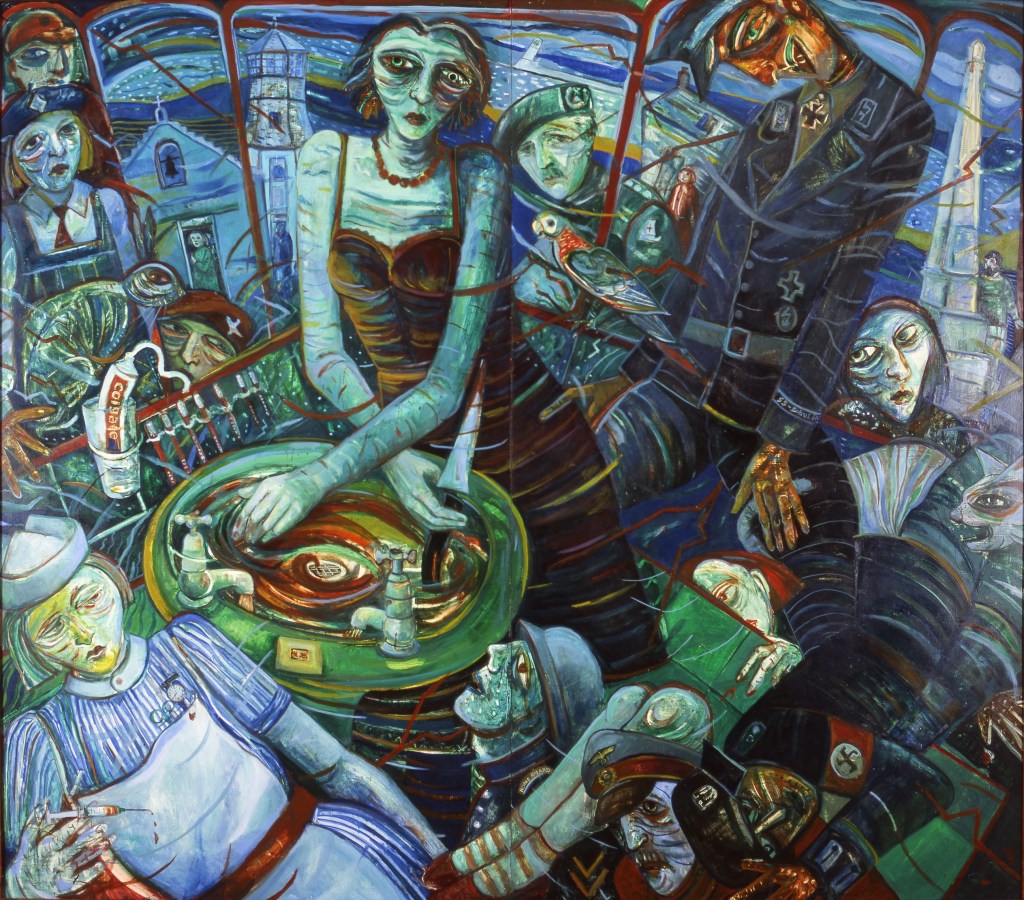
Joyce W Cairns They Said the War Was Partly to Blame (1986, oil on panel, 213 x 244cm)
Image courtesy of the artist

In They Said the War Was Partly to Blame (1986, oil on panel, 213 x 244cm) figures are orientated around the emotional core of the painting, Cairns’ mother, who stands at the apex of the composition over a vortex-like sink hole. The vantage point is the family bathroom at Dovecot Grove, Edinburgh, and Footdee, with its familiar harbour shapes in the background, moving back and forward through time, unlocking what is hidden and exploring painful family history. The painting feels drenched in sea green, as though drowning or being pitched on internal waves of awareness. There is another hue in play here too, like the green guiding light of a harbour buoy, that doesn’t allow us to run aground. As in many of her large-scale compositions, interlocking pyramids and tilted, angular horizons give a feeling of acute instability and unease. However emotionally off balance we may feel, the artist’s highly structured approach to composition is what enables us to stop, look closely and contemplate a scene we may not want to witness.  It is fascinating to see the accompanying study for this painting and the decisions made in terms of design and foreground. The psychological compression of figures echoes the dynamism of German Expressionism and Neue Sachlichkeit artists of the Weimar period. Painting humanity in terminal decline with brutal honesty, artists George Grosz, Otto Dix and Max Beckmann are a potent influence on Cairns’ work. However, her distinctive potency emerges through empathy, a passionate need not to just make sense of her own family history, but intergenerational trauma and collective memory.

Emotional connection is paramount in Cairns’ work, in her rendering of the human figure and her painstaking research. The importance of getting the details of artefacts, uniforms and memorabilia just right and bearing witness to what is hidden, acknowledges and honours civilian casualties of war. Many of her paintings are memorials in that respect. Although They Said the War Was Partly to Blame is a deeply personal exploration, as Cairns’ practice progresses frames of reference in her work continue to expand. The ‘personal odyssey’ carries within it a concern beyond the self. It is the artist as witness, looking inwards certainly, but outwards too, with a critical awareness of world events.
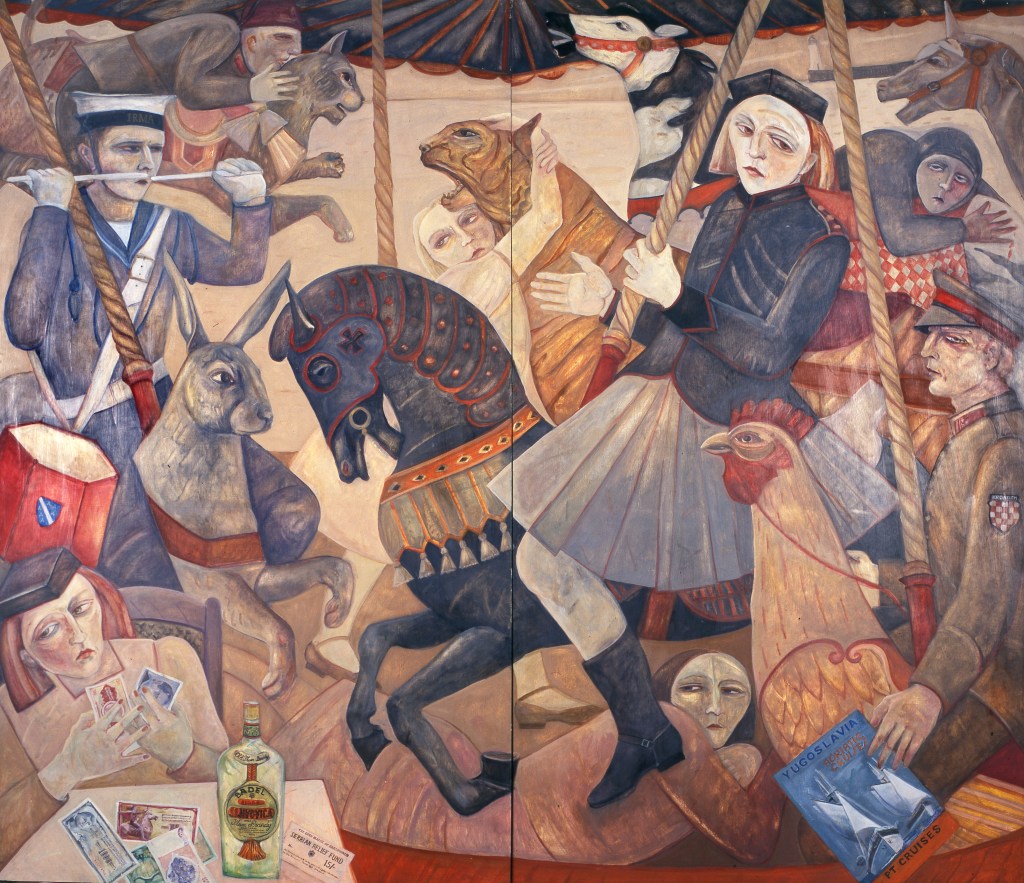
Joyce W Cairns Irma (1994-95, oil on panels, 213 x 244cm) Image courtesy of the artist.

Irma (1994-95, oil on panels, 213 x 244cm) is a beautiful example focused on a terrible subject, merging Cairns’ symbolic carousel of war with the story of Irma Hadzimuratovic, a young girl airlifted to the UK for treatment and sadly, a casualty of the Bosnian war. The image of the child clinging to the tiger haunts the background centre of the composition. As in many of Cairns’ paintings the artist’s face is present, although this is not always self-portraiture. In Irma, the gaze of the artist/ witness meets our own, reaching across time. Cairns confronts the cruelty and absurdity of war, often bringing to light the experiences of women and children.
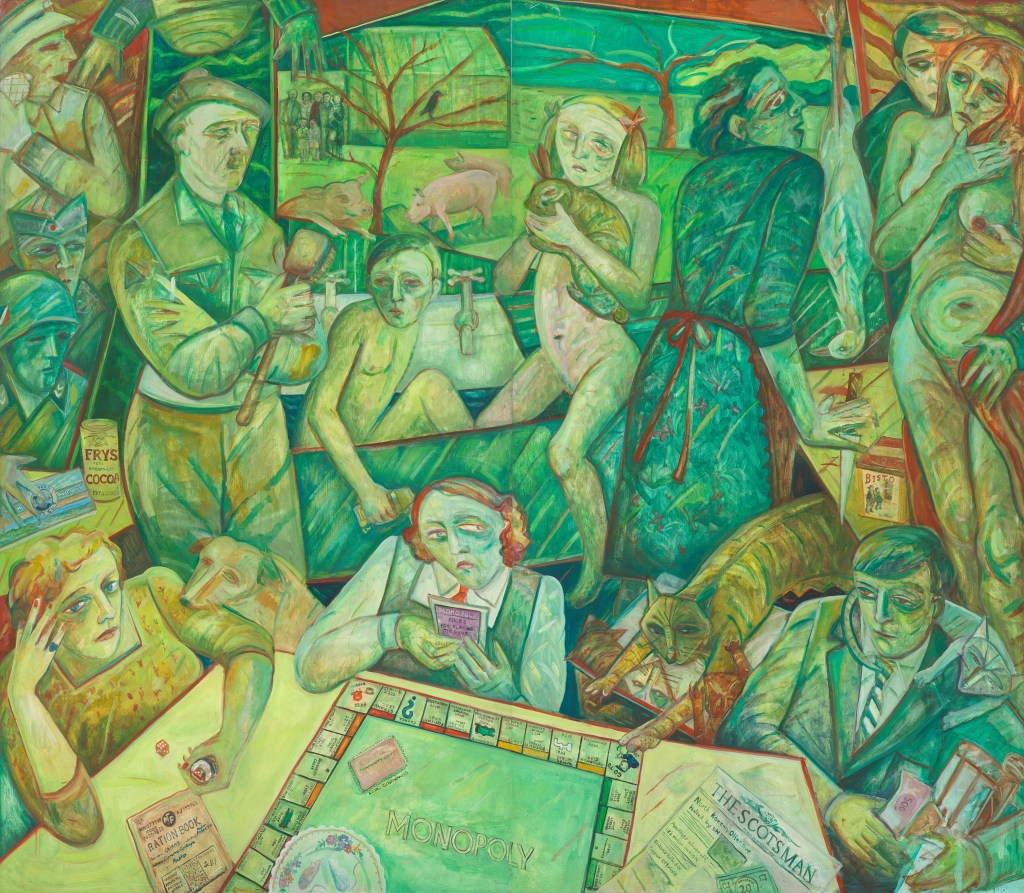
Joyce W Cairns Ratho,1951 (1990, oil on panel 213 x 244cm) Image courtesy of the artist.

Cairns’ experience as a child growing up in the post WWII era is reflected in the intimacy of objects as triggers of personal memory and collective remembrance. Often these are arranged in the foreground, like a shelf or windowsill of memorabilia we might collect in our own domestic space. In Ratho, 1951 (1990, oil on panel 213 x 244cm) this extends into the viewer’s space. A ration book, the monopoly game, the front page of The Scotsman (Friday 26 January 1951) with its headline ‘North Korean Offensive Halted by UN’ and a floral plate of morsels are offered up, together with a clutched copy of the rules of the game- monopoly and life. A myriad of narratives present themselves in the heightened opposites of red and green, and complex family dynamics. Ratho, 1951 is a psychological study of family life and memory with the unmentionable pushed to the margins, but ever-present in Cairns’ art. In an interview with the artist at her home in Footdee, in 2006 she reflected; ‘After the war people just didn’t want to know. When I was growing up, they wanted to put that aside. The early fifties when I was young was a pretty grim time in Britain, rationing and stuff like that…There were all kinds of shortages. Of course, as a child you didn’t realise it could be any different.’(2)
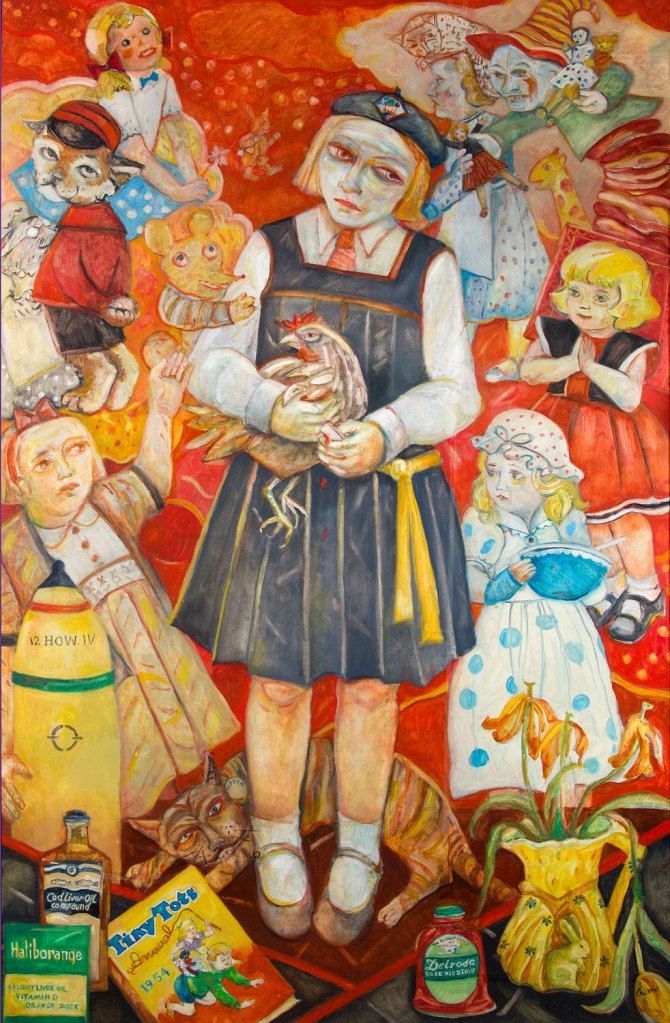
Joyce W Cairns Tiny Tots Annual 1954 (c. 2016, oil on canvas, 203 x 145cm) Image courtesy of the artist.

The seemingly bright painting of childhood Tiny Tots Annual 1954 (c. 2016, oil on canvas, 203 x 145cm) in dominant cadmium red and yellow is a highly visceral arrangement of figures and objects. Foreground bottles of rosehip syrup, cod liver oil and Haliborange (halibut liver oil, vitamin D and orange juice) provide a powerful sensory trigger for the post war generation of what was deemed good for the child. The question of what we are weaned on is inferred by a 12 HOW.IV missile which reads like a baby’s bottle. The central figure of the female child in school uniform clasps a hen, often a symbol of vulnerability in Cairns’ art. Her face is weary with age, giving a heightened sense of adult perspective to the whole scene. The figures and toys that surround her are part nursery rhyme, part comic book. A sibling-like figure with her hand around the missile reaches for the sleeve of the central protagonist / artist/ caregiver, while in the background a doll-like figure clasps her hands in prayer or delight. Emotional shifts encircle the painting, never allowing the viewer to get too cosy with nostalgia. A worried female child stands with a bowl in her hands to the lower right of the composition. Goldilocks with a full bowl of porridge hearing bears or an empty bowl and anticipation of gnawing hunger like Oliver Twist?  A recurrent rabbit jug family heirloom with spent lilies brings a sickly air to the scene. Like the nick of blood drops at the centre, there is a kind of reckoning within the fairytale façade, of coming to terms with the forces that shape us and make us who we are. The expression of the central female figure is knowing and complex, a sideways glance into a space beyond the picture plane, pensive, red eyed and perfectly still, as wave upon wave of associations hit the spectator.
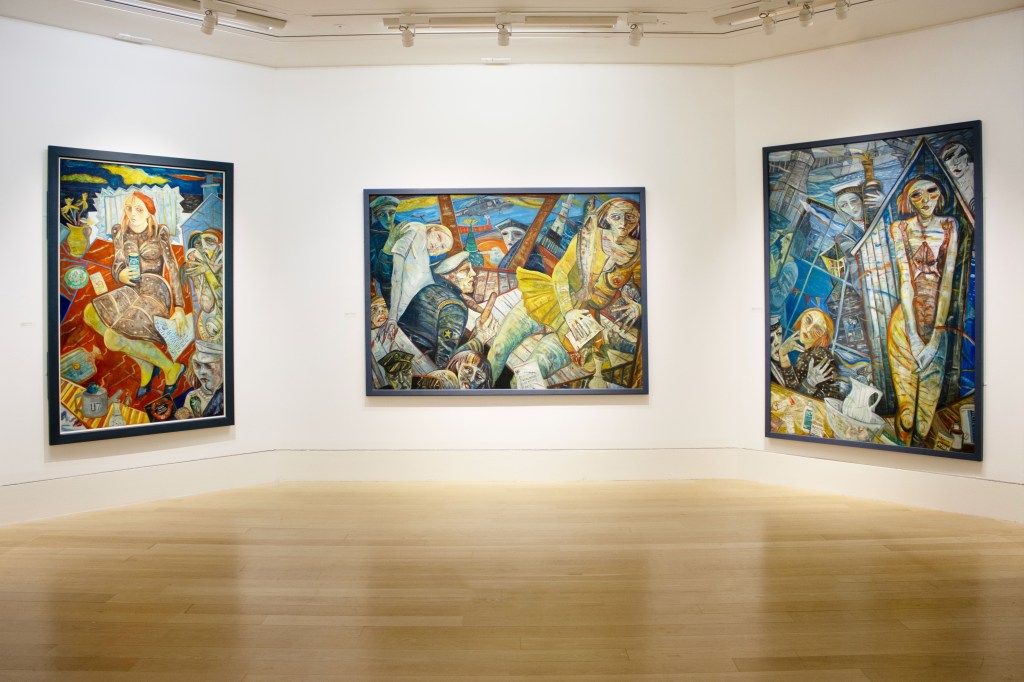
Joyce W Cairns – A Personal Odyssey Installation shot with On Board the Schleswig- Holstein (1989 oil on panel 220x 160cm) in the centre. Image courtesy of the Royal Scottish Academy.

There are many highlights in the show where facets of self, womanhood and femininity are explored by the mature artist. The Drying Green (1990 Oil on panel, 213 x 244cm), Sailing Through Polluted Seas (1988 oil on panel, 83 x 244cm) and On Board the Schleswig- Holstein (1989 oil on panel 220x 160cm) are as beautiful as they are challenging. Making connections within Cairns’ imagery is one of the great pleasures of the show. While the origins of enquiry might be personal or historically specific, Cairns creates spaces of imagination and confrontation that are satisfyingly multilayered. There is also a sense of being in the presence of a master of the craft, a nurturing, insistent force of life, absent in the work of many of her male contemporaries. In the 1980s and 90’s when the ‘New Glasgow Boys’ Peter Howson, Ken Currie, Adrian Wiszniewski and Steven Campbell were emerging with much acclaim in a resurgence of figurative art in Scotland, Cairns’ work during the same period is arguably more commanding in its emotional intelligence.  As Bill Hare’s excellent commentary on Cairns’ work over many years has suggested, there is a kinship with the work of Paula Rego. The power of visual storytelling, expression of female lived experience, uncompromising honesty and exploration of collective memory are distinctive qualities in each artist’s work. There is too, a ‘spirit tempered to endure’(3) that emerges from their timeless paintings. Critically, Cairns’ work reminds us that how we remember is how we endure.

Under the banner of this year’s Royal Scottish Academy 200th anniversary celebrations, A Personal Odyssey understandably frames Cairns’ work within RSA history and in the context of Scottish Art education. However, now is the time to acknowledge and celebrate the international stature of Joyce W Cairns’ work, which extends far beyond Scotland or any institution. Although there is a missed opportunity here for a full-scale public retrospective occupying the entire RSA galleries, A Personal Odyssey reveals the evolution, resilience and spirit of one of the UK’s finest artists. Joyce W Cairns’ powerful, monumental works assert the importance of painting in contemporary life, the multifaceted role of the artist as witness and our essential need for storytelling. At this point in history with war and destruction raging all over the planet, Cairns’ spirit of confrontation, compassion and insight is a shining light.
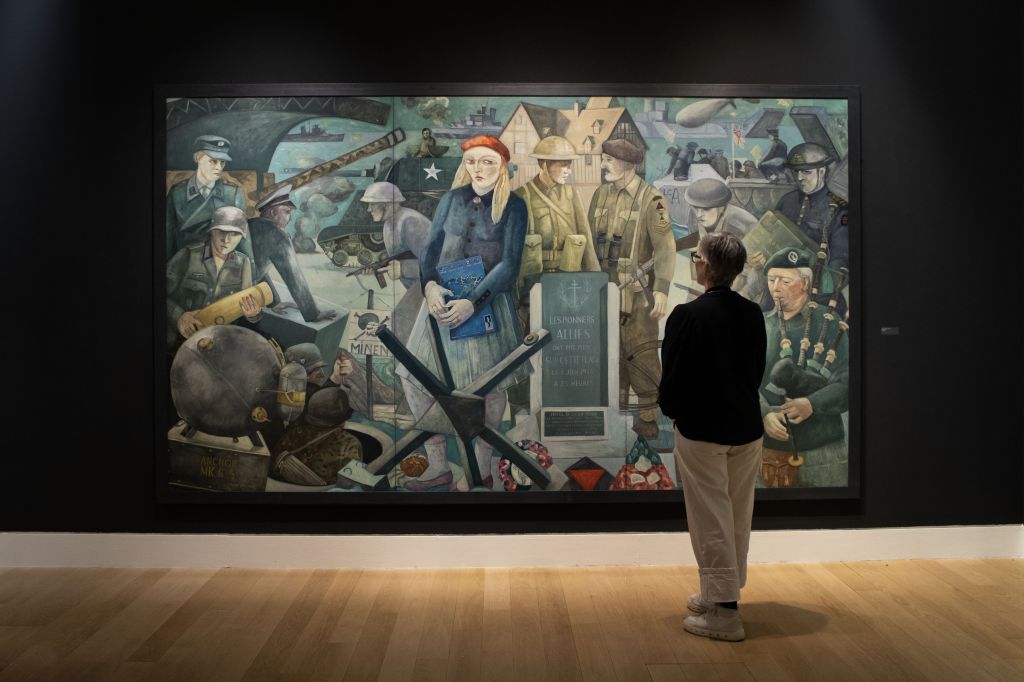
Joyce W Cairns – A Personal Odyssey installation shot with Sword Beach (1996, oil on panels, 213 x 366cm) by Joyce W Cairns. Image courtesy of the Royal Scottish Academy

Joyce W Cairns- A Personal Odyssey – Royal Scottish Academy exhibition page: https://www.royalscottishacademy.org/exhibitions/315-joyce-w.-cairns-a-personal-odyssey/overview

Georgina Coburn Review of War Tourist in Northings 24 March 2006: https://northings.com/2006/03/24/joyce-cairns-war-tourist

 Notes

  1. Joyce W Cairns interview with Georgina Coburn Footdee, Aberdeen, 18 March 2006.
  2. Joyce W Cairns interview with Georgina Coburn Footdee, Aberdeen, 18 March 2006.
  3. Quotation on the wall of the A Personal Odyssey exhibition space; ‘And if a god will wreck me yet again on the wine dark sea, I can bear that too, with a spirit tempered to endure.’ Homer, The Odyssey (trans Robert Fagles)

Thresholds – The Art of Carolynda Macdonald

Carolynda Macdonald River of Lost Souls (oil on linen, 113cm x 105cm)
Image courtesy of the artist and Kilmorack Gallery

‘I seek to bridge a recognisable world with that of an imaginary or mythological one. I almost always include birds as the main protagonists but have increasingly brought in human characters too. This alchemy of birds and fragments of old master figurative paintings, become vehicles for the subconscious to play and facilitate self-expression.’ Carolynda Macdonald

Working previously as a Biomedical Scientist in Microbiology, Carolynda Macdonald has progressively developed her painting practice since 1982, studying life drawing, printmaking and exhibiting extensively in the UK, USA, and Australia. Now based in Edinburgh, Macdonald’s recent exhibitions, including House of Macdonald with fellow artists Alan and Rory Macdonald, affirm her emergence as a distinctive voice in Contemporary Art. Drawing on traditions of painting in Western Art, the tradition celebrated by Macdonald is freedom of expression, art which is big enough to admit multiple layers of interpretation, making ‘paintings you can fall into.’ ‘Humanity being imprinted onto Nature’ is a strong theme in her latest work, where birds are threshold subjects, guardians of the natural world and human vulnerabilities.

River of Lost Souls (oil on linen, 113cm x 105cm) contains a scene of human betrayal, the cutting of Samson’s hair by Delilah’s accomplice, a removal of his supernatural power depicted by Rubens and reimagined here within the body of a bird. The brown, russet, crimson, and flesh tones glow humanely, emerging from a dark, cool, calm before storm background by the river’s edge. The human body is tucked protectively into the bird’s feathers, a safe space where humanity, emotion, and nature, within and without, can be examined. Poised on one leg, the bird’s gaze meets ours. This recognition, the confrontation of the eye of one species meeting another’s, is deeply arresting. It is a moment of tension that brings thought and feeling bubbling to the surface, in our immediate present and in relation to a shard of visual history.  The painting is a threshold space and being held within spaces where land, sky and water meet, have a particular role in Macdonald’s art. She composes images of sanctuary for her protagonists and the viewer, alive with tension and burgeoning consciousness, full of possibility. This feeling of potential, psychologically and in the realm of dreams, is incredibly subtle and potent. In River of Lost Souls, who or what gives us strength, is given new context out with the Old Testament Biblical story and an art historical canon of Old Male Masters.

There are a number of genres and art historical expectations in play here, and Macdonald inadvertently subverts them all, bringing fragments of grand Master subjects into intimate focus, honouring scientific enquiry and ornithological art with feeling, and bringing untold psychological depth to the traditionally demure arena of still life. The field of enquiry is truly expansive, painted with meticulous detail and devotion to craft. It is the joy of painting and not politics that drives Macdonald’s art. We are free to interpret meaning and lose ourselves in narratives of our own making- that’s the gift and flow within her painting. In the presence of an artistic voice that elevates the mind and spirit, we can confront difficult things and begin to heal. Macdonald describes the music of Jocelyn Pook, Lisa Gerrard and Portuguese Fado singing in such terms, and the same is true of her paintings.  

Carolynda Macdonald Beacon of Hope (oil on board, 25cm x 23cm)
Image courtesy of the artist and Kilmorack Gallery

Carolynda Macdonald brings her microbiologist’s eye to the pattern of life and creates different spheres of awareness in the process. In Beacon of Hope (oil on board, 25cm x 23cm) we see a feast of finely painted flowers reminiscent of Rachel Ruysch within the body of a tiny wren. Although delicately rendered, the dark bird is alert, determined and poised in readiness on a natural stone, clasping a diamond in its claw. Broken jewellery is strewn at its feet, a microcosm of detail in a mountainous landscape of macrocosmic emotions and association. There is a jewellery box inheritance opened here and an uncanny, fleshly light which plays across the surface of lake and sky in the background. The artist creates an atmosphere of profound stillness, a place of solace, contemplation and in this case, an unsettling suggestion of relationships being tested. Macdonald describes the objects in her paintings being ‘broadly drawn’ rather than autobiographical. ‘Pearls are beautiful things to paint- glowing. They can abstractly solve a painting. What a pearl is, what it means’ also comes into play. ‘Pearls are a living thing, a grain of sand, giving all these things a different life in the work.’ Sometimes the placement of objects emerge unconsciously out of a brushstroke and Macdonald is simply enjoying where the mark takes her. It is an art of instinct and precision, that allows the human condition to be explored in all its nuances, ‘including inner turmoil and vulnerability, love and hidden desires, betrayal, motherhood, and protectiveness.’

Carolynda Macdonald Fortress of Shadows (oil on board, 25 x 23cm)
Image courtesy of the artist and Kilmorack Gallery.

The intimate scale of Macdonald’s wren and robin paintings draws you in, often with unexpected twists. In Fortress of Shadows (oil on board, 25 x 23cm) the female form is revealed and protected within the body of the bird, perched on a silver jewellery box. The strawberries in the right foreground link with drapery which the female protagonist draws towards her body to shield it, her hand resting on the wren’s head. They are both vessels of potential narratives. The vulnerability of this reclining nude pose, seen so often in Western Art History as exposure for a male gaze, shifts to a more heightened state of awareness within, as if the threat exists beyond the boundaries of the picture plane, with the painting as refuge. The way Macdonald positions the female body gives it protection and agency -within the painting and the viewer, to begin to explore what this internal scene means to us.

Carolynda MacdonaldThe Scream (oil on board, 25 x 22cm) Image courtesy of the artist.

The Scream (oil on board, 25 x 22cm) is another powerful example, punching far above its scale and subverting the hierarchical dominance of large-scale History Painting. The combination of elements-still life, wren and jewellery, set in what feels like an 18th Century Arcadian landscape is juxtaposed with a fragment of Goya’s resistance painting The Third of May 1808, with civilians dying before a firing squad. Perched on the lid of a jewellery box, the open-mouthed wren omits a sound, amplified by the viewer’s imagination. There is a broken, half submerged ring or tether in the water, an intriguing detail that suggests shackles being broken on multiple levels. The potency of the scream, its volume and resonance is made by association, linked to the viewer’s awareness/experience and the scene of execution. There is beauty, horror and tension in this work achieved with consummate skill. The grand history painting is a fragment on the bird’s body, perhaps suggesting the relativity of human history when staring the current Anthropocene era in the face.

Carolynda Macdonald The Garden of Solace (oil on linen, 134 x 124cm) Image courtesy of the artist.

Our perception of violence in The Garden of Solace (oil on linen, 134 x 124cm) is tempered by how Macdonald leads the eye into the painting. The curves of the brown flamingo’s neck and beak direct us towards a fragment of Eugène Delacroix’s Death of Sardanapalus contained within its body. The extreme violence and chaos of this scene is repositioned so that we can actually be still with it and begin to interpret what is brought to the surface. It is a very powerful thing to give freedom to the imagination, both in the act of painting and enabling the viewer. This self -reflexivity is precisely what art is for, individually and collectively, to actively process what it means to be human, how we relate to each other and the natural world. In The Garden of Solace, the indifferent male ruler at the apex of Delacroix’s original painting is absent and the curve of the female body which mirrors the form of the beak opposite becomes more present. There is a sense of compassion and vulnerability that completely transforms the aggression of the original scene. The psychology and emotional intelligence of this painting is breathtaking. It is a wonderful example of the complexity and strength of art in expressing what often cannot be voiced or contemplated anywhere else. The beauty of these works lies in Macdonald’s ability to create a safe, yet gently confrontational space for a range of different emotions and experiences to be acknowledged and felt. ‘Removing the figures from their original context and narrative gives them a new life. Sanctuary (oil on linen, 91cm x 64cm) may be dream like and reassuring, the heron presenting as a guardian of the three figures within, but the clouds and water, receding in tsunami-like fashion, reveal an unsettling atmosphere which the bird resiliently withstands. The fragment of art history, Solimena’s Venus at the forge of Vulcan carries its own mythology, yet the chosen fragment and trio of resting hands makes this feel like a familial scene, rather than a distant narrative of ancient deities.

Carolynda Macdonald Sanctuary (oil on linen, 91cm x 64cm)
Image courtesy of the artist and Kilmorack Gallery

There are paintings where ‘rather than keeping these human figures within the birds’, Macdonald allows ‘them to break their boundaries and occupy a space between two worlds.’ In Where Spirits Run Free (oil on linen, 91cm x 84cm) figures float off the bird’s back, into a mythic landscape and nature’s elements. There is a sense of reverie in this action and in the handling of the background which feels made of us. It belongs to the Northern Romantic tradition of beholding the landscape/ nature and all it means to us, a quality internalised in Macdonald’s art, liberating the spirit.

Carolynda Macdonald Where Spirits Run Free (oil on linen, 91cm x 84cm)
Image courtesy of the artist and Kilmorack Gallery

There is also a powerful edge in paintings such as Refuge (oil on canvas, 91 x 83cm). Here the female figure breaks free from the body of the bird, hands outstretched and gazing above, beyond the picture plane. Although we feel there is something bearing down on her, she stands securely on the bird’s back. There is love in every brushstroke and we feel we are in safe hands to unpack the unseen but palpable sense of threat. The poise of the bird and the presence of nature comforts, while the true scale of humanity can be scrutinised. There is a drive towards renewal in Macdonald’s art, a calling, like the doves in her painting Kindred Spirits (oil on linen, 113 x 105cm), ‘vulnerable things coming together in a hostile landscape who have called each other to restore.’ Crossing these imaginative thresholds, we may discover strength, resilience, and the joy of possibility within ourselves and the wider world.

Carolynda Macdonald Refuge (oil on canvas, 91 x 83cm) Image courtesy of the artist.

Carolynda Macdonald’s work is currently on show in HOUSE OF MACDONALD, Kilmorack Gallery, Scotland, 16 March- 13 April 2024 https://www.kilmorackgallery.co.uk/exhibitions/404-house-of-macdonald-alan-macdonald-carolynda-macdonald-rory-macdonald/

PINKIE MACLURE LOST CONGREGATION

Centre for Contemporary Arts, Glasgow 17 June – 9 September 2023

Pinkie Maclure Totally Wired (Self Portrait with Insomnia Posy) 2020 63cm x 72cm, stained glass. Photograph courtesy of the artist.

Iconic award-winning artist Pinkie Maclure has been blazing a trail in visual art and music for over thirty years. Co-writing ten albums with musician and sound designer John Wills and revolutionising the art of stained glass, Maclure’s art is a potent, beautifully realised form of activism. Her ability to bring the most pressing issues and anxieties of our age into the light with power and compassion, resists dogma and triggers consciousness through imagination.

Maclure’s recent exhibitions at Homo Faber (Venice), Collect (London), the Outsider Art Fair (New York), the John Ruskin Prize (Manchester) and awards including the Sequested Prize, John Byrne Prize, Zealous Craft Prize and Jerwood Makers, have contributed to the artist’s growing international following. Represented in the National Museum of Scotland collection and private collections worldwide, Maclure’s distinctive voice as a visual artist, vocalist and musician has resounding impact. Her debut solo exhibition Lost Congregation at CCA Glasgow, is a thoroughly immersive and haunting experience. The show consists of three rooms of stained-glass, a 3D ambisonics sound installation and moving image, together with a series of live performances by the artist. In addition to new work, the exhibition is also a survey of key works from 2017-2023, including Pills for Ills, Ills for Pills (2018), addressing Britain’s opioid epidemic and Beauty Tricks (2017) a multilayered expose of the environmental and psychological cost of the beauty industry. (Discussed in a previous essay Pinkie MaclureBeauty Tricks https://www.kilmorackgallery.co.uk/pinkie-maclure-beaty-tricks-essay/ )

Pinkie Maclure Beauty Tricks 2017, stained glass Photograph courtesy of Kilmorack Gallery

Tackling the enormous sense of grief and loss felt by many people seeing ecological collapse unfold in real time, Maclure offers a vision of hope and connectivity with Nature’s capacity for renewal. It’s this spirit that enables you to emerge from the exhibition having faced the reality of climate crisis, human displacement, and misogyny with a sense of empowerment and optimism. The central work in the show is Maclure’s installation The Soil (2023) with sound installation Dust Won’t Lie, written and sung by Pinkie Maclure with John Wills. This dark, immersive space envelops the viewer in soundscape and imagery, on the wall, projected onto the floor and in a stunning, large scale stained glass at the far end of the room. This abandoned chapel feels haunted and ethereal, but inviting, two staggered groups of cushioned pews and Maclure’s mesmerising voice, as if drawn from the earth in tonal descent, ground the participant. Tangles of dead branches and the crunch of leaves underfoot evoke a kind of passing. An expression of human experience and resilience, Somehow We Mend (2023), reveals itself in the gloom, the eye directed to the wall work by an extended branch. A red thread connects the hand of a figure to a sewn and drawn panel with words, some censored or obliterated by ink, burnt cigarette holes and a band aid.

I UNSTUCK MYSELF FROM

SOMEONE’S SHOE

PEELED BACK THE SOUL AND

WALKED OUT

ALL THE WAY TO

THE BROW OF THE HILL WHERE

THE SILK

HUNG FROM THE TREES

SOMEHOW WE MEND, SOMEHOW,

SOMEHOW WE MEND IN THE END’

Pinkie Maclure Somehow We Mend 2023, mixed media.
Photograph by Alan Dimmick, courtesy of the artist.

This element of the installation is poignant and deeply affecting in its acknowledgement of lived experience, bringing the personal into what is historically held as a communal and religious space. Perception shifts in the shimmering projected light on the floor, where faces emerge and recede, like reflections in a pool of water, artist, youth, and crone goddess, digging deep beneath man-made architecture. Other elements of the soundscape provoke and soothe in contemplation, some are drawn from tradition, land and collective memory, the voices of women waulking cloth, a masculine voice in Scots song, calling children in from play, whispers, zooming traffic and the overarching statement of lament; ‘The Dust won’t lie.’ Is this because it is being stirred and disturbed, or because the earth and the dust we become speaks the ultimate truth? I find myself writing first about sound, because of the immediacy of being drawn sonically into the space, then there is light. Maclure’s large 3m x 2m stained glass is a revelation borne of all the thoughts, emotions and questions which swirl 360 degrees around the participant in the dark. In a reactionary age of fear and survival, Maclure brings much needed critical mass and ancient wisdom to the fore.

Pinkie Maclure The Soil 2023 3m x 2m, stained glass installation.
Photograph by Alan Dimmick, courtesy of the artist.

Her gothic peaked triptych of stained glass is a magnificent centrepiece, largely comprised of salvaged glass from a ‘Victorian greenhouse that blew down in a storm.’ The use of material feels poetic and ironic, a composition borne of destructive weather patterns of the Anthropocene. The central figure is radiant with questioning, her head tilted, gazing upwards, a flaxen haired Joan of Arc-like protagonist, hands clasped in prayer. Gardening gloves, wellies and fishnet tights bring her down to earth and the stream of urine which becomes a flowing stratum beneath her feet anchors the human body to nature’s eternal cycles. It is Maclure’s response to the horrifying prediction reported by the UN that ‘the world could run out of topsoil in sixty years’, also drawing on the knowledge that human urine contains nitrogen, potassium and phosphorous, ‘nutrients essential to healthy plant growth.’ That saintly vision, deferring authority to a divine God is delivered squarely into our hands. We are part of the body of nature and can be agents of regeneration, rather than destruction, if we choose. At the base of the composition, plants, microbes, fossil and seed forms give a sense of propensity to growth, a cycle of life starting again in a discarded banana and mouldy pie sprouting seedlings. The fragility of glass and the fractured word ‘Frag’ ‘ile’ in the upper black and white world of the composition, meets the ‘Fragile’ complete, written red in depths of soil. The upper section dominated by humanity is filled with fractured lines and industrial wires, fallow plough lines and delicate marks like those of ink suspension in water. It feels like a dystopian future, which of course is now. The narrative unfolds in each considered element. Magic, rage, loss, critical interrogation, compassion, humility, hope, and empowerment circulate throughout the exhibition.

Future Daysies (2023) asks what will we choose to nurture as a species, a hand raised, pointing upwards, an illuminated nucleus of cell division in the upper right and a mass of potential life below, or is it just a bloody soup of destruction? The hand and the light lift the spirit in favour of resilience, with or without God, a refrain of ‘somehow we mend.’

Pinkie Maclure Two Witches (Knowledge is Power) 2021, 62cm x 100cm, stained glass.
Photograph courtesy of the artist.

The idea of Future Daysies could also apply to Maclure’s Two Witches (Knowledge is Power) 2021, an unexpected vision of adolescence on the cusp of womanhood, coming into power and divining true agency. I say unexpected, because images of feminine youth, possessed of knowledge and potentiality are so rare. The words ‘knowledge is power’ written ‘in seven of the world’s most used languages’ wraps itself around the globe. Patriarchal societies excluding women are deposed by Maclure’s ‘winking owl’, ‘defecating on a freemasonry emblem’. Knowledge of the natural world is exalted in the torch attracting moths and self-determination in relation to one’s own body is celebrated in the flagpole flying a condom. It’s a powerful declaration of potential, and beauty in potential, that shines brightly in the darkest of spaces. Popular culture and oppressive regimes do not allow such expression of feminine strength and Maclure smashes the ceiling with her mighty, fragile art- it’s a wonderful thing to witness. Seeing visitors to the exhibition studying the intricate details, debate meanings and make connections with their own experiences was also a joy. This is what art is meant to do.

Completed ‘at the heights of the pandemic’ Maclure’s Totally Wired (Self Portrait with Insomnia Posy) 2020 reads as an awakening, not just from physical sleep or through a nightmare, but in the linear fracture of stained glass that rests on the artist’s forehead like a third eye. Intense blue and frenzied black drawn marks halo the portrait, with ‘the waving hands of friends on Zoom’ scattered above, ‘imprinted’ in the artist’s mind like a constellation of stars. It’s a response to horror and tragedy that reconstructs humanity, in the care and crafting of stained-glass. The split line pupils give a sense of altered perception and profound unease, contrasted with the warm toned, floral, lace textured blanket which the artist clutches to her chest. Held there too, is the comfort of Nature, a posy of herbs which in that moment is subdued by a man-made global crisis. The contradictory nature of Maclure’s art is true to life, in the profound need for confrontation and comfort. When I say comfort, I’m not talking about cosy distraction or denial, but the enduring, transformative action of hope, which lives first in the imagination.

Pinkie Maclure X-Ray Eye 2023, stained glass.
Photograph courtesy of the artist

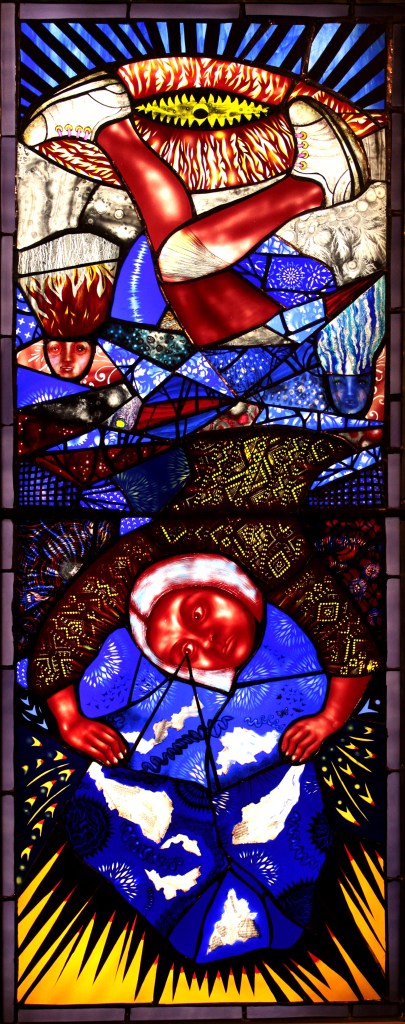
Although X-Ray Eye (2023) addresses a post truth world, the ‘twisting of words and fragmentation of social interaction’, it also recalls a strong cultural tradition of truth, in folk music and in the work of artists such as William Blake. Stephen Ellcock and Matt Osman’s book England on Fire, which features Maclure’s Green Man Searches for Wilderness (2020) taps into a seam of ancient knowing and divinity of imagination. In X-Ray Eye, Maclure’s female figure plunges head first, downward, like Blake’s The Simoniac Pope in the inferno. Though injured, she is far from helpless, flanked by opposing forces, fire and water, divided by argument, her hands pull words and assumptions apart, the fractured lead lines converging on her eye. The dominant colour within this space of exploration is the divine, sacred blue of medieval glass. Her sneakered feet straddle a portal of instinctual knowing at the apex of the composition. The body is fragmented, in a fallen position of discomfort, but there is also a will to understand that we feel will bring clarity, even in a climate of screaming opposition.

Walking away from the exhibition down Sauchiehall Street I saw a black and white poster with a lighthouse on it ‘The seas are rising and so are we’, a slogan adopted by climate activists. I had to smile, as the red, life affirming thread throughout Maclure’s extraordinary exhibition altered my perception of the world outside. ‘Somehow we mend, Somehow we mend in the end.’

Pinkie Maclure’s Lost Congregation continues at the Centre for Contemporary Arts, Glasgow until 9 September 2023. https://www.cca-glasgow.com/programme/lost-congregation

Klimt / Schiele

Drawings from the Albertina Museum, Vienna
Royal Academy of Arts, London
4 November 2018 – 3 February 2019

Egon Schiele, Seated Female Nude, Elbows Resting on Right Knee, 1914
Graphite, gouache on Japan paper, 48 x 32 cm
The Albertina Museum, Vienna
Exhibition organised by the Royal Academy of Arts, London and the Albertina Museum, Vienna

Der Zeit ihre Kunst. Der Kunst ihre Freiheit. / To the age its art, to art its freedom. (i)

The day before the Klimt / Schiele preview, I saw a London Underground billboard advertising the exhibition. Three naked figures with a banner collectively preserving modesty declared this work too shocking for public display, even in 2018. Potential offence and outrage are ever present in contemporary life, lived mostly online, with critical discussion and reflection harder to find. Coming face to face with humanity, warts and all, is a given with this exhibition and it would be a shame to expect anything less. Unmasking the nature of provocation and social propriety is unavoidable when following the drawn line of both artists. Although the official PR images don’t come close to representing it, the viewer is consistently arrested, having to psychologically, morally and ethically grapple with where they stand, often in relation to taboo subjects.

As the first exhibition in the UK to focus on the drawing practice of both artists, Klimt / Schiele presents a rare opportunity to see over 100 delicate works on paper from the Albertina Museum, Vienna. Among these are some of the finest examples of life drawing I’ve ever had the privilege to see, sublime, assured and intensely beautiful. Equally I loved this exhibition for the disquieting, uncomfortable questions it raised and for the timeless radicalism of both artists which positively sings, howls and scratches its way off the walls. The drawings are on an intimate scale and arranged thematically to highlight each artist’s creative process, explore relationships between them and engage with the confrontational nature of their work in juxtaposition. Together with this insightful visual survey, the centenary of the deaths of Gustav Klimt (1862-1918) and Egon Schiele (1890-1918) provide a timely focus for questions about art and censorship in our own time.

Continue reading

Emil Nolde – Colour is Life

Emil NOLDE (1867-1956)
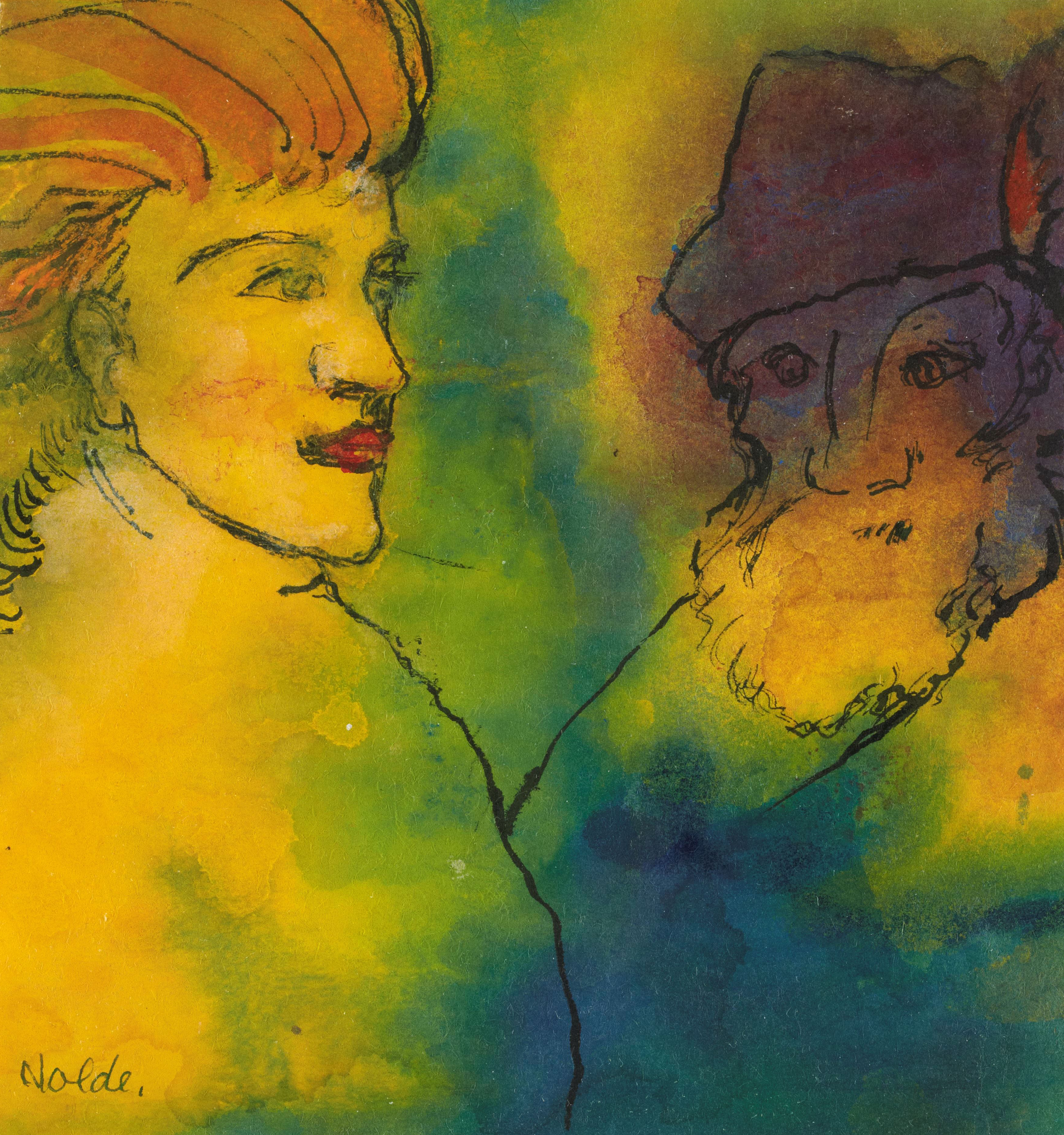
Old Man and Young Woman(Man with Feather in his Hat) (Alter Mann und junge Frau (Mann mit Feder am Hut)), c. 1930s-40s
Watercolour on paper, 16.2 x 15.4 cm
© Nolde Stiftung Seebüll

14 July – 21 October 2018

Scottish National Gallery of Modern Art (Modern Two)

“Colour is strength. Strength is life. Only strong harmonies are important.” Emil Nolde, Travels. Ostracism. Liberation. 1919–1946.

Colour is Life presents a rare opportunity to come to grips with the undeniable vibrancy and jarring contradictions in Emil Nolde’s art. This illuminating retrospective features 120 paintings, drawings, watercolours and prints from the Emil Nolde Foundation in Seebüll, Northern Germany. Nolde’s images reveal the journeys of his life; from rural villages, domestic gardens and highly charged religious subjects, to the bustling, industrial port of Hamburg, the cabarets of Berlin and indigenous people of Papua New Guinea. His extraordinary land and seascapes are among the highlights of the show, together with his controversial “unpainted pictures” incorporating elements of folklore and the grotesque.

Emil NOLDE (1867-1956)
Landscape (North Friesland), (Landschaft (Nordfriesland)),1920
Oil on canvas, 86.5 x 106.5 cm
© Nolde Stiftung Seebüll

Living on a shifting border between Germany and Denmark and with a lifetime (1867-1956) spanning two World Wars, there are inevitable conflicts in terms of how the artist saw himself and how he/his work has been perceived by successive generations. When this exhibition first opened at the National Gallery of Ireland in February 2018, The Independent ran with the headline; “Can you enjoy great art created by a Nazi? New Emile Nolde exhibition explores this dilemma.” The mistake we make too often in the age we are living in is making superior moral judgements that reinforce polarity rather than understanding, based on the assumption that the function of art is enjoyment. What I found fascinating in Colour is Life is human nature on display and how you must confront beauty and ugliness in full view of each other; in the comprehensive survey of Nolde’s work and within yourself as a viewer, or potential witness.

Continue reading

Rembrandt- Britain’s Discovery of the Master

Rembrandt van Rijn (1606-69)
A Woman in Bed, about 1645 – 1646
Oil on canvas, 81.1 x 67.8 cm
Collection: National Galleries of Scotland, presented by William McEwan 1892
Photo: Antonia Reeve

7 July – 14 October

Scottish National Gallery

“Britain’s love affair with one of history’s greatest artists” is the celebratory focus of the Scottish National Gallery’s latest summer blockbuster. Rembrandt: Britain’s Discovery of the Master features 140 works: oil paintings, drawings and etchings by Rembrandt Van Rijin, works from his workshop and those by British artists he inspired from the 18th Century to the present day. Seeing Rembrandt’s impact on the art of William Hogarth, Joshua Reynolds, Henry Raeburn, David Wilkie, Thomas Duncan, Augustus John, James Abbot McNeill Whistler, Jacob Epstein, Leon Kossoff, William Strang, Henryk Gotlib, Eduardo Paolozzi, Frank Auerbach, John Bellany, Ken Currie and Glen Brown is one of the fascinations of the show. It is also an exhibition about historical acquisition and how an artist’s legacy is enabled. Works on loan from the National Gallery, British Museum, Dulwich Picture Gallery and the Tate, London, the National Gallery of Ireland, The Hunterian, University of Glasgow, Kelvingrove Museum and Art Gallery, Glasgow, Rijksmuseum, Amsterdam, Museum of Fine Arts, Boston, USA, and the National Gallery of Art, Washington D.C bring together familiar images, new discoveries and reflections on why Rembrandt is so revered.

Outside the Netherlands, the UK holds the largest collection of Rembrandt works, a trend that began during the reign of Charles I and reached fever pitch in the 18th Century, when prints, drawings and paintings were highly sought after by private collectors. Cataloguing the artist’s work also began at this time, an indicator of Rembrandt as currency and a practical response to market driven climate of forgers and respectful copyists. The desirability of Rembrandt’s work among collectors in the British Isles has resulted in much wider awareness of his work and most importantly, the opportunity to experience it live, having found its way into public collections. Coming eyeball to eyeball with a Rembrandt seems to level all arguments about what good or bad art is. At base he shows us what art is, what it is for and why it matters.

Continue reading

NOW

JENNYSAVILLE, SARA BARKER,CHRISTINE BORLAND, ROBIN RHODE, MARKUS SCHINWALD and CATHERINE STREET. 

JENNY SAVILLE
Rosetta II, 2005 – 2006
Oil on watercolour paper, mounted on board, 252 x 187.5cm
Private collection © Jenny Saville
Courtesy of the artist and Gagosian

March until 16 September 2018
Scottish National Gallery of Modern Art (Modern One), Edinburgh.

It’s hard to believe that the latest instalment of NOW, part of the Scottish National Gallery of Modern Art’s contemporary art programme, is the first major showing of Jenny Saville’s work in Scotland and only her third exhibition in a UK museum. It seems that for many of our finest artists, international acclaim is a pre-requisite for national acknowledgement. The Scottish National Gallery’s newly acquired Study for Branded (1992, Oil on paper, 100.3 x 74.4 cm) is amazingly the only example of Saville’s work currently in a UK public collection, made possible by the Henry and Sula Walton Fund.  Whilst the curatorial aim of the three year NOW exhibition programme is very much about placing contemporary Scottish Art in an international context, it also illuminates the national context of how we regard art and artists in the 21st century.

The purchase of multiple works from Saville’s Glasgow School of Art graduating show by collector Charles Saatchi, her participation in the Saatchi Gallery’s Young British Artists III exhibition (1994) and the Royal Academy’s exhibition Sensation: Young British Artists (1997), effectively launched Saville’s career in terms currency on the international art market. However, that’s not what gives her work its immense power, universality, or ultimate value. As five rooms of her work spanning 26 years powerfully testify, she achieves that integrity entirely on her own terms. The scale of this artist’s emotional intelligence, discipline and command of painting is truly extraordinary, crossing multiple boundaries in how we perceive the female body, art and humanity.

In the history of Western Art and the Scottish figurative tradition Saville’s work radically transforms perception of the female nude with its unflinching honesty. Presenting completely “un-idealised”, “uncompromising” images of the human body, Saville confronts us with the timeless and sometimes overwhelming truth of human vulnerability. It’s a truth which ideal Beauty has cloaked for centuries, then effectively obliterated in popular culture of the 21st Century. At base we are all flesh, magnified in Saville’s adept handling of oils, pastel and charcoal, with all the discomfort and fragility which attends mortality.

Continue reading