JOYCE W CAIRNS – A Personal Odyssey

Royal Scottish Academy, Edinburgh 1 August – 2 September 2026
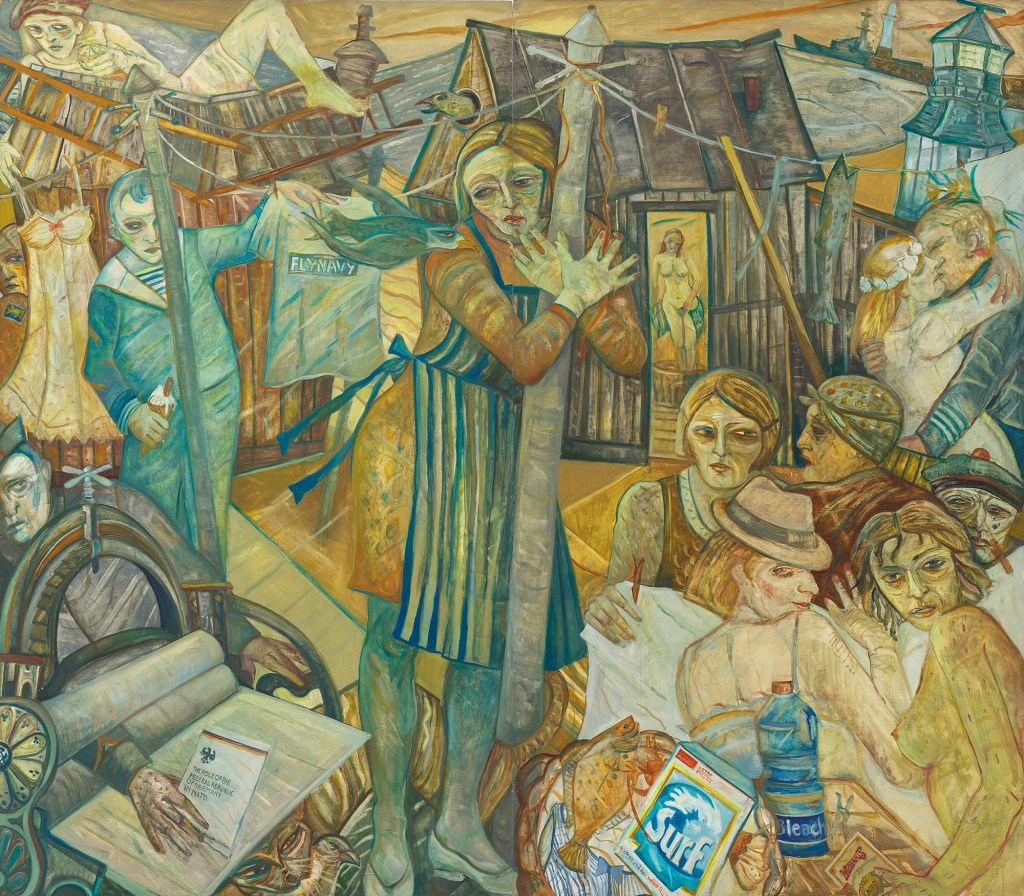
Joyce W Cairns The Drying Green (1990 Oil on panel, 213 x 244cm) Image courtesy of the artist.

Joyce W Cairns is a powerful storyteller with an unflinching eye on the human condition. Her epic memory paintings are among the most significant works in contemporary art, borne in the intimate study of objects and hidden histories. Her commitment to the human subject and to the discipline of painting transcend the autobiographical. Exhibiting since 1969, Cairns has walked her own path, choosing to situate herself for much of her career in the Northeast of Scotland. This unique vantage point, the village of Footdee, Aberdeen, has shaped the intense focus and characteristic edginess of her practice. The contemporary relevance and timeless significance of Cairns’ work is immediately striking, unlocking family history and illuminating multigenerational experiences of love, loss and trauma. Tackling difficult subject matter and addressing war on the home front, Cairns’ critical and empathic grasp of history could not be more pertinent. She brings the crafting of a painting and the visceral qualities of paint to the fore, tacit reminders of what human beings need to make sense of the world. In a ‘Post Truth’ age where we increasingly experience reality through screens, Cairns’ work is a reminder to dig deep where you stand.

Born in Edinburgh in 1947, Cairns studied at Gray’s School of Art, Aberdeen (1966-71), the Royal College of Art, London (1971-74), Gloucester College of Art and Design (1974-75) and Goldsmith’s College, University of London (1975-76). In 1976 she returned to Gray’s School of Art as a lecturer in drawing and painting. Throughout the 1980’s and 1990’s her mature style in large scale figurative composition emerged, with bodies of work inspired by her childhood in Edinburgh, the village of Footdee, the underbelly of life around Aberdeen harbour, WWI, the Gulf war and Bosnian war. The decade long research and development of her monumental War Tourist exhibition, held at Aberdeen Art Gallery in 2006, was a remarkable achievement. The discovery of a suitcase of her father’s wartime memorabilia in 1995 prompted Cairns to retrace her father’s journey through WWII in Normandy and Tunisia. She then visited Germany, Austria, the Czech Republic and Poland in wider exploration of WWII and in response to human suffering during the Holocaust. As she stated in a 2006 interview, ‘I’m not doing war paintings, its memory paintings.’ (1)  As she searched for her father, she became the ‘War Tourist’, combining past and present, and bringing female perspective to world conflicts. The War Tourist exhibition brought together Cairns’ paintings, drawings and prints from the 1980’s to the 2000’s, together with artefacts spanning her exploration of different theatres of war. Some of these paintings are included in A Personal Odyssey. After a long association with the RSA including awards, exhibiting and as a Royal Scottish Academician, in 2018 Cairns became the first female president in the Royal Scottish Academy’s history.

Cairns’ achievements are many and her influence on generations of Scottish artists profound. However, standing in front of her work it is the emotional connection to her subject, her intellect, humour and mastery of large-scale composition that consistently shines through decades of dedicated practice. Cairns’ work is confrontational and compassionate in equal measure, able to assimilate ‘memory, history and lived experience’ like nobody else. Although significant large-scale museum works such as Shadows of the Past, Liberation Ceremony, Rennes (1984), TV Dinners (1991) The Deadly Wars (1993) and other works from the War Tourist cycle are regretfully missing, A Personal Odyssey is an important survey of the artist’s work. The exhibition gives valuable insights into Cairns evolution from the late 1960’s to the present day and is a welcome opportunity for visitors to experience her work first hand.  
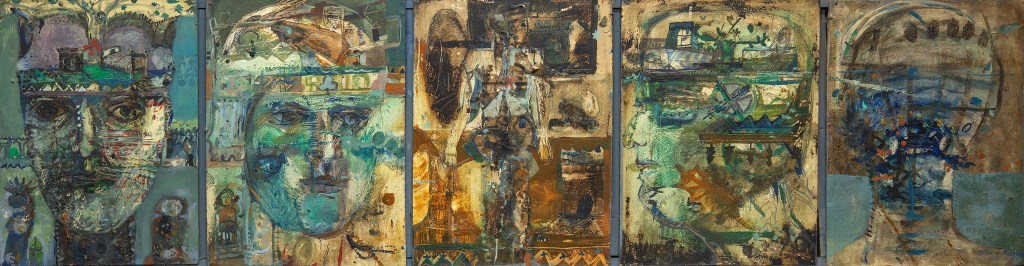
Joyce W Cairns Disintegration of Mankind (1970, oil on panel) Image courtesy of the artist.
Joyce W Cairns Pursued, Conquered and Assimilated (1971, oil on panel) Image courtesy of the artist.

Cairns has always possessed the vision and indomitable spirit that enables an artist to transcend themselves, evidenced here in her earliest work. Pastel Self Portrait (1969/70, pastel on paper, 31 x 20cm) brings a sense of self possession and enquiry as the artist resolutely meets the viewer’s gaze. The powerful lyricism and extraordinary range of mark in Cairn’s early works is impressive. Disintegration of Mankind (1970, oil on panel) encompasses our false sense of human progression in a series of five increasingly abstract figures, with the final head baring its teeth. Right from the start there is much in her handling of paint that is incredibly beautiful and assured, combined with a commitment to seeking truth, within and without.  ‘Disintegration of Mankind’, ‘Pursued, Conquered and Assimilated’ (1971), ‘Requiem for a Soul (1971-2) and Man may come, man may go (1972) are fine examples from this period, characterised by dreamlike fluidity and exceptional skill. In Pursued, Conquered and Assimilated,’ there is a feeling of what memories are held in the body and in threshold spaces, houses, doorways, fragments of collage, ancient art and mythology. Awarded an RSA Carnegie Travelling Scholarship in 1971, Cairns travelled to Italy, fuelling her interest in medieval and pre-Renaissance Art. Her multi-panelled approach has a kinship with devotional art practice as she develops her own symbolism. Falling Woman (1969 /70, gouache on paper, 48 x 29cm) gives a taste of what is to come in the female figure or portrait merged with domestic architecture and communal spaces of comfort or reckoning. The perfect counterfoil in confronting difficult subject matter is the inherent care in crafting the image, which becomes progressively honed throughout the 1980’s and 1990’s as the scale and ambition of Cairns’ work increases.
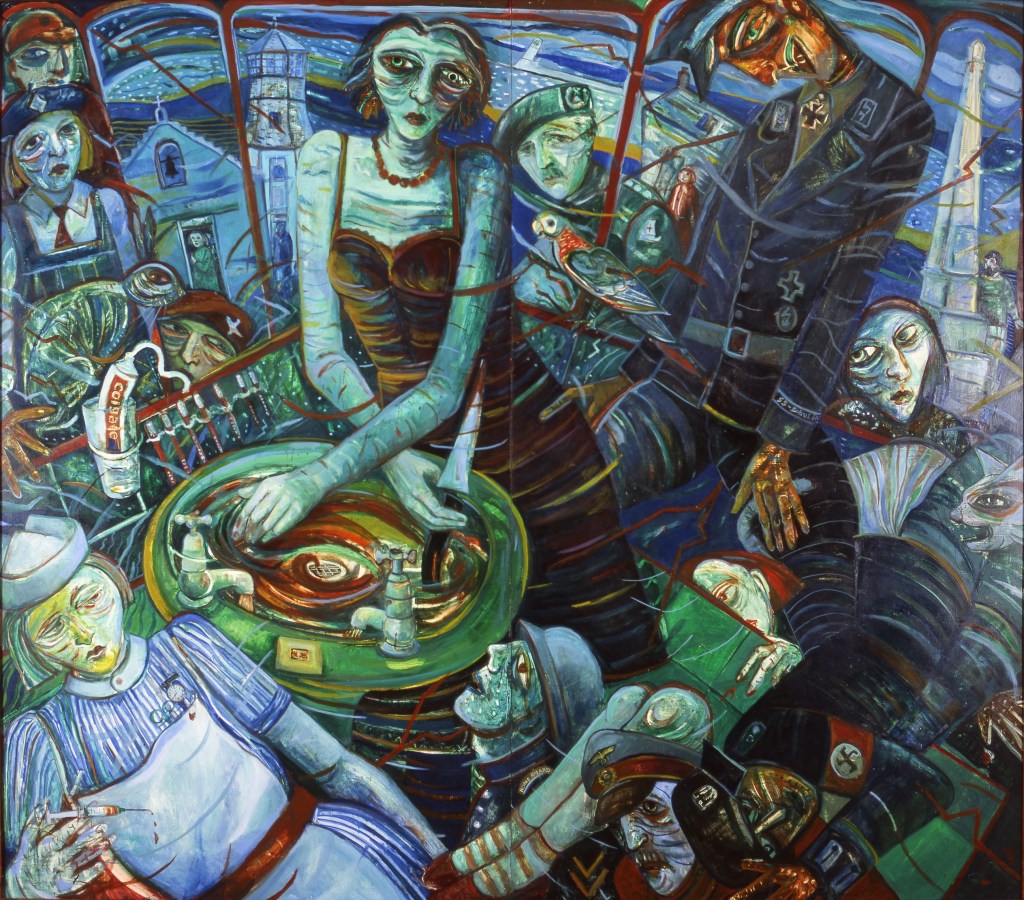
Joyce W Cairns They Said the War Was Partly to Blame (1986, oil on panel, 213 x 244cm)
Image courtesy of the artist

In They Said the War Was Partly to Blame (1986, oil on panel, 213 x 244cm) figures are orientated around the emotional core of the painting, Cairns’ mother, who stands at the apex of the composition over a vortex-like sink hole. The vantage point is the family bathroom at Dovecot Grove, Edinburgh, and Footdee, with its familiar harbour shapes in the background, moving back and forward through time, unlocking what is hidden and exploring painful family history. The painting feels drenched in sea green, as though drowning or being pitched on internal waves of awareness. There is another hue in play here too, like the green guiding light of a harbour buoy, that doesn’t allow us to run aground. As in many of her large-scale compositions, interlocking pyramids and tilted, angular horizons give a feeling of acute instability and unease. However emotionally off balance we may feel, the artist’s highly structured approach to composition is what enables us to stop, look closely and contemplate a scene we may not want to witness.  It is fascinating to see the accompanying study for this painting and the decisions made in terms of design and foreground. The psychological compression of figures echoes the dynamism of German Expressionism and Neue Sachlichkeit artists of the Weimar period. Painting humanity in terminal decline with brutal honesty, artists George Grosz, Otto Dix and Max Beckmann are a potent influence on Cairns’ work. However, her distinctive potency emerges through empathy, a passionate need not to just make sense of her own family history, but intergenerational trauma and collective memory.

Emotional connection is paramount in Cairns’ work, in her rendering of the human figure and her painstaking research. The importance of getting the details of artefacts, uniforms and memorabilia just right and bearing witness to what is hidden, acknowledges and honours civilian casualties of war. Many of her paintings are memorials in that respect. Although They Said the War Was Partly to Blame is a deeply personal exploration, as Cairns’ practice progresses frames of reference in her work continue to expand. The ‘personal odyssey’ carries within it a concern beyond the self. It is the artist as witness, looking inwards certainly, but outwards too, with a critical awareness of world events.
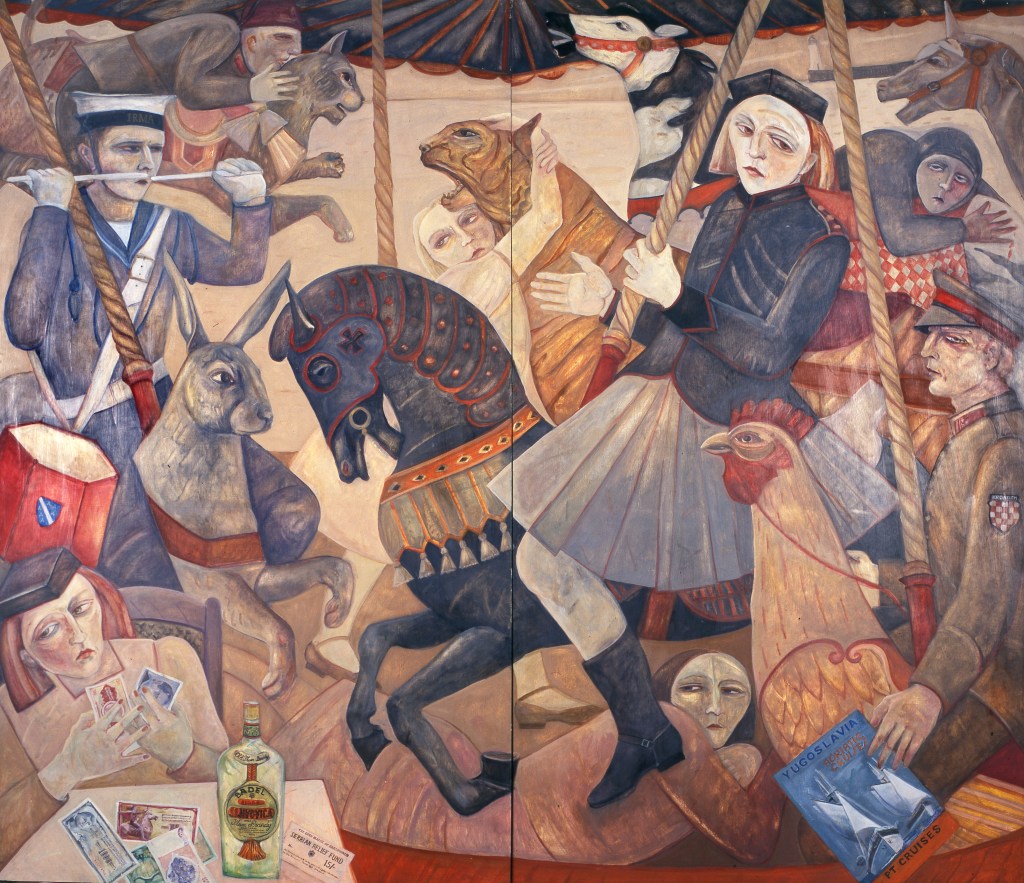
Joyce W Cairns Irma (1994-95, oil on panels, 213 x 244cm) Image courtesy of the artist.

Irma (1994-95, oil on panels, 213 x 244cm) is a beautiful example focused on a terrible subject, merging Cairns’ symbolic carousel of war with the story of Irma Hadzimuratovic, a young girl airlifted to the UK for treatment and sadly, a casualty of the Bosnian war. The image of the child clinging to the tiger haunts the background centre of the composition. As in many of Cairns’ paintings the artist’s face is present, although this is not always self-portraiture. In Irma, the gaze of the artist/ witness meets our own, reaching across time. Cairns confronts the cruelty and absurdity of war, often bringing to light the experiences of women and children.
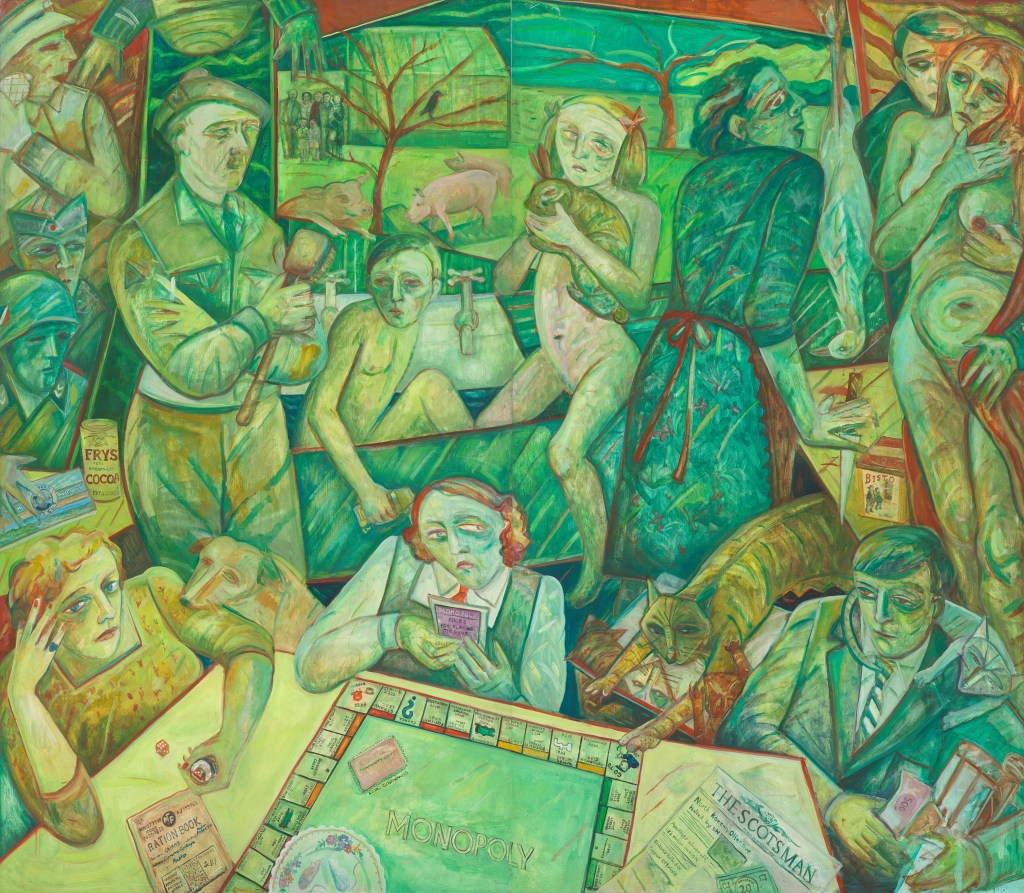
Joyce W Cairns Ratho,1951 (1990, oil on panel 213 x 244cm) Image courtesy of the artist.

Cairns’ experience as a child growing up in the post WWII era is reflected in the intimacy of objects as triggers of personal memory and collective remembrance. Often these are arranged in the foreground, like a shelf or windowsill of memorabilia we might collect in our own domestic space. In Ratho, 1951 (1990, oil on panel 213 x 244cm) this extends into the viewer’s space. A ration book, the monopoly game, the front page of The Scotsman (Friday 26 January 1951) with its headline ‘North Korean Offensive Halted by UN’ and a floral plate of morsels are offered up, together with a clutched copy of the rules of the game- monopoly and life. A myriad of narratives present themselves in the heightened opposites of red and green, and complex family dynamics. Ratho, 1951 is a psychological study of family life and memory with the unmentionable pushed to the margins, but ever-present in Cairns’ art. In an interview with the artist at her home in Footdee, in 2006 she reflected; ‘After the war people just didn’t want to know. When I was growing up, they wanted to put that aside. The early fifties when I was young was a pretty grim time in Britain, rationing and stuff like that…There were all kinds of shortages. Of course, as a child you didn’t realise it could be any different.’(2)
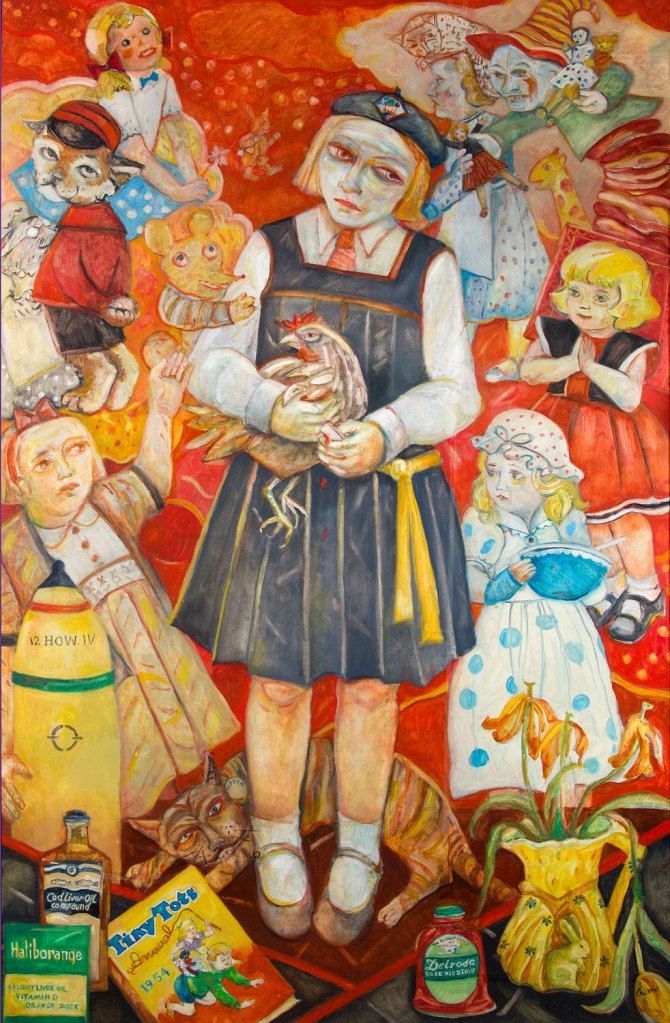
Joyce W Cairns Tiny Tots Annual 1954 (c. 2016, oil on canvas, 203 x 145cm) Image courtesy of the artist.

The seemingly bright painting of childhood Tiny Tots Annual 1954 (c. 2016, oil on canvas, 203 x 145cm) in dominant cadmium red and yellow is a highly visceral arrangement of figures and objects. Foreground bottles of rosehip syrup, cod liver oil and Haliborange (halibut liver oil, vitamin D and orange juice) provide a powerful sensory trigger for the post war generation of what was deemed good for the child. The question of what we are weaned on is inferred by a 12 HOW.IV missile which reads like a baby’s bottle. The central figure of the female child in school uniform clasps a hen, often a symbol of vulnerability in Cairns’ art. Her face is weary with age, giving a heightened sense of adult perspective to the whole scene. The figures and toys that surround her are part nursery rhyme, part comic book. A sibling-like figure with her hand around the missile reaches for the sleeve of the central protagonist / artist/ caregiver, while in the background a doll-like figure clasps her hands in prayer or delight. Emotional shifts encircle the painting, never allowing the viewer to get too cosy with nostalgia. A worried female child stands with a bowl in her hands to the lower right of the composition. Goldilocks with a full bowl of porridge hearing bears or an empty bowl and anticipation of gnawing hunger like Oliver Twist?  A recurrent rabbit jug family heirloom with spent lilies brings a sickly air to the scene. Like the nick of blood drops at the centre, there is a kind of reckoning within the fairytale façade, of coming to terms with the forces that shape us and make us who we are. The expression of the central female figure is knowing and complex, a sideways glance into a space beyond the picture plane, pensive, red eyed and perfectly still, as wave upon wave of associations hit the spectator.
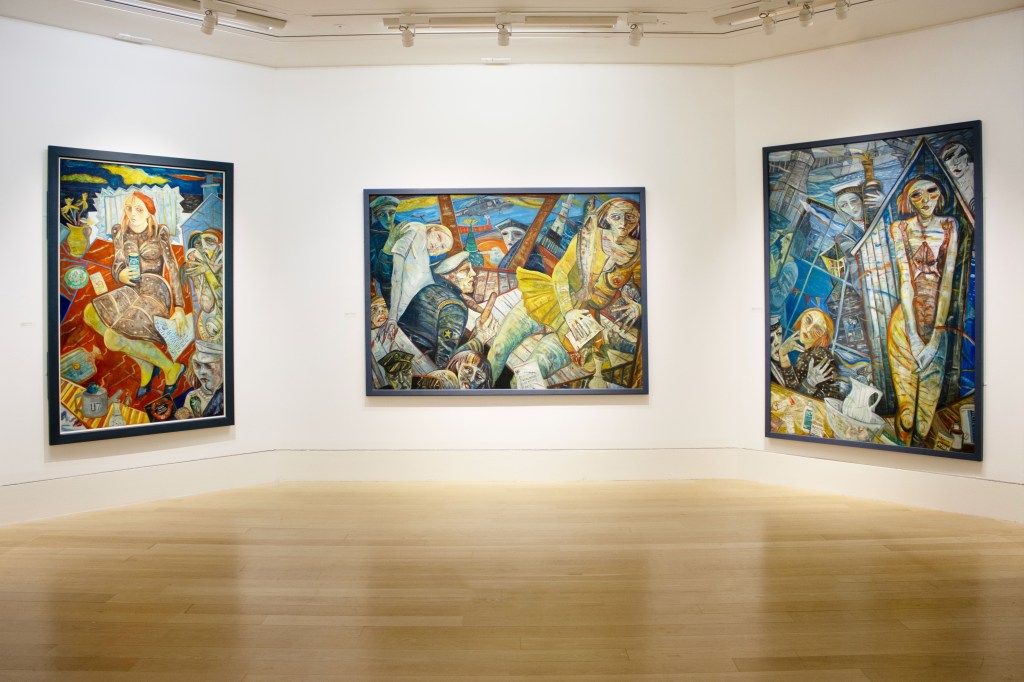
Joyce W Cairns – A Personal Odyssey Installation shot with On Board the Schleswig- Holstein (1989 oil on panel 220x 160cm) in the centre. Image courtesy of the Royal Scottish Academy.

There are many highlights in the show where facets of self, womanhood and femininity are explored by the mature artist. The Drying Green (1990 Oil on panel, 213 x 244cm), Sailing Through Polluted Seas (1988 oil on panel, 83 x 244cm) and On Board the Schleswig- Holstein (1989 oil on panel 220x 160cm) are as beautiful as they are challenging. Making connections within Cairns’ imagery is one of the great pleasures of the show. While the origins of enquiry might be personal or historically specific, Cairns creates spaces of imagination and confrontation that are satisfyingly multilayered. There is also a sense of being in the presence of a master of the craft, a nurturing, insistent force of life, absent in the work of many of her male contemporaries. In the 1980s and 90’s when the ‘New Glasgow Boys’ Peter Howson, Ken Currie, Adrian Wiszniewski and Steven Campbell were emerging with much acclaim in a resurgence of figurative art in Scotland, Cairns’ work during the same period is arguably more commanding in its emotional intelligence.  As Bill Hare’s excellent commentary on Cairns’ work over many years has suggested, there is a kinship with the work of Paula Rego. The power of visual storytelling, expression of female lived experience, uncompromising honesty and exploration of collective memory are distinctive qualities in each artist’s work. There is too, a ‘spirit tempered to endure’(3) that emerges from their timeless paintings. Critically, Cairns’ work reminds us that how we remember is how we endure.

Under the banner of this year’s Royal Scottish Academy 200th anniversary celebrations, A Personal Odyssey understandably frames Cairns’ work within RSA history and in the context of Scottish Art education. However, now is the time to acknowledge and celebrate the international stature of Joyce W Cairns’ work, which extends far beyond Scotland or any institution. Although there is a missed opportunity here for a full-scale public retrospective occupying the entire RSA galleries, A Personal Odyssey reveals the evolution, resilience and spirit of one of the UK’s finest artists. Joyce W Cairns’ powerful, monumental works assert the importance of painting in contemporary life, the multifaceted role of the artist as witness and our essential need for storytelling. At this point in history with war and destruction raging all over the planet, Cairns’ spirit of confrontation, compassion and insight is a shining light.
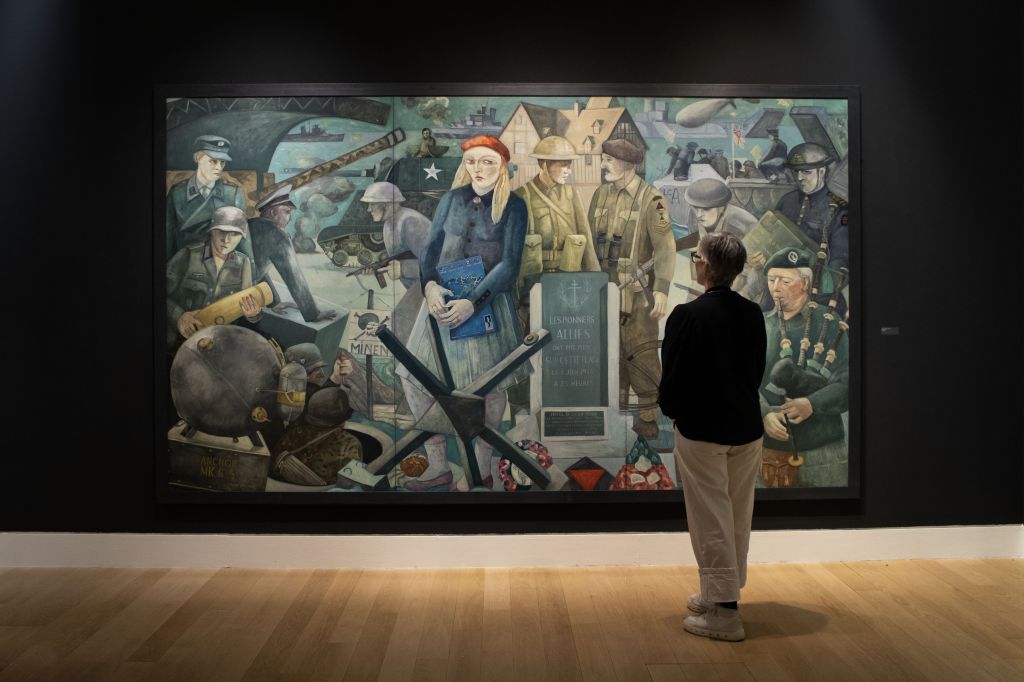
Joyce W Cairns – A Personal Odyssey installation shot with Sword Beach (1996, oil on panels, 213 x 366cm) by Joyce W Cairns. Image courtesy of the Royal Scottish Academy

Joyce W Cairns- A Personal Odyssey – Royal Scottish Academy exhibition page: https://www.royalscottishacademy.org/exhibitions/315-joyce-w.-cairns-a-personal-odyssey/overview

Georgina Coburn Review of War Tourist in Northings 24 March 2006: https://northings.com/2006/03/24/joyce-cairns-war-tourist

 Notes

  1. Joyce W Cairns interview with Georgina Coburn Footdee, Aberdeen, 18 March 2006.
  2. Joyce W Cairns interview with Georgina Coburn Footdee, Aberdeen, 18 March 2006.
  3. Quotation on the wall of the A Personal Odyssey exhibition space; ‘And if a god will wreck me yet again on the wine dark sea, I can bear that too, with a spirit tempered to endure.’ Homer, The Odyssey (trans Robert Fagles)

Thresholds – The Art of Carolynda Macdonald

Carolynda Macdonald River of Lost Souls (oil on linen, 113cm x 105cm)
Image courtesy of the artist and Kilmorack Gallery

‘I seek to bridge a recognisable world with that of an imaginary or mythological one. I almost always include birds as the main protagonists but have increasingly brought in human characters too. This alchemy of birds and fragments of old master figurative paintings, become vehicles for the subconscious to play and facilitate self-expression.’ Carolynda Macdonald

Working previously as a Biomedical Scientist in Microbiology, Carolynda Macdonald has progressively developed her painting practice since 1982, studying life drawing, printmaking and exhibiting extensively in the UK, USA, and Australia. Now based in Edinburgh, Macdonald’s recent exhibitions, including House of Macdonald with fellow artists Alan and Rory Macdonald, affirm her emergence as a distinctive voice in Contemporary Art. Drawing on traditions of painting in Western Art, the tradition celebrated by Macdonald is freedom of expression, art which is big enough to admit multiple layers of interpretation, making ‘paintings you can fall into.’ ‘Humanity being imprinted onto Nature’ is a strong theme in her latest work, where birds are threshold subjects, guardians of the natural world and human vulnerabilities.

River of Lost Souls (oil on linen, 113cm x 105cm) contains a scene of human betrayal, the cutting of Samson’s hair by Delilah’s accomplice, a removal of his supernatural power depicted by Rubens and reimagined here within the body of a bird. The brown, russet, crimson, and flesh tones glow humanely, emerging from a dark, cool, calm before storm background by the river’s edge. The human body is tucked protectively into the bird’s feathers, a safe space where humanity, emotion, and nature, within and without, can be examined. Poised on one leg, the bird’s gaze meets ours. This recognition, the confrontation of the eye of one species meeting another’s, is deeply arresting. It is a moment of tension that brings thought and feeling bubbling to the surface, in our immediate present and in relation to a shard of visual history.  The painting is a threshold space and being held within spaces where land, sky and water meet, have a particular role in Macdonald’s art. She composes images of sanctuary for her protagonists and the viewer, alive with tension and burgeoning consciousness, full of possibility. This feeling of potential, psychologically and in the realm of dreams, is incredibly subtle and potent. In River of Lost Souls, who or what gives us strength, is given new context out with the Old Testament Biblical story and an art historical canon of Old Male Masters.

There are a number of genres and art historical expectations in play here, and Macdonald inadvertently subverts them all, bringing fragments of grand Master subjects into intimate focus, honouring scientific enquiry and ornithological art with feeling, and bringing untold psychological depth to the traditionally demure arena of still life. The field of enquiry is truly expansive, painted with meticulous detail and devotion to craft. It is the joy of painting and not politics that drives Macdonald’s art. We are free to interpret meaning and lose ourselves in narratives of our own making- that’s the gift and flow within her painting. In the presence of an artistic voice that elevates the mind and spirit, we can confront difficult things and begin to heal. Macdonald describes the music of Jocelyn Pook, Lisa Gerrard and Portuguese Fado singing in such terms, and the same is true of her paintings.  

Carolynda Macdonald Beacon of Hope (oil on board, 25cm x 23cm)
Image courtesy of the artist and Kilmorack Gallery

Carolynda Macdonald brings her microbiologist’s eye to the pattern of life and creates different spheres of awareness in the process. In Beacon of Hope (oil on board, 25cm x 23cm) we see a feast of finely painted flowers reminiscent of Rachel Ruysch within the body of a tiny wren. Although delicately rendered, the dark bird is alert, determined and poised in readiness on a natural stone, clasping a diamond in its claw. Broken jewellery is strewn at its feet, a microcosm of detail in a mountainous landscape of macrocosmic emotions and association. There is a jewellery box inheritance opened here and an uncanny, fleshly light which plays across the surface of lake and sky in the background. The artist creates an atmosphere of profound stillness, a place of solace, contemplation and in this case, an unsettling suggestion of relationships being tested. Macdonald describes the objects in her paintings being ‘broadly drawn’ rather than autobiographical. ‘Pearls are beautiful things to paint- glowing. They can abstractly solve a painting. What a pearl is, what it means’ also comes into play. ‘Pearls are a living thing, a grain of sand, giving all these things a different life in the work.’ Sometimes the placement of objects emerge unconsciously out of a brushstroke and Macdonald is simply enjoying where the mark takes her. It is an art of instinct and precision, that allows the human condition to be explored in all its nuances, ‘including inner turmoil and vulnerability, love and hidden desires, betrayal, motherhood, and protectiveness.’

Carolynda Macdonald Fortress of Shadows (oil on board, 25 x 23cm)
Image courtesy of the artist and Kilmorack Gallery.

The intimate scale of Macdonald’s wren and robin paintings draws you in, often with unexpected twists. In Fortress of Shadows (oil on board, 25 x 23cm) the female form is revealed and protected within the body of the bird, perched on a silver jewellery box. The strawberries in the right foreground link with drapery which the female protagonist draws towards her body to shield it, her hand resting on the wren’s head. They are both vessels of potential narratives. The vulnerability of this reclining nude pose, seen so often in Western Art History as exposure for a male gaze, shifts to a more heightened state of awareness within, as if the threat exists beyond the boundaries of the picture plane, with the painting as refuge. The way Macdonald positions the female body gives it protection and agency -within the painting and the viewer, to begin to explore what this internal scene means to us.

Carolynda MacdonaldThe Scream (oil on board, 25 x 22cm) Image courtesy of the artist.

The Scream (oil on board, 25 x 22cm) is another powerful example, punching far above its scale and subverting the hierarchical dominance of large-scale History Painting. The combination of elements-still life, wren and jewellery, set in what feels like an 18th Century Arcadian landscape is juxtaposed with a fragment of Goya’s resistance painting The Third of May 1808, with civilians dying before a firing squad. Perched on the lid of a jewellery box, the open-mouthed wren omits a sound, amplified by the viewer’s imagination. There is a broken, half submerged ring or tether in the water, an intriguing detail that suggests shackles being broken on multiple levels. The potency of the scream, its volume and resonance is made by association, linked to the viewer’s awareness/experience and the scene of execution. There is beauty, horror and tension in this work achieved with consummate skill. The grand history painting is a fragment on the bird’s body, perhaps suggesting the relativity of human history when staring the current Anthropocene era in the face.

Carolynda Macdonald The Garden of Solace (oil on linen, 134 x 124cm) Image courtesy of the artist.

Our perception of violence in The Garden of Solace (oil on linen, 134 x 124cm) is tempered by how Macdonald leads the eye into the painting. The curves of the brown flamingo’s neck and beak direct us towards a fragment of Eugène Delacroix’s Death of Sardanapalus contained within its body. The extreme violence and chaos of this scene is repositioned so that we can actually be still with it and begin to interpret what is brought to the surface. It is a very powerful thing to give freedom to the imagination, both in the act of painting and enabling the viewer. This self -reflexivity is precisely what art is for, individually and collectively, to actively process what it means to be human, how we relate to each other and the natural world. In The Garden of Solace, the indifferent male ruler at the apex of Delacroix’s original painting is absent and the curve of the female body which mirrors the form of the beak opposite becomes more present. There is a sense of compassion and vulnerability that completely transforms the aggression of the original scene. The psychology and emotional intelligence of this painting is breathtaking. It is a wonderful example of the complexity and strength of art in expressing what often cannot be voiced or contemplated anywhere else. The beauty of these works lies in Macdonald’s ability to create a safe, yet gently confrontational space for a range of different emotions and experiences to be acknowledged and felt. ‘Removing the figures from their original context and narrative gives them a new life. Sanctuary (oil on linen, 91cm x 64cm) may be dream like and reassuring, the heron presenting as a guardian of the three figures within, but the clouds and water, receding in tsunami-like fashion, reveal an unsettling atmosphere which the bird resiliently withstands. The fragment of art history, Solimena’s Venus at the forge of Vulcan carries its own mythology, yet the chosen fragment and trio of resting hands makes this feel like a familial scene, rather than a distant narrative of ancient deities.

Carolynda Macdonald Sanctuary (oil on linen, 91cm x 64cm)
Image courtesy of the artist and Kilmorack Gallery

There are paintings where ‘rather than keeping these human figures within the birds’, Macdonald allows ‘them to break their boundaries and occupy a space between two worlds.’ In Where Spirits Run Free (oil on linen, 91cm x 84cm) figures float off the bird’s back, into a mythic landscape and nature’s elements. There is a sense of reverie in this action and in the handling of the background which feels made of us. It belongs to the Northern Romantic tradition of beholding the landscape/ nature and all it means to us, a quality internalised in Macdonald’s art, liberating the spirit.

Carolynda Macdonald Where Spirits Run Free (oil on linen, 91cm x 84cm)
Image courtesy of the artist and Kilmorack Gallery

There is also a powerful edge in paintings such as Refuge (oil on canvas, 91 x 83cm). Here the female figure breaks free from the body of the bird, hands outstretched and gazing above, beyond the picture plane. Although we feel there is something bearing down on her, she stands securely on the bird’s back. There is love in every brushstroke and we feel we are in safe hands to unpack the unseen but palpable sense of threat. The poise of the bird and the presence of nature comforts, while the true scale of humanity can be scrutinised. There is a drive towards renewal in Macdonald’s art, a calling, like the doves in her painting Kindred Spirits (oil on linen, 113 x 105cm), ‘vulnerable things coming together in a hostile landscape who have called each other to restore.’ Crossing these imaginative thresholds, we may discover strength, resilience, and the joy of possibility within ourselves and the wider world.

Carolynda Macdonald Refuge (oil on canvas, 91 x 83cm) Image courtesy of the artist.

Carolynda Macdonald’s work is currently on show in HOUSE OF MACDONALD, Kilmorack Gallery, Scotland, 16 March- 13 April 2024 https://www.kilmorackgallery.co.uk/exhibitions/404-house-of-macdonald-alan-macdonald-carolynda-macdonald-rory-macdonald/

Scottish Women Artists: 250 Years of Challenging Perception

Dovecot Studios, Edinburgh, 28 July 2023 – January 2024

Exhibition book Scottish Women Artists, alongside Beatrice Huntington’s Cellist, c.1925
Picture Phil Wilkinson / Dovecot Studios

Walking across the North Bridge in Edinburgh on my way to see the Scottish Women Artists exhibition, I saw this poster by https://artistsforwomanlifefreedom.com/ and Jack Arts.

Billboard Poster by Artists for Woman Life Freedom and Jack Arts on North Bridge, Edinburgh.
Picture: Georgina Coburn.

The central question posed by artist Abbas Zahedi stopped me in my tracks. This text, and the slogan above, ‘Woman, Life. Freedom’, used by the Kurdish Women’s movement and more recently in solidarity with Iranian women and girls fighting for equality, was a stark reminder of women’s rights/human rights in retrograde globally. The internal diagram in the left-hand panel by Koushna Navabi had a sticker applied to the womb, branded like a graffiti tag, perhaps reclaiming that space of origin. More disturbingly, the right-hand panel by Hadi Falapishi appeared to have been defaced, a section torn away to obscure the standing female figure with her arms outstretched. Cultures of oppression are everywhere- some more subtle than others.

Glancing to my right, I could see the banner over the City Art Centre for yet another capital male blockbuster – Peter Howson, whose testosterone fuelled paintings simply mirror the source of war and misogyny. Arguably a retrospective by Joyce W Cairns, including her large-scale cycle of War Tourist works, could have easily occupied the same space, bringing mastery of the medium and understanding of the human condition powerfully into play. Elected the first female president of the Royal Scottish Academy in 2018, Cairns’ astonishing body of work is represented by a single painting of intimate scale (Eastern Approaches c1999) in the Scottish Women Artists exhibition, a missed opportunity for the Edinburgh art world and the world visiting Edinburgh, to see the depth and breadth it has been missing from artists based outwith the central belt.

Although there are some incredible gems in this show, including works by Phoebe Anna Traquair, Bessie MacNicol, Frances MacDonald MacNair, Hannah Frank, Beatrice Huntington, Wilhelmina Barnes Graham, Margot Sandeman, Joan Eardley, Agnes Parker Miller, Frances Walker, Alberta Whittle, Helen Flockhart and Sam Ainsley, there are also many absences in the implied national survey of Scottish Women Artists. The exhibition mainly centres on works owned by the Fleming Collection and no doubt reflects historical patterns of collection and curation, as it does contemporary cultural accounting. The very term ‘Women Artists’, or ‘Women’s Art,’ has a host of associations pinned against it and I found myself wondering about how such ideas informed what I was seeing in terms of subject matter, institutional curation, and thematic bent.

While I can have no argument with the celebratory intention of the show, who remains unknown, or unshown, and why is a topic ripe for discussion, socially, culturally, and geographically. There is also a somewhat naïve premise in the narrative of this show, an assumption of superiority over the past; ‘In an era when women lead Scotland’s galleries and art schools, it is easy to forget the prejudices and barriers their predecessors have faced.’ Really? I think the question persists about how many women today are denied the ‘opportunity to seek or develop an artistic career’, or in a wider context, if they are able to pursue any career, the value attributed and actually paid for their work. The ‘marriage bar’ to female employment may no longer exist, but the question of equality and entitlement persists, heightened by the British Class system, the current cost of living crisis and the socio-economic conditions the vast majority of women consistently find themselves in. Yes, there have been strides forward in representation, but cultural attribution of value for women, together with equality, has a very long way to go.

Walking into the show the viewer is confronted with a polarity of art historical quotes; Artemesia Gentileschi’s battle cry ‘I’ll show you what a woman can do’ (1649) and art critic John Ruskin’s ridiculous claim that ‘There never having been such a being yet as a lady who could paint’ (1858). Perhaps more useful than a ‘Yes we can!’, ‘No you can’t!’ posturing is another quote on the wall at the start of the exhibition by Dame Ethel Walker in 1958.

‘There is no such thing as a woman artist. There are only two kinds of artist- bad and good.’

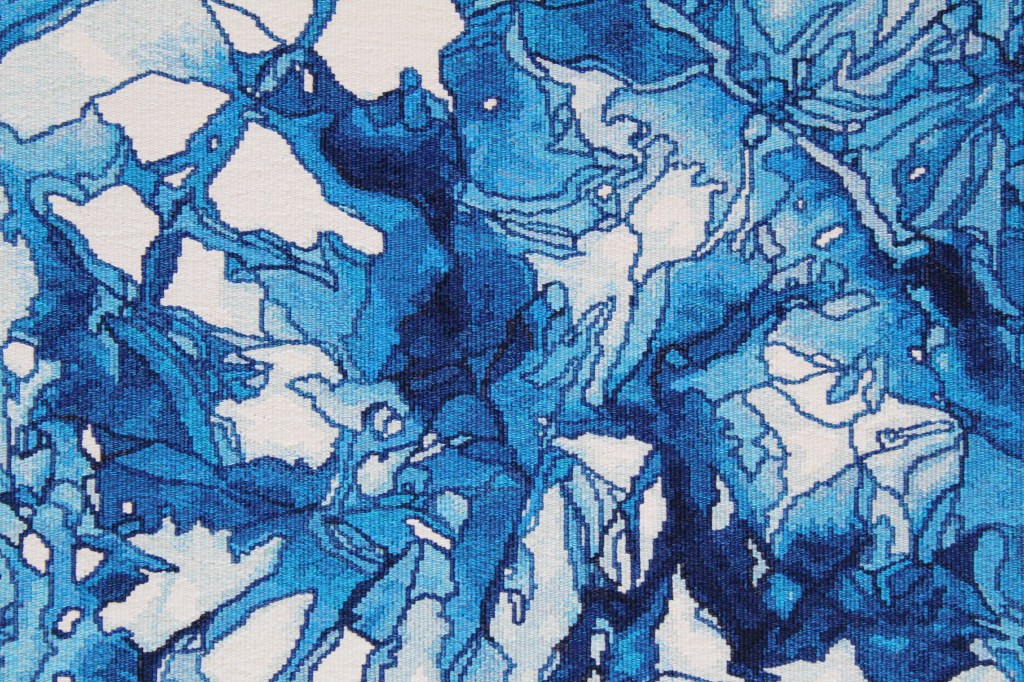
In the spirit of Dame Ethel Walker, I have to say that I found some of the examples of work by Scottish Women Artists disappointing, particularly in the contemporary / final section of the show, which felt tokenistic, given the emphasis on 20th Century and earlier works. I left the gallery feeling unconvinced and wanting when I should have been punching the air. The title ‘Scottish Women Artists – 250 Years of Challenging Perception’ didn’t necessarily match what I saw on display – perhaps because it wasn’t challenging perception enough overall. Works like Alberta Whittle’s Entanglement is More Than Blood (2021-22, watercolour on paper) which articulates the complexity of identity so beautifully in its ever-questioning serpentine forms, contrasted sharply with works such as Rachel Maclean’s garish, simplistic treatment of body dysmorphia I’m Fine/Save Mi, 2021. Rug, gun tufted. Wool, polypropylene and canvas) or Sekai Machache’s Lively Blue tapestry (2023), which gains meaning through accompanying text. Based on an expressive abstract ink drawing and Machache’s investigation of the Colonial History of indigo, it is arguably not the best example of her work in comparison to the artist’s more challenging, nuanced film and photographic works.

Dovecot Tufter, Louise Trotter, adjusting Rachel Maclean I’m fine – Save Mi 2021.
Picture Phil Wilkinson / Dovecot Studios
Sekai Machache and Dovecot Studios Lively Blue 2023. Picture: Dovecot Studios

Sam Ainsley’s This Land is Your Land (2012, digital pigment print, on loan from Glasgow Women’s Library) with its coastline of word association and multilayered provocation, felt like a Rorschach blot test, facing and meeting forms of self-identification. It’s a work that like the best in the show, provides a trigger for questions, stories, and further explorations.  Standing in front of Bessie MacNicol’s Portrait of Hornel (1896, oil on canvas, National Trust for Scotland, Broughton House and Garden) it is impossible not to feel the loss of an artistic trajectory cut short by death in childbirth. MacNicol’s paint handling and masterful, emotionally intelligent rendering of her sitter, triggers the imagination. In the context of this exhibition, what is most impressive is her resounding presence as she meets the eye of a fellow male artist as an equal, in every single mark. Her intention, all her knowing and understanding of medium and subject, her visual language distilled, still speaks 119 years after her death.

Dovecot Studios, Edinburgh, Scotland. Scottish Women Artists: 250 Years of Challenging Perception Picture Phil Wilkinson / Dovecot Studios

Many questions remain- what does it mean to be a Scottish artist or a Woman artist and who owns culture? Perhaps one of the most pertinent questions of all, triggered by a billboard on the way to the exhibition.

https://dovecotstudios.com/exhibitions/scottish-women-artists