JOYCE W CAIRNS – A Personal Odyssey

Royal Scottish Academy, Edinburgh 1 August – 2 September 2026
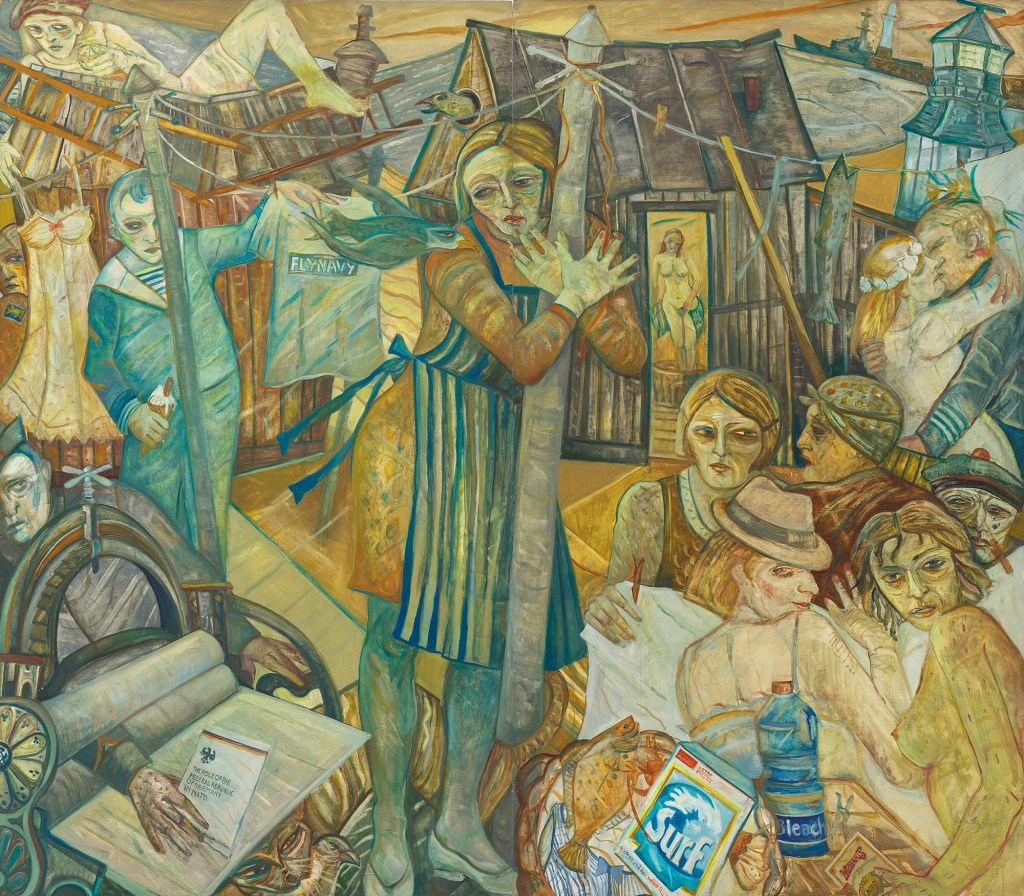
Joyce W Cairns The Drying Green (1990 Oil on panel, 213 x 244cm) Image courtesy of the artist.

Joyce W Cairns is a powerful storyteller with an unflinching eye on the human condition. Her epic memory paintings are among the most significant works in contemporary art, borne in the intimate study of objects and hidden histories. Her commitment to the human subject and to the discipline of painting transcend the autobiographical. Exhibiting since 1969, Cairns has walked her own path, choosing to situate herself for much of her career in the Northeast of Scotland. This unique vantage point, the village of Footdee, Aberdeen, has shaped the intense focus and characteristic edginess of her practice. The contemporary relevance and timeless significance of Cairns’ work is immediately striking, unlocking family history and illuminating multigenerational experiences of love, loss and trauma. Tackling difficult subject matter and addressing war on the home front, Cairns’ critical and empathic grasp of history could not be more pertinent. She brings the crafting of a painting and the visceral qualities of paint to the fore, tacit reminders of what human beings need to make sense of the world. In a ‘Post Truth’ age where we increasingly experience reality through screens, Cairns’ work is a reminder to dig deep where you stand.

Born in Edinburgh in 1947, Cairns studied at Gray’s School of Art, Aberdeen (1966-71), the Royal College of Art, London (1971-74), Gloucester College of Art and Design (1974-75) and Goldsmith’s College, University of London (1975-76). In 1976 she returned to Gray’s School of Art as a lecturer in drawing and painting. Throughout the 1980’s and 1990’s her mature style in large scale figurative composition emerged, with bodies of work inspired by her childhood in Edinburgh, the village of Footdee, the underbelly of life around Aberdeen harbour, WWI, the Gulf war and Bosnian war. The decade long research and development of her monumental War Tourist exhibition, held at Aberdeen Art Gallery in 2006, was a remarkable achievement. The discovery of a suitcase of her father’s wartime memorabilia in 1995 prompted Cairns to retrace her father’s journey through WWII in Normandy and Tunisia. She then visited Germany, Austria, the Czech Republic and Poland in wider exploration of WWII and in response to human suffering during the Holocaust. As she stated in a 2006 interview, ‘I’m not doing war paintings, its memory paintings.’ (1)  As she searched for her father, she became the ‘War Tourist’, combining past and present, and bringing female perspective to world conflicts. The War Tourist exhibition brought together Cairns’ paintings, drawings and prints from the 1980’s to the 2000’s, together with artefacts spanning her exploration of different theatres of war. Some of these paintings are included in A Personal Odyssey. After a long association with the RSA including awards, exhibiting and as a Royal Scottish Academician, in 2018 Cairns became the first female president in the Royal Scottish Academy’s history.

Cairns’ achievements are many and her influence on generations of Scottish artists profound. However, standing in front of her work it is the emotional connection to her subject, her intellect, humour and mastery of large-scale composition that consistently shines through decades of dedicated practice. Cairns’ work is confrontational and compassionate in equal measure, able to assimilate ‘memory, history and lived experience’ like nobody else. Although significant large-scale museum works such as Shadows of the Past, Liberation Ceremony, Rennes (1984), TV Dinners (1991) The Deadly Wars (1993) and other works from the War Tourist cycle are regretfully missing, A Personal Odyssey is an important survey of the artist’s work. The exhibition gives valuable insights into Cairns evolution from the late 1960’s to the present day and is a welcome opportunity for visitors to experience her work first hand.  
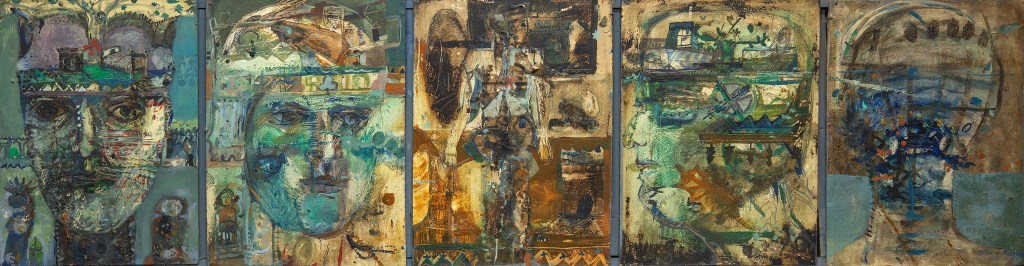
Joyce W Cairns Disintegration of Mankind (1970, oil on panel) Image courtesy of the artist.
Joyce W Cairns Pursued, Conquered and Assimilated (1971, oil on panel) Image courtesy of the artist.

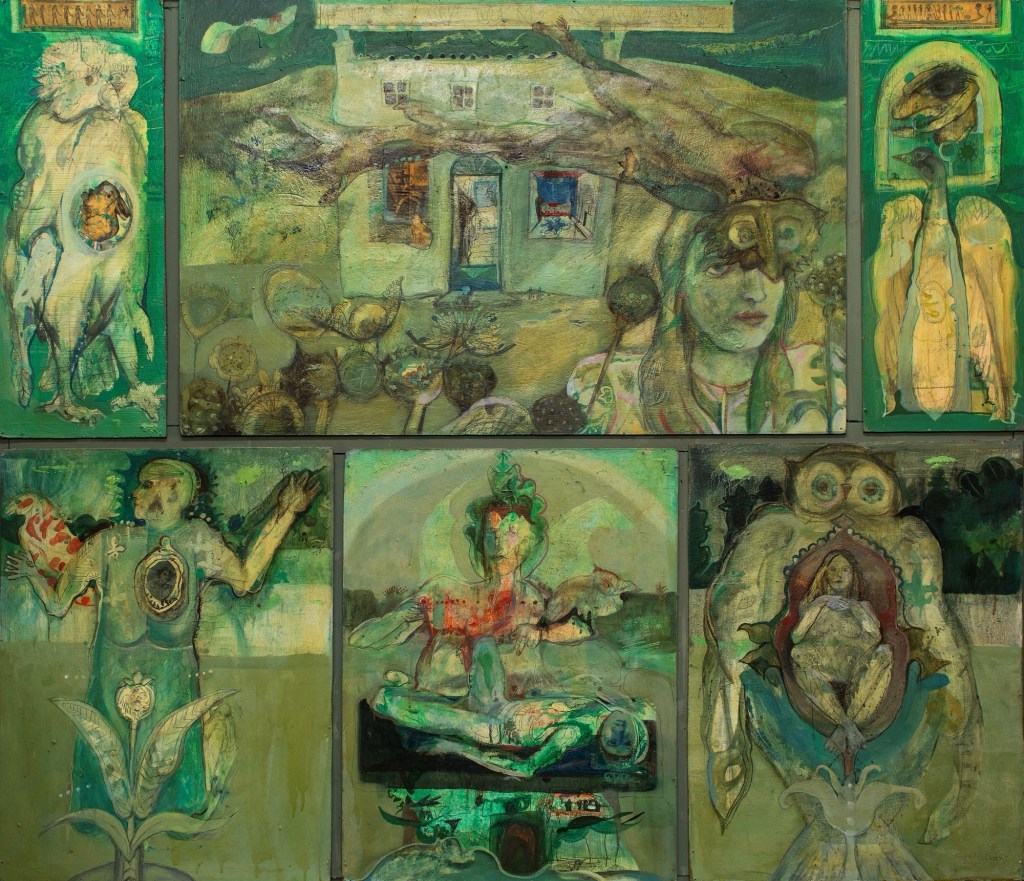
Cairns has always possessed the vision and indomitable spirit that enables an artist to transcend themselves, evidenced here in her earliest work. Pastel Self Portrait (1969/70, pastel on paper, 31 x 20cm) brings a sense of self possession and enquiry as the artist resolutely meets the viewer’s gaze. The powerful lyricism and extraordinary range of mark in Cairn’s early works is impressive. Disintegration of Mankind (1970, oil on panel) encompasses our false sense of human progression in a series of five increasingly abstract figures, with the final head baring its teeth. Right from the start there is much in her handling of paint that is incredibly beautiful and assured, combined with a commitment to seeking truth, within and without.  ‘Disintegration of Mankind’, ‘Pursued, Conquered and Assimilated’ (1971), ‘Requiem for a Soul (1971-2) and Man may come, man may go (1972) are fine examples from this period, characterised by dreamlike fluidity and exceptional skill. In Pursued, Conquered and Assimilated,’ there is a feeling of what memories are held in the body and in threshold spaces, houses, doorways, fragments of collage, ancient art and mythology. Awarded an RSA Carnegie Travelling Scholarship in 1971, Cairns travelled to Italy, fuelling her interest in medieval and pre-Renaissance Art. Her multi-panelled approach has a kinship with devotional art practice as she develops her own symbolism. Falling Woman (1969 /70, gouache on paper, 48 x 29cm) gives a taste of what is to come in the female figure or portrait merged with domestic architecture and communal spaces of comfort or reckoning. The perfect counterfoil in confronting difficult subject matter is the inherent care in crafting the image, which becomes progressively honed throughout the 1980’s and 1990’s as the scale and ambition of Cairns’ work increases.
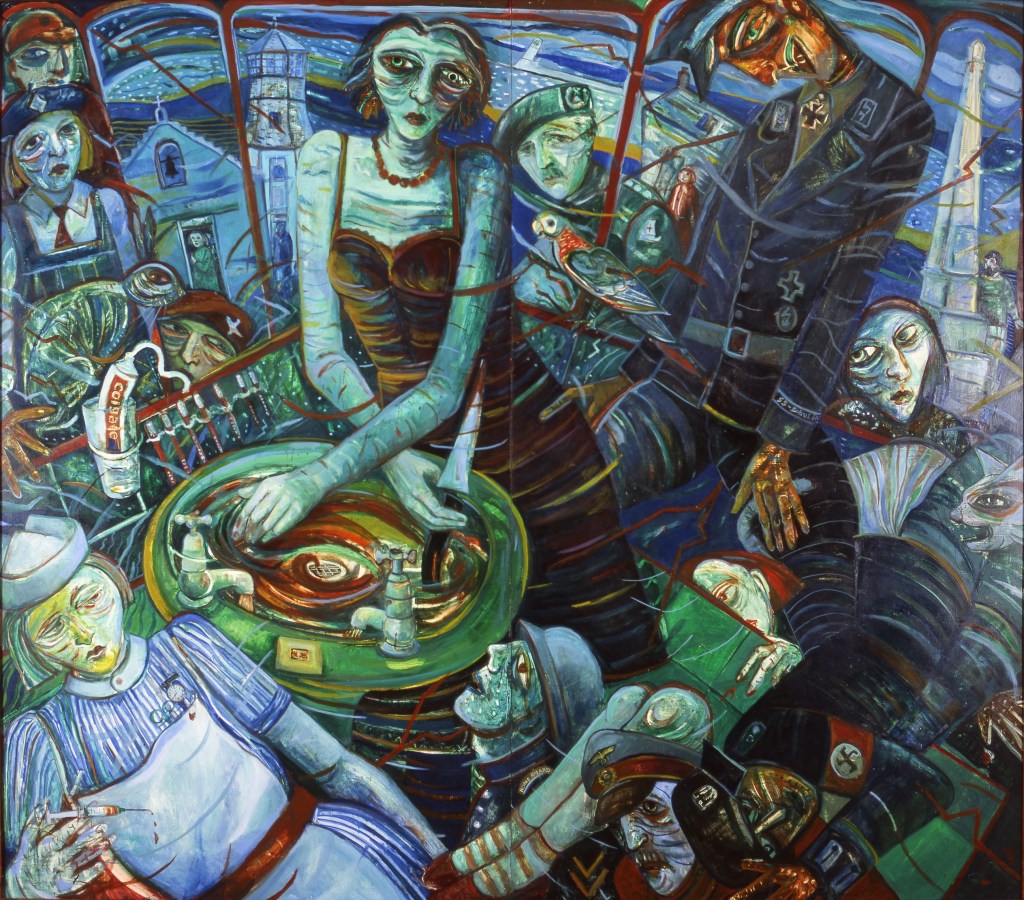
Joyce W Cairns They Said the War Was Partly to Blame (1986, oil on panel, 213 x 244cm)
Image courtesy of the artist

In They Said the War Was Partly to Blame (1986, oil on panel, 213 x 244cm) figures are orientated around the emotional core of the painting, Cairns’ mother, who stands at the apex of the composition over a vortex-like sink hole. The vantage point is the family bathroom at Dovecot Grove, Edinburgh, and Footdee, with its familiar harbour shapes in the background, moving back and forward through time, unlocking what is hidden and exploring painful family history. The painting feels drenched in sea green, as though drowning or being pitched on internal waves of awareness. There is another hue in play here too, like the green guiding light of a harbour buoy, that doesn’t allow us to run aground. As in many of her large-scale compositions, interlocking pyramids and tilted, angular horizons give a feeling of acute instability and unease. However emotionally off balance we may feel, the artist’s highly structured approach to composition is what enables us to stop, look closely and contemplate a scene we may not want to witness.  It is fascinating to see the accompanying study for this painting and the decisions made in terms of design and foreground. The psychological compression of figures echoes the dynamism of German Expressionism and Neue Sachlichkeit artists of the Weimar period. Painting humanity in terminal decline with brutal honesty, artists George Grosz, Otto Dix and Max Beckmann are a potent influence on Cairns’ work. However, her distinctive potency emerges through empathy, a passionate need not to just make sense of her own family history, but intergenerational trauma and collective memory.

Emotional connection is paramount in Cairns’ work, in her rendering of the human figure and her painstaking research. The importance of getting the details of artefacts, uniforms and memorabilia just right and bearing witness to what is hidden, acknowledges and honours civilian casualties of war. Many of her paintings are memorials in that respect. Although They Said the War Was Partly to Blame is a deeply personal exploration, as Cairns’ practice progresses frames of reference in her work continue to expand. The ‘personal odyssey’ carries within it a concern beyond the self. It is the artist as witness, looking inwards certainly, but outwards too, with a critical awareness of world events.
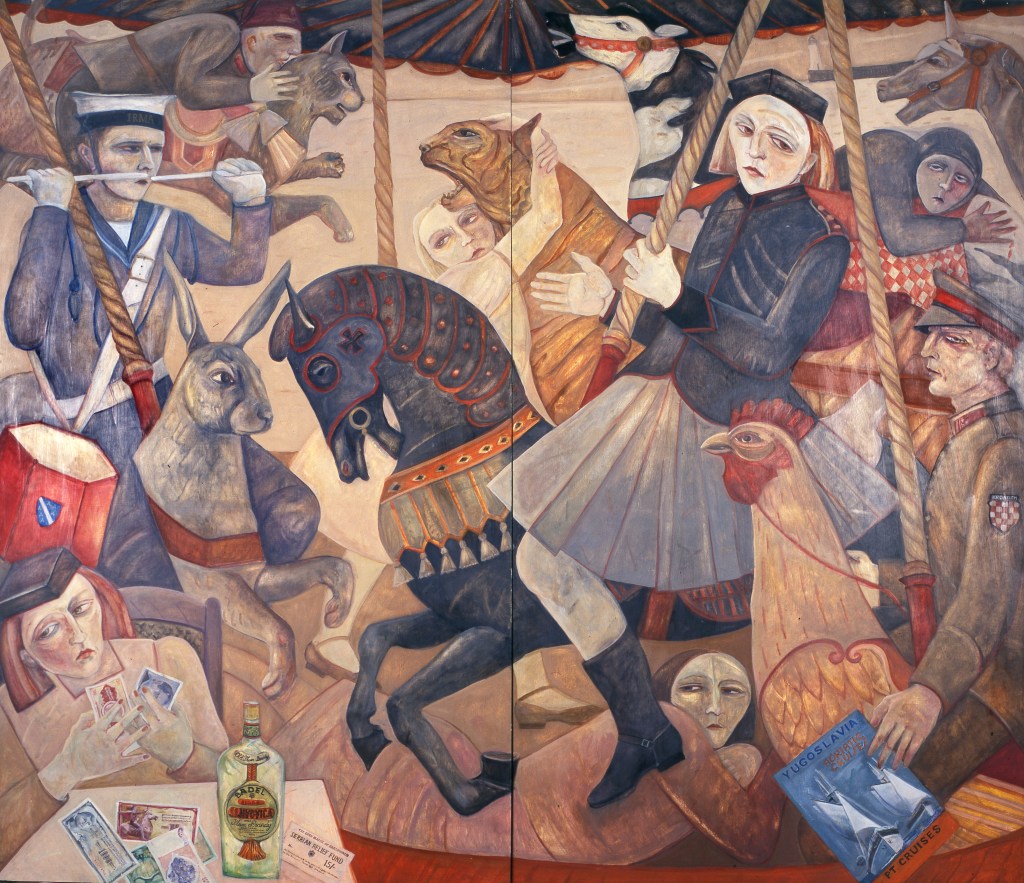
Joyce W Cairns Irma (1994-95, oil on panels, 213 x 244cm) Image courtesy of the artist.

Irma (1994-95, oil on panels, 213 x 244cm) is a beautiful example focused on a terrible subject, merging Cairns’ symbolic carousel of war with the story of Irma Hadzimuratovic, a young girl airlifted to the UK for treatment and sadly, a casualty of the Bosnian war. The image of the child clinging to the tiger haunts the background centre of the composition. As in many of Cairns’ paintings the artist’s face is present, although this is not always self-portraiture. In Irma, the gaze of the artist/ witness meets our own, reaching across time. Cairns confronts the cruelty and absurdity of war, often bringing to light the experiences of women and children.
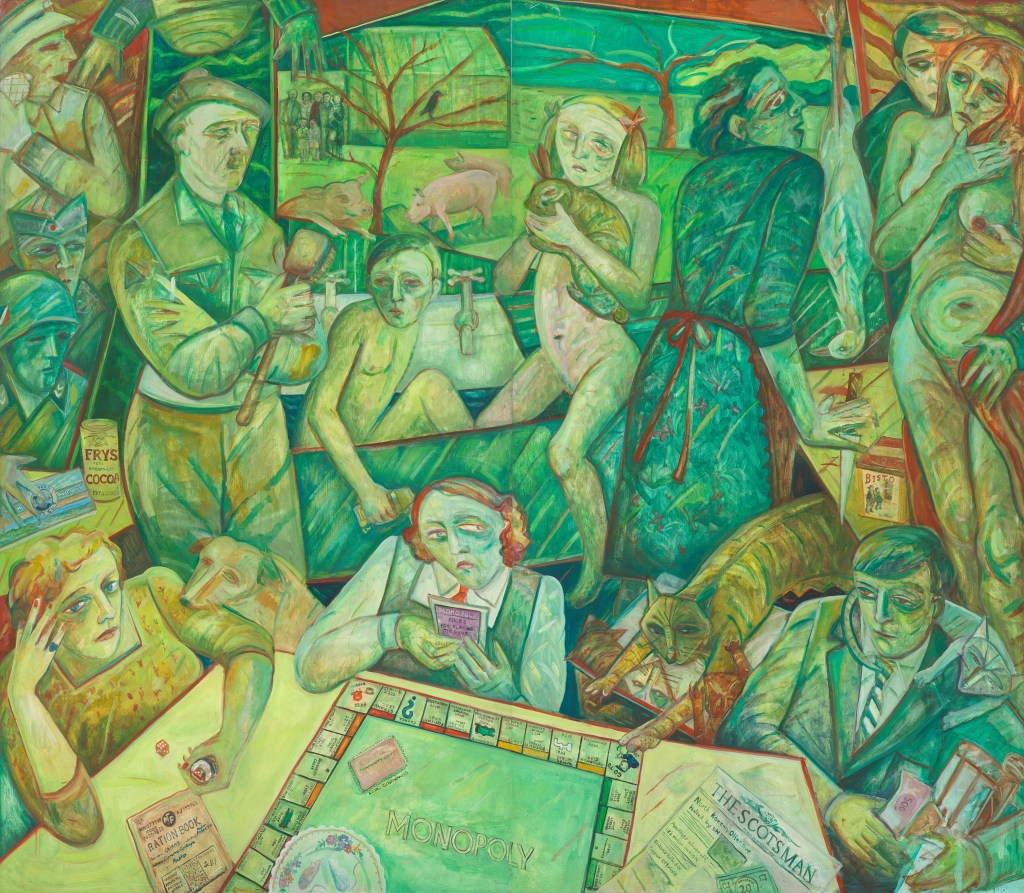
Joyce W Cairns Ratho,1951 (1990, oil on panel 213 x 244cm) Image courtesy of the artist.

Cairns’ experience as a child growing up in the post WWII era is reflected in the intimacy of objects as triggers of personal memory and collective remembrance. Often these are arranged in the foreground, like a shelf or windowsill of memorabilia we might collect in our own domestic space. In Ratho, 1951 (1990, oil on panel 213 x 244cm) this extends into the viewer’s space. A ration book, the monopoly game, the front page of The Scotsman (Friday 26 January 1951) with its headline ‘North Korean Offensive Halted by UN’ and a floral plate of morsels are offered up, together with a clutched copy of the rules of the game- monopoly and life. A myriad of narratives present themselves in the heightened opposites of red and green, and complex family dynamics. Ratho, 1951 is a psychological study of family life and memory with the unmentionable pushed to the margins, but ever-present in Cairns’ art. In an interview with the artist at her home in Footdee, in 2006 she reflected; ‘After the war people just didn’t want to know. When I was growing up, they wanted to put that aside. The early fifties when I was young was a pretty grim time in Britain, rationing and stuff like that…There were all kinds of shortages. Of course, as a child you didn’t realise it could be any different.’(2)
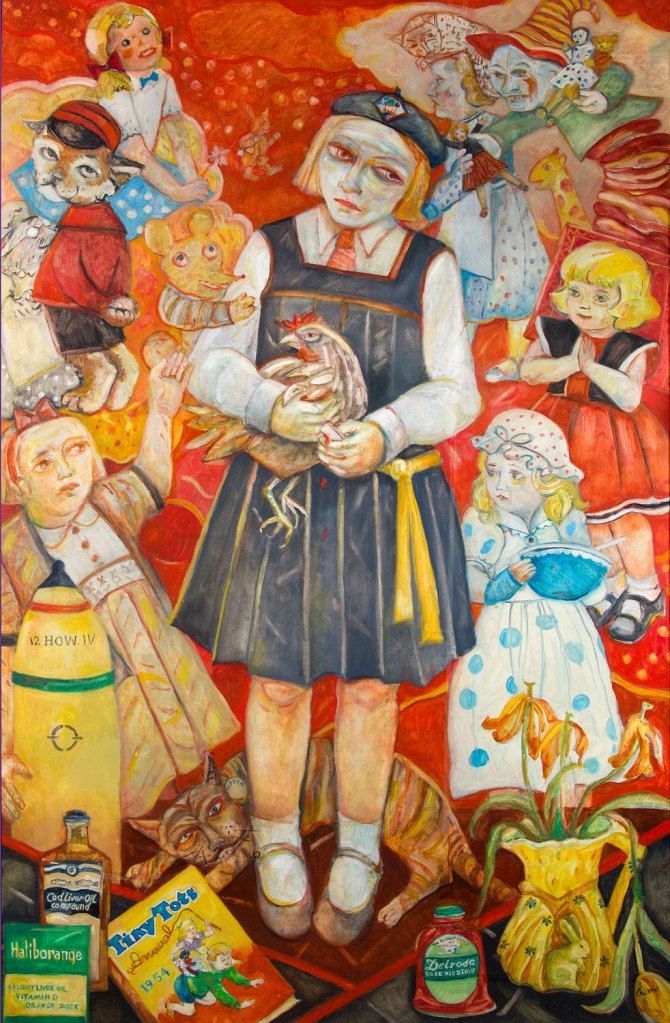
Joyce W Cairns Tiny Tots Annual 1954 (c. 2016, oil on canvas, 203 x 145cm) Image courtesy of the artist.

The seemingly bright painting of childhood Tiny Tots Annual 1954 (c. 2016, oil on canvas, 203 x 145cm) in dominant cadmium red and yellow is a highly visceral arrangement of figures and objects. Foreground bottles of rosehip syrup, cod liver oil and Haliborange (halibut liver oil, vitamin D and orange juice) provide a powerful sensory trigger for the post war generation of what was deemed good for the child. The question of what we are weaned on is inferred by a 12 HOW.IV missile which reads like a baby’s bottle. The central figure of the female child in school uniform clasps a hen, often a symbol of vulnerability in Cairns’ art. Her face is weary with age, giving a heightened sense of adult perspective to the whole scene. The figures and toys that surround her are part nursery rhyme, part comic book. A sibling-like figure with her hand around the missile reaches for the sleeve of the central protagonist / artist/ caregiver, while in the background a doll-like figure clasps her hands in prayer or delight. Emotional shifts encircle the painting, never allowing the viewer to get too cosy with nostalgia. A worried female child stands with a bowl in her hands to the lower right of the composition. Goldilocks with a full bowl of porridge hearing bears or an empty bowl and anticipation of gnawing hunger like Oliver Twist?  A recurrent rabbit jug family heirloom with spent lilies brings a sickly air to the scene. Like the nick of blood drops at the centre, there is a kind of reckoning within the fairytale façade, of coming to terms with the forces that shape us and make us who we are. The expression of the central female figure is knowing and complex, a sideways glance into a space beyond the picture plane, pensive, red eyed and perfectly still, as wave upon wave of associations hit the spectator.
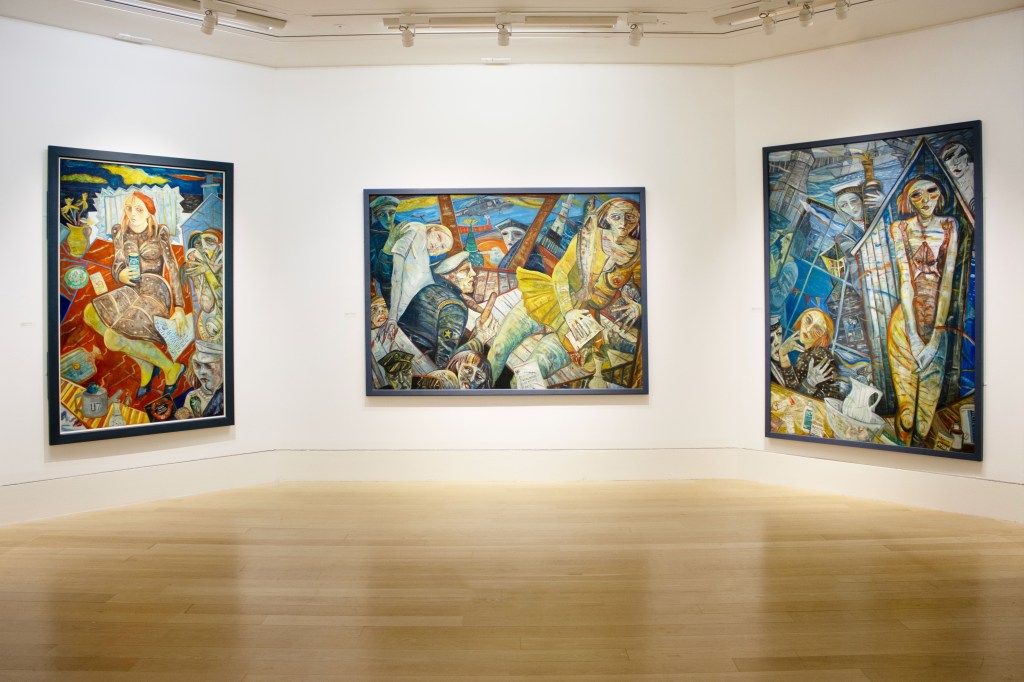
Joyce W Cairns – A Personal Odyssey Installation shot with On Board the Schleswig- Holstein (1989 oil on panel 220x 160cm) in the centre. Image courtesy of the Royal Scottish Academy.

There are many highlights in the show where facets of self, womanhood and femininity are explored by the mature artist. The Drying Green (1990 Oil on panel, 213 x 244cm), Sailing Through Polluted Seas (1988 oil on panel, 83 x 244cm) and On Board the Schleswig- Holstein (1989 oil on panel 220x 160cm) are as beautiful as they are challenging. Making connections within Cairns’ imagery is one of the great pleasures of the show. While the origins of enquiry might be personal or historically specific, Cairns creates spaces of imagination and confrontation that are satisfyingly multilayered. There is also a sense of being in the presence of a master of the craft, a nurturing, insistent force of life, absent in the work of many of her male contemporaries. In the 1980s and 90’s when the ‘New Glasgow Boys’ Peter Howson, Ken Currie, Adrian Wiszniewski and Steven Campbell were emerging with much acclaim in a resurgence of figurative art in Scotland, Cairns’ work during the same period is arguably more commanding in its emotional intelligence.  As Bill Hare’s excellent commentary on Cairns’ work over many years has suggested, there is a kinship with the work of Paula Rego. The power of visual storytelling, expression of female lived experience, uncompromising honesty and exploration of collective memory are distinctive qualities in each artist’s work. There is too, a ‘spirit tempered to endure’(3) that emerges from their timeless paintings. Critically, Cairns’ work reminds us that how we remember is how we endure.

Under the banner of this year’s Royal Scottish Academy 200th anniversary celebrations, A Personal Odyssey understandably frames Cairns’ work within RSA history and in the context of Scottish Art education. However, now is the time to acknowledge and celebrate the international stature of Joyce W Cairns’ work, which extends far beyond Scotland or any institution. Although there is a missed opportunity here for a full-scale public retrospective occupying the entire RSA galleries, A Personal Odyssey reveals the evolution, resilience and spirit of one of the UK’s finest artists. Joyce W Cairns’ powerful, monumental works assert the importance of painting in contemporary life, the multifaceted role of the artist as witness and our essential need for storytelling. At this point in history with war and destruction raging all over the planet, Cairns’ spirit of confrontation, compassion and insight is a shining light.
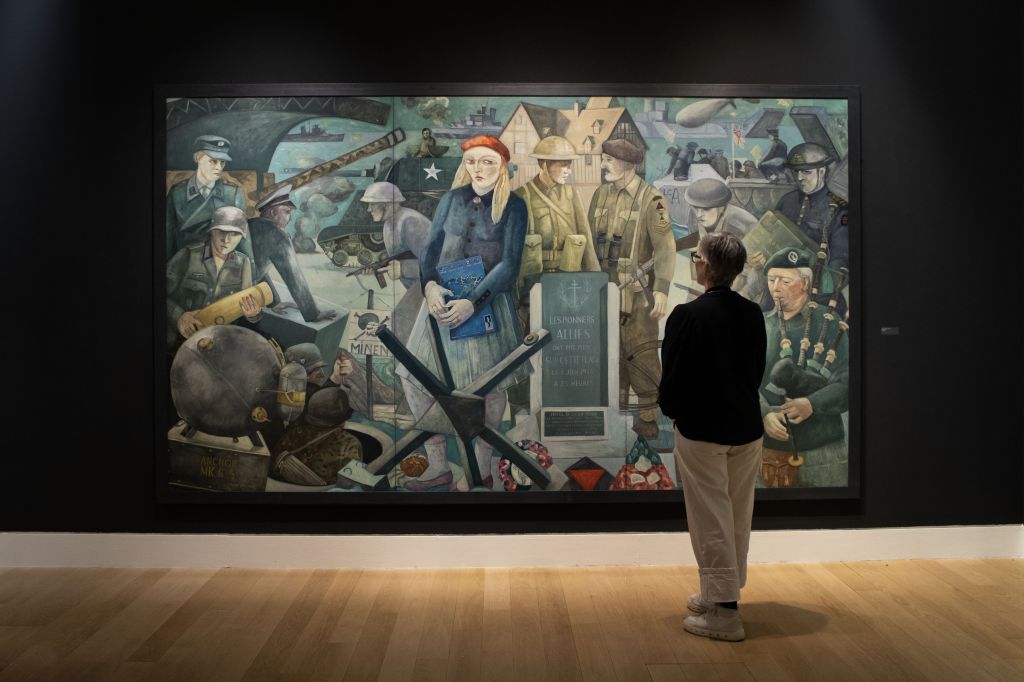
Joyce W Cairns – A Personal Odyssey installation shot with Sword Beach (1996, oil on panels, 213 x 366cm) by Joyce W Cairns. Image courtesy of the Royal Scottish Academy

Joyce W Cairns- A Personal Odyssey – Royal Scottish Academy exhibition page: https://www.royalscottishacademy.org/exhibitions/315-joyce-w.-cairns-a-personal-odyssey/overview

Georgina Coburn Review of War Tourist in Northings 24 March 2006: https://northings.com/2006/03/24/joyce-cairns-war-tourist

 Notes

  1. Joyce W Cairns interview with Georgina Coburn Footdee, Aberdeen, 18 March 2006.
  2. Joyce W Cairns interview with Georgina Coburn Footdee, Aberdeen, 18 March 2006.
  3. Quotation on the wall of the A Personal Odyssey exhibition space; ‘And if a god will wreck me yet again on the wine dark sea, I can bear that too, with a spirit tempered to endure.’ Homer, The Odyssey (trans Robert Fagles)

EXPRESSIONISTS: KANDINSKY, MÜNTER AND THE BLUE RIDER

Tate Modern 25 April – 25 October 2024

Franz MarcTiger, 1912 Lenbachhaus Munich, Donation of the Bernhard and Elly Koehler Foundation 1965

‘The whole work, called art, knows no borders or nations, only humanity.’

Der Blaue Reiter Almanac 1911

In many ways Expressionists: Kandinsky, Münter and The Blue Rider feels like a miraculous, timely gift. This is a stunning show, full of life affirming energy and new discoveries, largely drawn from works preserved by Gabriele Münter through both world wars and donated to the Municipal Gallery at the Lenbachhaus, Munich in 1957. The brief flowering of Der Blaue Reiter group resulted in art so dazzling that it still burns brightly and imprints the soul. It is exhilarating to feel the colour, sense of possibility and pure elation in works such as Kandinsky’s Munich- Before the City (1908, oil paint on board) and sobering to contemplate what followed. World wars, toxic nationalism, the systematic denial of freedom of expression, persecution, exile, and genocide. The 1937 Entartete Kunst /Degenerate Art exhibition staged by the Nazis in Munich included works by Wassily Kandinsky, Paul Klee, Franz Marc, and Lyonel Feininger as objects of ridicule and persecution. Walking through the Expressionists exhibition, seeing the celebration of self-expression with a future of the artist as target, made me reflect on currents at work in the world today.

I felt overwhelmingly uplifted by the vision of creative individuals throughout this exhibition, their art as rich and vibrant as the day it was made. I also felt their collective belief in internationalism and freedom of expression eroding in real time beneath my feet. The tension between what could be and the global precipice we now stand upon, perhaps made this show even more urgent and brilliant, a real beacon of light and colour. There is a spirit of resilience, fellowship and joy permeating this show, an energy which is felt in every mark and in the fluidity between artistic disciplines, encompassing visual art, sculpture, photography, theatre, dance, and music. Exploration of place, the city of Munich and the Murnau countryside are beautifully woven into the story of Der Blaue Reiter group, their collaborations, passions, and support of each other. This ‘transnational community’ of artists; French, German, Swiss, Russian, and American, gravitated towards the spiritual in Art, experimented with symbolism, abstraction and explored complexity of identity in ways that make life circa 2024 feel retrograde.

There are impressive and deeply moving works by familiar artists, Wassily Kandinsky, Franz Marc, Gabriele Münter, Paul Klee and Robert Delaunay, however it is the work of lesser-known artists that are a revelation. Among them Erma Bossi, Elisabeth Epstein and Marianne Werefkin, and works by unknown artists from Asia and North Africa. The influence of non-Western art on members of Der Blaue Reiter group is visually striking and begs further investigation. Images from the 1910 Masterpieces of Muhammadan Art exhibition in Munich, which included 3600 works drawn from European collections, and Gabriele Münter’s photographs of Tunisia are examples of this interest in “primitive art” and the “vast Orient.” The 1900’s European lens and Imperial language is dated, but as a Photograph of a leather Safavid bookbinding lacquered in gold, 16th century c1910 and Nobleman on a tiger hunt North Indian / Rajasthan 19th century reverse glass painting demonstrate, these are ‘masterpieces’ with resounding voices of their own. Seeing a facsimile of Shishi Lion, early 19th century, attributed to Katsushika Hokusai as part of Der Blaue Reiter Almanac display and Franz Marc’s Tiger (1912), there is an inner spirit unleashed and understood in both that has nothing to do with stylistic imitation.

Erma Bossi Circus, 1909 Lenbachhaus Munich, on permanent loan from the Gabriele Münter and Johannes Eichner Foundation, Munich

The emergence of distinct creative voices and personalities within Der Blaue Reiter group is one of the great delights of this show. Erma Bossi’s Circus (1909, oil paint on card) places the viewer in the elliptical spin of a live performance. The mesmerising rhythm of movement in horse and rider, within the colourful interior space of a circus tent, draws the viewer into a self-reflexive space. Bossi makes us part of the foreground view of three clowns, inferring that rather than just passively watching, we too are part of the act.

Elisabeth Epstein, Self-Portrait, 1911. Lenbachhaus Munich on permanent loan from the Gabriele Münter and Johannes Eichner Foundation

Elisabeth Epstein’s Self Portrait (1911, oil on card) is another wonderful discovery and like Bossi’s Circus, a trigger for seeking out more of her work. Born in Ukraine, Epstein defied the conventions of her day, left her husband and son, and moved to Moscow, Paris, and Munich to develop her art. In this bold composition, she fills the picture frame, a naked shoulder bringing a sense of vulnerability to the figure, while her arms are folded diagonally across her body, like a protective barrier to her inner world. Emotionally contradictory colours of cool greens and blues with warm yellow and pink flesh tones make this self portrait a fascinating, ambiguous vision of self. The confidence in paint handling, masterful composition and dark, articulate outlines of the face and body, present a deeply centred image of a woman absorbed in the process of becoming her true creative self.

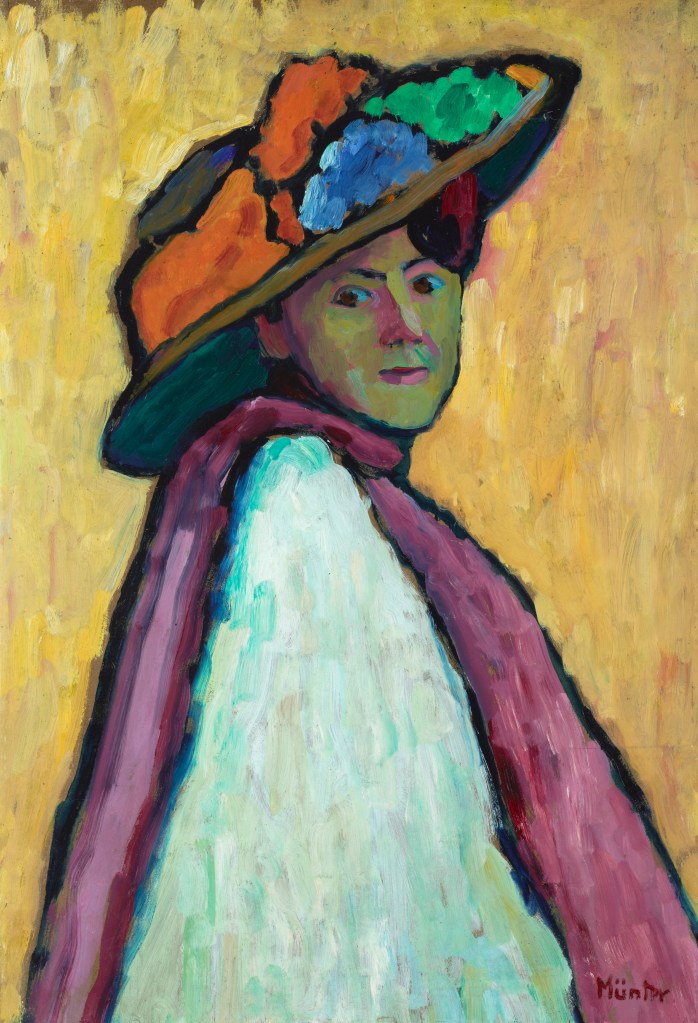
Gabriele Münter Portrait of Marianne von Werefkin, 1909
Lenbachhaus Munich, Donation of Gabriele Münter, 1957 © DACS 2023

Two images of Marianne Werefkin, Gabriele Münter’s portrait of the artist (1909) and Werefkin’s fierce self-portrait aged 50 (1910) provide an intriguing, extreme contrast of character. The artist’s projected inner self is sharply juxtaposed with the kindly, fashionable woman in Münter’s portrait. Coming from a position of privilege, Werefkin was fortunate to have financial independence and supported other artists in her circle. Her statement ‘I am not a man I am not a woman. I am I’ chimes perfectly with the incandescent, red eyed confrontation of her self-portrait, actively challenging the viewer. She is one of the most interesting members of the group, her paintings and drawings one of the highlights of the show. Werefkin’s dynamic sketchbooks (d3 undated) are filled with jewel-like colour and her line radiates life. The beautiful trance-like silhouettes of The Skaters (1911, Tempera on paper on board) and her extraordinary composition of loss, light and anguish The Storm (c. 1907, Tempera on paper on cardboard) are deeply contemplative works, drawing on ancient, spiritual traditions of image making in this medium.

Marianne von Werefkin,Self-portrait I, c.1910. Lenbachhaus Munich

The Murnau countryside was an environment that elevated all of Werefkin’s insight, skill and creative energy. Watching people move towards and be absorbed by The Prayer (1910, tempera on paper on board) is a tangible, emotive example of the Divine synonymous with Nature. The sense of elevation comes not just from line and form which cradles elements of nature and human architecture together, but in deep blues and greens that convey the mountains growing and the spire extending into the realm of those peaks.  In the foreground, a white bearded man and a female figure kneel before an alcove statue of the crucifixion. It is an image that has specific religious associations, however it is also open in the same way the sky is, to imagination and interpretation. The Red Tree (1910, tempera on paper on board) is another magnificent example, where a lone figure sits beneath fiery, vibrant growth, dwarfed by the mountain and staring into the hut or chapel as a gateway. It is a captivating, radiant hymn to Nature and the artist’s own nature, an irrepressible combination of dynamic elements which communicates a state of connection with forces greater than oneself.

Marianne von Werefkin, The Red Tree, L’Albero Rosso, 1910. Fondazione Marianne Werefkin, Museo Comunale d’Arte Moderna, Ascona

Tragically Franz Marc died from his injuries at the Battle of Verdun in 1916, but his sacred vision of the natural world is one which will hopefully strike a chord with a whole new generation of viewers at Tate Modern. The visible impact of his work on visitors to the exhibition was heartening, smiles of recognition, joy, excitement, an inner light illuminating people’s faces, particularly as they entered a room of large scale works In the Rain, The Tiger and Doe in the Monastery Garden, a breathtaking trio on a single wall. Marc’s fractured style is that of a prism, a kaleidoscopic, distilled vision that makes his paintings so distinctive and magnetic.

In the Rain (1912, oil on canvas) depicts Marc, his wife and their dog, sheltering in a deluge. The figures are alone in their thoughts and in this shimmering field of colour and light we can see Marc’s commitment to a different state of being. ‘I’m striving to intensify my feeling for the organic rhythm of all things, trying to feel myself pantheistically in the quivering and flow of blood in nature, in trees, animals, the air…’ This also manifests in Marc’s notes and exploration of colour theory including Arthur Schopenhauer’s On Vision and Colours (1816), the writings of physiologist Ernst Wilhelm Von Brucke and meteorologist Wihelm Von Bezold. Viewing Marc’s Deer in the Snow (1911) through a prism in the exhibition, opens different dimensions of the artist’s practice and sheds new light on his approach to painting. ‘Only the prism has become indispensable to me…Nearly every painting requires an alteration of its use; sometimes it appears nigh on impossible. It serves the purpose of checking adjacent colours for their purity.’

Franz Marc, In the Rain, 1912. Lenbachhaus Munich, Donation of Bernhard and Elly Koehler

 Marc’s acute sensitivity to light and darkness assumes a spiritual dimension, seen in two paintings which dance with colour in different ways. In Doe in the Monastery Garden (1912, oil on canvas) the animal’s head is inclined towards a higher power, a glimpse of lunar blue in the high left corner. Inclining curves are felt in the trees and foliage, with high contrasts of green and red in dynamic counterpoint. There is unity and a sense of balance in play in the painting as a Gesamkunstwerk, an all-embracing synthesis, which here imbues a sense of inner calm. Whatever your beliefs- a holy spirit is present as a bridge between human architecture and nature.

In stark contrast Deer in the Woods (1912, oil on canvas) depicts darkness as a dominant force in the inclining tree, which menacingly compresses the deer’s body into a position of concealment and fear. We feel the threat, that something is coming. Fronds reach out and the air stirs in the high right corner like an apparition. Our emotions and sense of danger are heightened by the dominance of red in the painting and the angular bisection of the canvas by the tree trunk, which curiously also holds a distorted oval of white light.

Der Blaue Reiter group’s curiosity about many different ways of seeing, the art of different cultures and ages, the intense relationship between colour and sound, the investigation of colour theory from Goethe’s Theory of Colours (1810), Issac Newton and Schopenhauer, the belief in internationalism and the ‘inner necessity of art’  has much to teach us in a world hell bent on materiality and linear progress. There is above all else hope in the Expressionists’ experimental, collaborative engagement with the world which sent me back out into ours with a fighting spirit of optimism. There are times when colour and light does not win, but here in Tate Modern an alternative presents itself, and what a glorious endorsement of the human spirit it is.

Expressionists | Tate Modern

Revisionism and the Art of Decay

“Poetry fettered fetters the human race. Nations are destroyed or flourish in proportion as their poetry, painting and music are destroyed or flourish” William Blake

Detail J.M. Waterhouse Hylas and the Nymphs (1896) Manchester Art Gallery.

In July I attended the opening of the Emil Nolde- Colour is Life exhibition at the Scottish National Gallery of Modern Art, the subject of a previous post. It’s an exhibition that has remained in my mind ever since, for the issues it raised as much as the art. When the show first opened in Dublin, The Independent ran with the headline; “Can you enjoy great art created by a Nazi? New Emile Nolde exhibition explores this dilemma.” William Cook’s article suggested that; “the big question for our times is whether you can condemn someone’s sexual conduct, and still enjoy their art. In the case of painter Emil Nolde, can we delight in his work even though he was an enthusiastic supporter of Adolf Hitler?” This question has been compounded by reports of wider historical revisionism in the press throughout 2018. Some based on well-meaning curatorial or civic actions, all begging further investigation.

The renaming of a 1929 Emily Carr painting by the Art Gallery of Ontario, the removal of a 19th Century nude painting by J.M. Waterhouse at the Manchester Art Gallery, the recent controversy of boycotted music by Richard Wagner aired on Israeli radio and the removal of an “Early Days” racist colonial statue in San Francisco are all potent examples, worthy of their own article.  Each one is an act of historical revisionism that raises essential questions about who owns culture. Who has the right to alter or remove historical documents, artefacts or art objects from public view and under what circumstances, if at all? In my profession all art is political, whether consciously nailing its colours to the mast or not. The expression of ideas can certainly be dangerous, depending on the ideological intent of the maker and the lens of hindsight / historical context we use to examine it. However, reading a book, seeing a play, film, art exhibition or listening to music doesn’t mean you agree with the content or the opinions of the artist(s) who created it. You have free will (as long as you live in a place that hasn’t banned the means of expression) to make up your own mind. At what point did we need to be protected from that process and for whose benefit?

Continue reading

Emil Nolde – Colour is Life

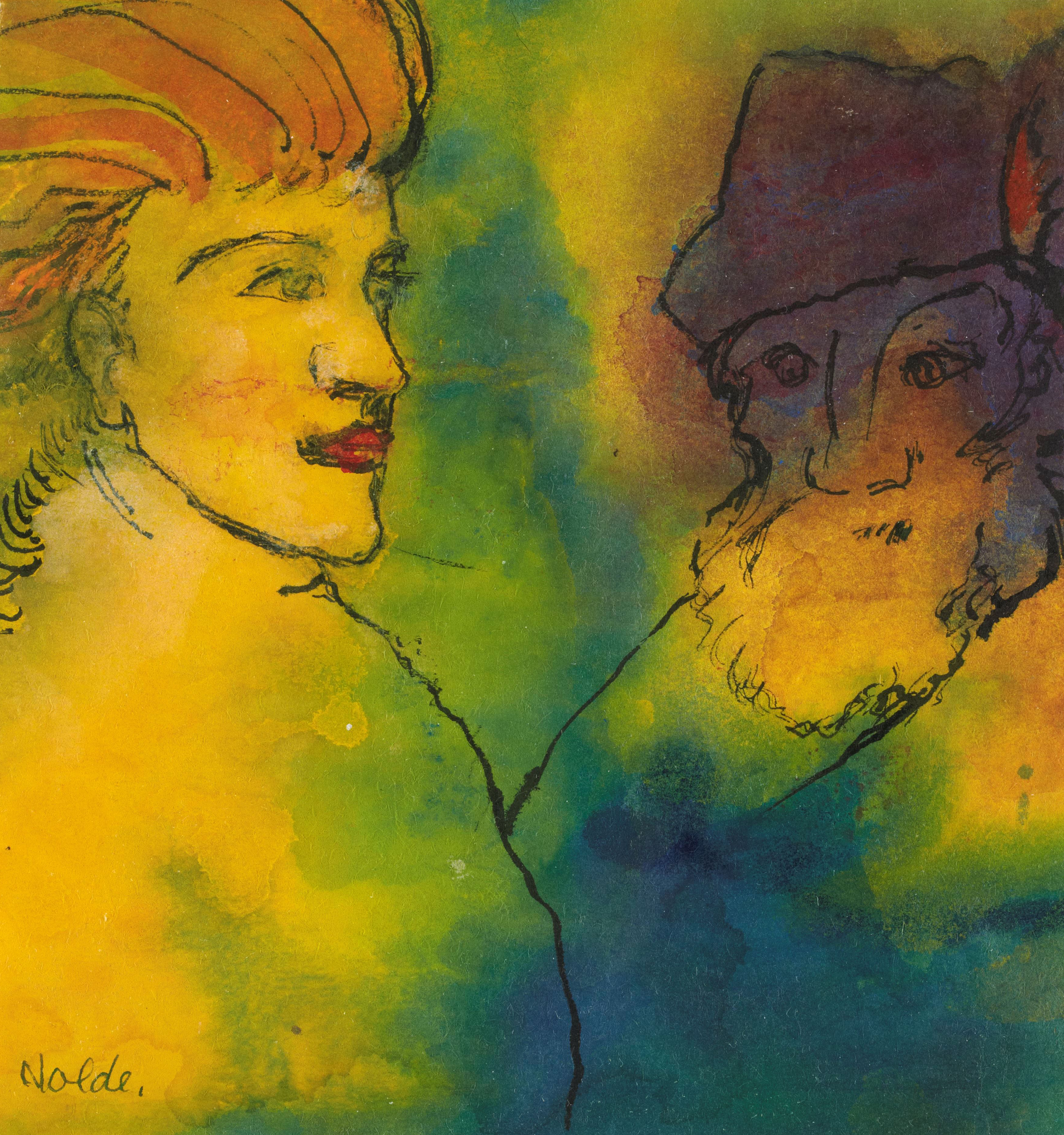
Emil NOLDE (1867-1956)
Old Man and Young Woman(Man with Feather in his Hat) (Alter Mann und junge Frau (Mann mit Feder am Hut)), c. 1930s-40s
Watercolour on paper, 16.2 x 15.4 cm
© Nolde Stiftung Seebüll

14 July – 21 October 2018

Scottish National Gallery of Modern Art (Modern Two)

“Colour is strength. Strength is life. Only strong harmonies are important.” Emil Nolde, Travels. Ostracism. Liberation. 1919–1946.

Colour is Life presents a rare opportunity to come to grips with the undeniable vibrancy and jarring contradictions in Emil Nolde’s art. This illuminating retrospective features 120 paintings, drawings, watercolours and prints from the Emil Nolde Foundation in Seebüll, Northern Germany. Nolde’s images reveal the journeys of his life; from rural villages, domestic gardens and highly charged religious subjects, to the bustling, industrial port of Hamburg, the cabarets of Berlin and indigenous people of Papua New Guinea. His extraordinary land and seascapes are among the highlights of the show, together with his controversial “unpainted pictures” incorporating elements of folklore and the grotesque.

Emil NOLDE (1867-1956)
Landscape (North Friesland), (Landschaft (Nordfriesland)),1920
Oil on canvas, 86.5 x 106.5 cm
© Nolde Stiftung Seebüll

Living on a shifting border between Germany and Denmark and with a lifetime (1867-1956) spanning two World Wars, there are inevitable conflicts in terms of how the artist saw himself and how he/his work has been perceived by successive generations. When this exhibition first opened at the National Gallery of Ireland in February 2018, The Independent ran with the headline; “Can you enjoy great art created by a Nazi? New Emile Nolde exhibition explores this dilemma.” The mistake we make too often in the age we are living in is making superior moral judgements that reinforce polarity rather than understanding, based on the assumption that the function of art is enjoyment. What I found fascinating in Colour is Life is human nature on display and how you must confront beauty and ugliness in full view of each other; in the comprehensive survey of Nolde’s work and within yourself as a viewer, or potential witness.

Continue reading