Thresholds – The Art of Carolynda Macdonald

Carolynda Macdonald River of Lost Souls (oil on linen, 113cm x 105cm)
Image courtesy of the artist and Kilmorack Gallery

‘I seek to bridge a recognisable world with that of an imaginary or mythological one. I almost always include birds as the main protagonists but have increasingly brought in human characters too. This alchemy of birds and fragments of old master figurative paintings, become vehicles for the subconscious to play and facilitate self-expression.’ Carolynda Macdonald

Working previously as a Biomedical Scientist in Microbiology, Carolynda Macdonald has progressively developed her painting practice since 1982, studying life drawing, printmaking and exhibiting extensively in the UK, USA, and Australia. Now based in Edinburgh, Macdonald’s recent exhibitions, including House of Macdonald with fellow artists Alan and Rory Macdonald, affirm her emergence as a distinctive voice in Contemporary Art. Drawing on traditions of painting in Western Art, the tradition celebrated by Macdonald is freedom of expression, art which is big enough to admit multiple layers of interpretation, making ‘paintings you can fall into.’ ‘Humanity being imprinted onto Nature’ is a strong theme in her latest work, where birds are threshold subjects, guardians of the natural world and human vulnerabilities.

River of Lost Souls (oil on linen, 113cm x 105cm) contains a scene of human betrayal, the cutting of Samson’s hair by Delilah’s accomplice, a removal of his supernatural power depicted by Rubens and reimagined here within the body of a bird. The brown, russet, crimson, and flesh tones glow humanely, emerging from a dark, cool, calm before storm background by the river’s edge. The human body is tucked protectively into the bird’s feathers, a safe space where humanity, emotion, and nature, within and without, can be examined. Poised on one leg, the bird’s gaze meets ours. This recognition, the confrontation of the eye of one species meeting another’s, is deeply arresting. It is a moment of tension that brings thought and feeling bubbling to the surface, in our immediate present and in relation to a shard of visual history.  The painting is a threshold space and being held within spaces where land, sky and water meet, have a particular role in Macdonald’s art. She composes images of sanctuary for her protagonists and the viewer, alive with tension and burgeoning consciousness, full of possibility. This feeling of potential, psychologically and in the realm of dreams, is incredibly subtle and potent. In River of Lost Souls, who or what gives us strength, is given new context out with the Old Testament Biblical story and an art historical canon of Old Male Masters.

There are a number of genres and art historical expectations in play here, and Macdonald inadvertently subverts them all, bringing fragments of grand Master subjects into intimate focus, honouring scientific enquiry and ornithological art with feeling, and bringing untold psychological depth to the traditionally demure arena of still life. The field of enquiry is truly expansive, painted with meticulous detail and devotion to craft. It is the joy of painting and not politics that drives Macdonald’s art. We are free to interpret meaning and lose ourselves in narratives of our own making- that’s the gift and flow within her painting. In the presence of an artistic voice that elevates the mind and spirit, we can confront difficult things and begin to heal. Macdonald describes the music of Jocelyn Pook, Lisa Gerrard and Portuguese Fado singing in such terms, and the same is true of her paintings.  

Carolynda Macdonald Beacon of Hope (oil on board, 25cm x 23cm)
Image courtesy of the artist and Kilmorack Gallery

Carolynda Macdonald brings her microbiologist’s eye to the pattern of life and creates different spheres of awareness in the process. In Beacon of Hope (oil on board, 25cm x 23cm) we see a feast of finely painted flowers reminiscent of Rachel Ruysch within the body of a tiny wren. Although delicately rendered, the dark bird is alert, determined and poised in readiness on a natural stone, clasping a diamond in its claw. Broken jewellery is strewn at its feet, a microcosm of detail in a mountainous landscape of macrocosmic emotions and association. There is a jewellery box inheritance opened here and an uncanny, fleshly light which plays across the surface of lake and sky in the background. The artist creates an atmosphere of profound stillness, a place of solace, contemplation and in this case, an unsettling suggestion of relationships being tested. Macdonald describes the objects in her paintings being ‘broadly drawn’ rather than autobiographical. ‘Pearls are beautiful things to paint- glowing. They can abstractly solve a painting. What a pearl is, what it means’ also comes into play. ‘Pearls are a living thing, a grain of sand, giving all these things a different life in the work.’ Sometimes the placement of objects emerge unconsciously out of a brushstroke and Macdonald is simply enjoying where the mark takes her. It is an art of instinct and precision, that allows the human condition to be explored in all its nuances, ‘including inner turmoil and vulnerability, love and hidden desires, betrayal, motherhood, and protectiveness.’

Carolynda Macdonald Fortress of Shadows (oil on board, 25 x 23cm)
Image courtesy of the artist and Kilmorack Gallery.

The intimate scale of Macdonald’s wren and robin paintings draws you in, often with unexpected twists. In Fortress of Shadows (oil on board, 25 x 23cm) the female form is revealed and protected within the body of the bird, perched on a silver jewellery box. The strawberries in the right foreground link with drapery which the female protagonist draws towards her body to shield it, her hand resting on the wren’s head. They are both vessels of potential narratives. The vulnerability of this reclining nude pose, seen so often in Western Art History as exposure for a male gaze, shifts to a more heightened state of awareness within, as if the threat exists beyond the boundaries of the picture plane, with the painting as refuge. The way Macdonald positions the female body gives it protection and agency -within the painting and the viewer, to begin to explore what this internal scene means to us.

Carolynda MacdonaldThe Scream (oil on board, 25 x 22cm) Image courtesy of the artist.

The Scream (oil on board, 25 x 22cm) is another powerful example, punching far above its scale and subverting the hierarchical dominance of large-scale History Painting. The combination of elements-still life, wren and jewellery, set in what feels like an 18th Century Arcadian landscape is juxtaposed with a fragment of Goya’s resistance painting The Third of May 1808, with civilians dying before a firing squad. Perched on the lid of a jewellery box, the open-mouthed wren omits a sound, amplified by the viewer’s imagination. There is a broken, half submerged ring or tether in the water, an intriguing detail that suggests shackles being broken on multiple levels. The potency of the scream, its volume and resonance is made by association, linked to the viewer’s awareness/experience and the scene of execution. There is beauty, horror and tension in this work achieved with consummate skill. The grand history painting is a fragment on the bird’s body, perhaps suggesting the relativity of human history when staring the current Anthropocene era in the face.

Carolynda Macdonald The Garden of Solace (oil on linen, 134 x 124cm) Image courtesy of the artist.

Our perception of violence in The Garden of Solace (oil on linen, 134 x 124cm) is tempered by how Macdonald leads the eye into the painting. The curves of the brown flamingo’s neck and beak direct us towards a fragment of Eugène Delacroix’s Death of Sardanapalus contained within its body. The extreme violence and chaos of this scene is repositioned so that we can actually be still with it and begin to interpret what is brought to the surface. It is a very powerful thing to give freedom to the imagination, both in the act of painting and enabling the viewer. This self -reflexivity is precisely what art is for, individually and collectively, to actively process what it means to be human, how we relate to each other and the natural world. In The Garden of Solace, the indifferent male ruler at the apex of Delacroix’s original painting is absent and the curve of the female body which mirrors the form of the beak opposite becomes more present. There is a sense of compassion and vulnerability that completely transforms the aggression of the original scene. The psychology and emotional intelligence of this painting is breathtaking. It is a wonderful example of the complexity and strength of art in expressing what often cannot be voiced or contemplated anywhere else. The beauty of these works lies in Macdonald’s ability to create a safe, yet gently confrontational space for a range of different emotions and experiences to be acknowledged and felt. ‘Removing the figures from their original context and narrative gives them a new life. Sanctuary (oil on linen, 91cm x 64cm) may be dream like and reassuring, the heron presenting as a guardian of the three figures within, but the clouds and water, receding in tsunami-like fashion, reveal an unsettling atmosphere which the bird resiliently withstands. The fragment of art history, Solimena’s Venus at the forge of Vulcan carries its own mythology, yet the chosen fragment and trio of resting hands makes this feel like a familial scene, rather than a distant narrative of ancient deities.

Carolynda Macdonald Sanctuary (oil on linen, 91cm x 64cm)
Image courtesy of the artist and Kilmorack Gallery

There are paintings where ‘rather than keeping these human figures within the birds’, Macdonald allows ‘them to break their boundaries and occupy a space between two worlds.’ In Where Spirits Run Free (oil on linen, 91cm x 84cm) figures float off the bird’s back, into a mythic landscape and nature’s elements. There is a sense of reverie in this action and in the handling of the background which feels made of us. It belongs to the Northern Romantic tradition of beholding the landscape/ nature and all it means to us, a quality internalised in Macdonald’s art, liberating the spirit.

Carolynda Macdonald Where Spirits Run Free (oil on linen, 91cm x 84cm)
Image courtesy of the artist and Kilmorack Gallery

There is also a powerful edge in paintings such as Refuge (oil on canvas, 91 x 83cm). Here the female figure breaks free from the body of the bird, hands outstretched and gazing above, beyond the picture plane. Although we feel there is something bearing down on her, she stands securely on the bird’s back. There is love in every brushstroke and we feel we are in safe hands to unpack the unseen but palpable sense of threat. The poise of the bird and the presence of nature comforts, while the true scale of humanity can be scrutinised. There is a drive towards renewal in Macdonald’s art, a calling, like the doves in her painting Kindred Spirits (oil on linen, 113 x 105cm), ‘vulnerable things coming together in a hostile landscape who have called each other to restore.’ Crossing these imaginative thresholds, we may discover strength, resilience, and the joy of possibility within ourselves and the wider world.

Carolynda Macdonald Refuge (oil on canvas, 91 x 83cm) Image courtesy of the artist.

Carolynda Macdonald’s work is currently on show in HOUSE OF MACDONALD, Kilmorack Gallery, Scotland, 16 March- 13 April 2024 https://www.kilmorackgallery.co.uk/exhibitions/404-house-of-macdonald-alan-macdonald-carolynda-macdonald-rory-macdonald/

ANSELM

‘What interests me is the transformation, not the monument. I don’t construct ruins, but I feel ruins are moments when things show themselves. A ruin is not a catastrophe. It is the moment when things can start again.’ Anselm Kiefer

Wim Wenders’ film Anselm begins with the light of dawn, and a sequence of sculptures from Anselm Kiefer’s Die Frauen der Antike / Women of Antiquity series. The first, is a flowing, tethered white dress being slowly reclaimed by nature’s elements, the camera pans through trees, accompanied by an operatic female voice in German, then a duet of sculptural solidarity. The slow, sweeping camera movement allows space for contemplation and establishes an attitude of reverence. Emerging from many whispered voices is a declarationwe may be nameless forgotten ones- but we don’t forget a thing.This series of white dresses, with symbolic objects where female figurative heads should be, are immediately arresting and poignant. Pierced with shards of glass, crowned with razor wire, towers, a ‘Melancholia’ cube and lead books, they mine a deep seam of history, mythology, and association. They have a tense, poised elegance, of purity and violent unrest, not haunted as female victims but each a haunting, ethereal, and enduring presence. Time wraps itself cyclically around these forms. We feel we are witnessing an ending and a beginning simultaneously. The style- not entirely artist film and not entirely linear fact-based documentary may frustrate some viewers, but seeing Kiefer’s work to scale on film is such a joy, it eclipses all else. This is a film about the artist, experienced primarily through his work.

Often in Anselm there are moments of retrieval and reconstruction- in photographs, fragments of vintage film, snippets of poetry by Paul Celan and Ingeborg Bachmann, in German song and forest imagery, potent touchstones in Kiefer’s long career that inform readings of his art. The film is textural in the same way memory can be, and this movement of burgeoning awareness, which comes from inside the artist’s work, is what makes the film so immersive. I saw it in 2D, so can’t comment on the 3D experience, though I can imagine based on Wenders’ previous work that in 3D, appreciation of Kiefer’s immense, tactile art would be heightened in the cinema. Wenders’ 2011 film Pina utilised 3D magnificently in a riveting portrait of Pina Bausch that placed audiences at the centre of her visceral choreography. Wenders captured the life force and very soul of Bausch’s work. It’s a case of technical depth of field being used to explore the collective subconscious, a quality shared by Wener Herzog’s Cave of Forgotten Dreams (2010) where 3D added to the holistic experience of ancient cave paintings- not just as entertainment but a way of being in the world. When a filmmaker can integrate the vision and intent of their subject as part of their process, that’s when the magic happens! Is this film magic? Perhaps not quite in the way Pina was, but Kiefer’s vision on film is utterly compelling throughout.

Wim Wenders Anselm

Anselm Kiefer’s palette, diagrammatically labelled, places malen (to paint) eternally hovering between Himmel and erde (heaven and earth). His work is fiercely grounded and aspirational/ spiritual, qualities that Wenders honours in his approach, taking in the magnitude and concentrated detail of Kiefer’s art. There is a shared understanding of cultural roots by director and artist as part of the same generation, and a certain playfulness too, such an essential element in the studio, that permeate the film. When familial photographs are introduced, the camera movement is like a magic lantern slide show, framed by Reiniger-like forest silhouettes and punctuated by a hung figure full stop. There’s a visual language of discovery, that chimes with the child-self wandering through the film, a counterfoil to feelings of loss and exile, the aging artist cycling through decades of work and material. It is a warehouse of human experience of incalculable value, especially now. ‘You can’t just paint a landscape when tanks have driven through it,’ says Kiefer. Conscience becoming consciousness is ever present in his work.

Anselm is a poetic and deeply moving portrait of an artist, who perhaps more than any other, has grappled with the unthinkable – in 1939 Germany, or in the face of any regime in the present or future, what would you do? Kiefer is brave enough to admit that the answer is steeped in uncertainty. Born in Germany in 1945, into a society in collective denial of the past, Kiefer’s art taps deep into the human psyche. In his own words ‘I held a mirror up to everyone’s face,’ confronting the all-pervasive silence with works like his Occupations series (1968-69). Drawing on the German Romantic tradition and its systematic abuse at the hands of the Nazis, Kiefer is self-cast as a Friedrich-like lone figure in his father’s uniform. The elation of coming face to face with Nature is defiled by a banned salute, confronting human nature and societal taboos instead, in an act of protest.  Kiefer’s monumental art which incorporates painting, sculpture and installation emerges resiliently from the rubble. He is insistent about ‘not forgetting’- the ‘open wound’ of history, our essential connection with ancient mythologies to understand, and the ‘unbearable lightness’ of what we are in the universe. He’s an artist who has absorbed the whole of human history and transcended himself in the process, as all great artists do. Seeing the expression on his face as he works undoes the macho cigar smoking. He is vulnerable, and to make connections across generations he truly needs to be, his art demands no less.

One of the great pleasures of this film is seeing Kiefer’s immense work, so exquisitely tactile in its encrusted, alchemical layers, beautifully captured on film by cinematographer Franz Lustig. From drone footage of the Kiefer’s incredible 200-acre studio complex in Barjac, Southern France, to the artist in closeup, burning pathways through a colossal painting with a blowtorch, using incineration to create a horizon. The collection of material, thought and action in his studio, the subterranean chambers of mind and epic architectural constructions are breathtaking. Experienced in the flesh, it is impossible to be in the presence of Kiefer’s work and not be moved by the sheer scale of consciousness and transformation, ironically born out of civilization in collapse. He admits that ‘nothing is part of being.’ I often feel intense loss when looking at his work, but I also feel hope in the making and Wenders captures this quality in the presence of Anselm’s younger self, played by Anton Wenders, the child that accompanies the adult artist throughout. The belief ‘that childhood is an empty space, like the beginning of the world’ carries hope within it. The same is true of Kiefer’s extraordinary work.

Anselm is screening in 2D and 3D in cinemas and streaming on Curzon Home Cinema in the UK.

PINKIE MACLURE LOST CONGREGATION

Centre for Contemporary Arts, Glasgow 17 June – 9 September 2023

Pinkie Maclure Totally Wired (Self Portrait with Insomnia Posy) 2020 63cm x 72cm, stained glass. Photograph courtesy of the artist.

Iconic award-winning artist Pinkie Maclure has been blazing a trail in visual art and music for over thirty years. Co-writing ten albums with musician and sound designer John Wills and revolutionising the art of stained glass, Maclure’s art is a potent, beautifully realised form of activism. Her ability to bring the most pressing issues and anxieties of our age into the light with power and compassion, resists dogma and triggers consciousness through imagination.

Maclure’s recent exhibitions at Homo Faber (Venice), Collect (London), the Outsider Art Fair (New York), the John Ruskin Prize (Manchester) and awards including the Sequested Prize, John Byrne Prize, Zealous Craft Prize and Jerwood Makers, have contributed to the artist’s growing international following. Represented in the National Museum of Scotland collection and private collections worldwide, Maclure’s distinctive voice as a visual artist, vocalist and musician has resounding impact. Her debut solo exhibition Lost Congregation at CCA Glasgow, is a thoroughly immersive and haunting experience. The show consists of three rooms of stained-glass, a 3D ambisonics sound installation and moving image, together with a series of live performances by the artist. In addition to new work, the exhibition is also a survey of key works from 2017-2023, including Pills for Ills, Ills for Pills (2018), addressing Britain’s opioid epidemic and Beauty Tricks (2017) a multilayered expose of the environmental and psychological cost of the beauty industry. (Discussed in a previous essay Pinkie MaclureBeauty Tricks https://www.kilmorackgallery.co.uk/pinkie-maclure-beaty-tricks-essay/ )

Pinkie Maclure Beauty Tricks 2017, stained glass Photograph courtesy of Kilmorack Gallery

Tackling the enormous sense of grief and loss felt by many people seeing ecological collapse unfold in real time, Maclure offers a vision of hope and connectivity with Nature’s capacity for renewal. It’s this spirit that enables you to emerge from the exhibition having faced the reality of climate crisis, human displacement, and misogyny with a sense of empowerment and optimism. The central work in the show is Maclure’s installation The Soil (2023) with sound installation Dust Won’t Lie, written and sung by Pinkie Maclure with John Wills. This dark, immersive space envelops the viewer in soundscape and imagery, on the wall, projected onto the floor and in a stunning, large scale stained glass at the far end of the room. This abandoned chapel feels haunted and ethereal, but inviting, two staggered groups of cushioned pews and Maclure’s mesmerising voice, as if drawn from the earth in tonal descent, ground the participant. Tangles of dead branches and the crunch of leaves underfoot evoke a kind of passing. An expression of human experience and resilience, Somehow We Mend (2023), reveals itself in the gloom, the eye directed to the wall work by an extended branch. A red thread connects the hand of a figure to a sewn and drawn panel with words, some censored or obliterated by ink, burnt cigarette holes and a band aid.

I UNSTUCK MYSELF FROM

SOMEONE’S SHOE

PEELED BACK THE SOUL AND

WALKED OUT

ALL THE WAY TO

THE BROW OF THE HILL WHERE

THE SILK

HUNG FROM THE TREES

SOMEHOW WE MEND, SOMEHOW,

SOMEHOW WE MEND IN THE END’

Pinkie Maclure Somehow We Mend 2023, mixed media.
Photograph by Alan Dimmick, courtesy of the artist.

This element of the installation is poignant and deeply affecting in its acknowledgement of lived experience, bringing the personal into what is historically held as a communal and religious space. Perception shifts in the shimmering projected light on the floor, where faces emerge and recede, like reflections in a pool of water, artist, youth, and crone goddess, digging deep beneath man-made architecture. Other elements of the soundscape provoke and soothe in contemplation, some are drawn from tradition, land and collective memory, the voices of women waulking cloth, a masculine voice in Scots song, calling children in from play, whispers, zooming traffic and the overarching statement of lament; ‘The Dust won’t lie.’ Is this because it is being stirred and disturbed, or because the earth and the dust we become speaks the ultimate truth? I find myself writing first about sound, because of the immediacy of being drawn sonically into the space, then there is light. Maclure’s large 3m x 2m stained glass is a revelation borne of all the thoughts, emotions and questions which swirl 360 degrees around the participant in the dark. In a reactionary age of fear and survival, Maclure brings much needed critical mass and ancient wisdom to the fore.

Pinkie Maclure The Soil 2023 3m x 2m, stained glass installation.
Photograph by Alan Dimmick, courtesy of the artist.

Her gothic peaked triptych of stained glass is a magnificent centrepiece, largely comprised of salvaged glass from a ‘Victorian greenhouse that blew down in a storm.’ The use of material feels poetic and ironic, a composition borne of destructive weather patterns of the Anthropocene. The central figure is radiant with questioning, her head tilted, gazing upwards, a flaxen haired Joan of Arc-like protagonist, hands clasped in prayer. Gardening gloves, wellies and fishnet tights bring her down to earth and the stream of urine which becomes a flowing stratum beneath her feet anchors the human body to nature’s eternal cycles. It is Maclure’s response to the horrifying prediction reported by the UN that ‘the world could run out of topsoil in sixty years’, also drawing on the knowledge that human urine contains nitrogen, potassium and phosphorous, ‘nutrients essential to healthy plant growth.’ That saintly vision, deferring authority to a divine God is delivered squarely into our hands. We are part of the body of nature and can be agents of regeneration, rather than destruction, if we choose. At the base of the composition, plants, microbes, fossil and seed forms give a sense of propensity to growth, a cycle of life starting again in a discarded banana and mouldy pie sprouting seedlings. The fragility of glass and the fractured word ‘Frag’ ‘ile’ in the upper black and white world of the composition, meets the ‘Fragile’ complete, written red in depths of soil. The upper section dominated by humanity is filled with fractured lines and industrial wires, fallow plough lines and delicate marks like those of ink suspension in water. It feels like a dystopian future, which of course is now. The narrative unfolds in each considered element. Magic, rage, loss, critical interrogation, compassion, humility, hope, and empowerment circulate throughout the exhibition.

Future Daysies (2023) asks what will we choose to nurture as a species, a hand raised, pointing upwards, an illuminated nucleus of cell division in the upper right and a mass of potential life below, or is it just a bloody soup of destruction? The hand and the light lift the spirit in favour of resilience, with or without God, a refrain of ‘somehow we mend.’

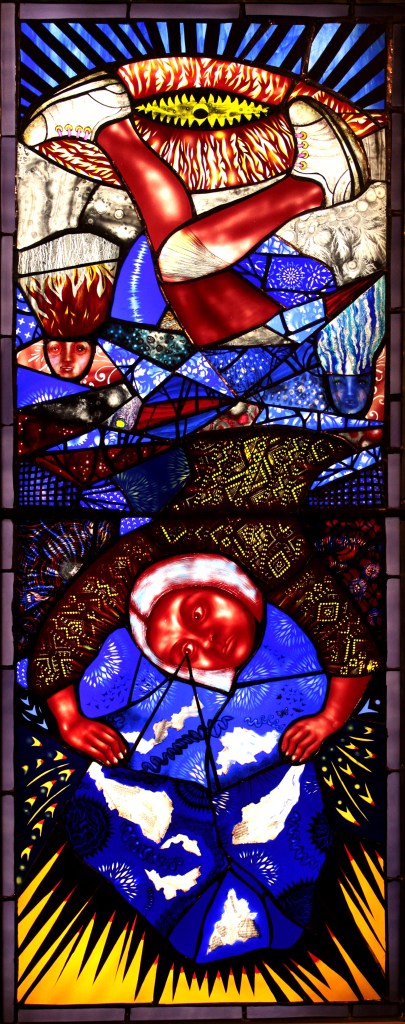
Pinkie Maclure Two Witches (Knowledge is Power) 2021, 62cm x 100cm, stained glass.
Photograph courtesy of the artist.

The idea of Future Daysies could also apply to Maclure’s Two Witches (Knowledge is Power) 2021, an unexpected vision of adolescence on the cusp of womanhood, coming into power and divining true agency. I say unexpected, because images of feminine youth, possessed of knowledge and potentiality are so rare. The words ‘knowledge is power’ written ‘in seven of the world’s most used languages’ wraps itself around the globe. Patriarchal societies excluding women are deposed by Maclure’s ‘winking owl’, ‘defecating on a freemasonry emblem’. Knowledge of the natural world is exalted in the torch attracting moths and self-determination in relation to one’s own body is celebrated in the flagpole flying a condom. It’s a powerful declaration of potential, and beauty in potential, that shines brightly in the darkest of spaces. Popular culture and oppressive regimes do not allow such expression of feminine strength and Maclure smashes the ceiling with her mighty, fragile art- it’s a wonderful thing to witness. Seeing visitors to the exhibition studying the intricate details, debate meanings and make connections with their own experiences was also a joy. This is what art is meant to do.

Completed ‘at the heights of the pandemic’ Maclure’s Totally Wired (Self Portrait with Insomnia Posy) 2020 reads as an awakening, not just from physical sleep or through a nightmare, but in the linear fracture of stained glass that rests on the artist’s forehead like a third eye. Intense blue and frenzied black drawn marks halo the portrait, with ‘the waving hands of friends on Zoom’ scattered above, ‘imprinted’ in the artist’s mind like a constellation of stars. It’s a response to horror and tragedy that reconstructs humanity, in the care and crafting of stained-glass. The split line pupils give a sense of altered perception and profound unease, contrasted with the warm toned, floral, lace textured blanket which the artist clutches to her chest. Held there too, is the comfort of Nature, a posy of herbs which in that moment is subdued by a man-made global crisis. The contradictory nature of Maclure’s art is true to life, in the profound need for confrontation and comfort. When I say comfort, I’m not talking about cosy distraction or denial, but the enduring, transformative action of hope, which lives first in the imagination.

Pinkie Maclure X-Ray Eye 2023, stained glass.
Photograph courtesy of the artist

Although X-Ray Eye (2023) addresses a post truth world, the ‘twisting of words and fragmentation of social interaction’, it also recalls a strong cultural tradition of truth, in folk music and in the work of artists such as William Blake. Stephen Ellcock and Matt Osman’s book England on Fire, which features Maclure’s Green Man Searches for Wilderness (2020) taps into a seam of ancient knowing and divinity of imagination. In X-Ray Eye, Maclure’s female figure plunges head first, downward, like Blake’s The Simoniac Pope in the inferno. Though injured, she is far from helpless, flanked by opposing forces, fire and water, divided by argument, her hands pull words and assumptions apart, the fractured lead lines converging on her eye. The dominant colour within this space of exploration is the divine, sacred blue of medieval glass. Her sneakered feet straddle a portal of instinctual knowing at the apex of the composition. The body is fragmented, in a fallen position of discomfort, but there is also a will to understand that we feel will bring clarity, even in a climate of screaming opposition.

Walking away from the exhibition down Sauchiehall Street I saw a black and white poster with a lighthouse on it ‘The seas are rising and so are we’, a slogan adopted by climate activists. I had to smile, as the red, life affirming thread throughout Maclure’s extraordinary exhibition altered my perception of the world outside. ‘Somehow we mend, Somehow we mend in the end.’

Pinkie Maclure’s Lost Congregation continues at the Centre for Contemporary Arts, Glasgow until 9 September 2023. https://www.cca-glasgow.com/programme/lost-congregation

Beauty and Rage – Pinkie Maclure’s ‘Brigid in Dualchas’

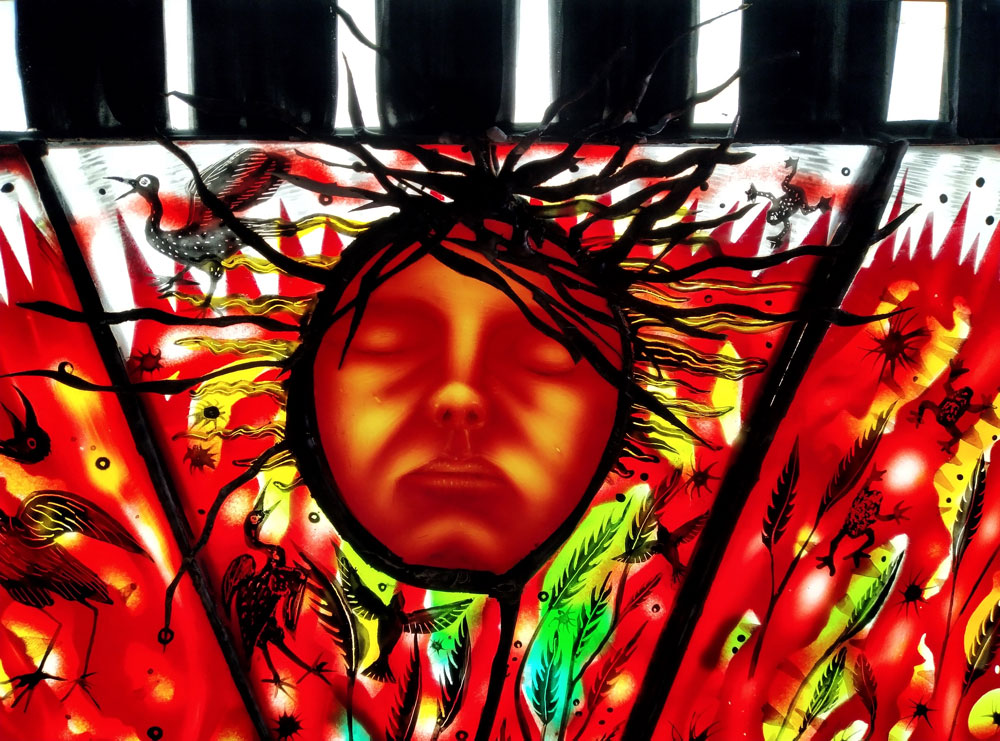
Pinkie Maclure ‘Brigid in Dualchas’ (2022, stained glass and lightbox, 65cm x 62cm)
Photograph by Tony Davidson, Kilmorack Gallery.

Radically transforming the art of stained glass, Pinkie Maclure’s latest work brings feminine power and the climate crisis brilliantly into focus.

Pinkie Maclure’s Brigid in Dualchas feels like a songline, tapping deep into the earth and our collective unconscious through storytelling. It is an image of origin, crisis and ultimately, hope. Illuminated in glass, a medium as fragile as humanity, Maclure’s Brigid takes full possession of beauty and rage. Rendered with consummate skill, this goddess of pre-Christian Ireland becomes conduit and cure, a contemporary icon of emboldening solidarity and potential change. All Maclure’s work presents the viewer with a knife edge of burgeoning consciousness and action, here contrasting ‘the old traditions and worship of nature with our contemporary abuse of nature and the resulting climate crisis.’

Brigid (Brighde or Bride in Scotland) is a deity of keening and healing, a protector of nature and an apt patron saint for the Anthropocene era we are living in. In a global context circa 2022, her luminous presence is a confrontation.  Reappraisal of feminine power, not as ‘other’ but as an intrinsic aspect of all life and creation, has never been more urgent and cuts through all cultures and gender identification. Maclure’s Brigid is a sacred flaming red flag to reconnect with ancient, indigenous knowledge, not just to survive, but to reclaim life on this planet in all its eternal mystery and wonder.

The idea of ‘Dualchas’ in the Gaelic tradition, which ‘refers to the intimate bonds that exist between the natural world, the land and its people, transmitted through generations’ is communicated in the female figure placed centre stage, described by the artist as the goddess ‘in her element.’

Pinkie Maclure Detail- ‘Brigid in Dualchas’ (2022, stained glass and lightbox)
Photograph by Tony Davidson, Kilmorack Gallery

Maclure’s composition is alive with free association. Colour radiates through layered glass in a strong, opposing palette of bloody red and divine blue, evocative of earthly and spiritual planes. Brigid is engulfed in red, a colour which drenches her arms and hands ‘Carrie’ style, while her softly glowing face, eyes closed, is pure repose. There’s great ambiguity here, between a defiant, enduring lifeforce and potential carnage being unleashed. Microbes on finely etched tree branches are underpinned by a vestige of pattern, akin to Medieval stained glass, shining beneath. The smallest details are held aloft by all that has come before, layer upon layer of concept, craft and understanding. In Maclure’s own words;

‘I sandblast, paint, fire, engrave and layer glass and relish the inherent chaos of such an unpredictable medium. The slowness of the process lets me access subconscious, dreamlike imagery and tell stories linking real-life, contemporary experiences with historical texts, characters, and events.’

Pinkie Maclure Detail- Brigid in Dualchas’ (2022, stained glass and lightbox)
Photograph by Tony Davidson, Kilmorack Gallery

Pinkie Maclure’s art is a masterful union of ideas and technique which encompasses the entire spectrum of art practice. Like the figure of Brigid in Dualchas, the artist’s upward diagonal path of pure neon lightening may be framed in linear black and white geometry, but this in no way contains her. Brigid moves beyond the upper frame of the composition, pulsing with colour and energy. This petal like radiation of lead line, form and colour bring order and meaning out of chaos. It is pure Zeitgeist, but it is more than that.

The goddess is resolutely complex and complete, divine and human, seen in a Christ-like pose. Associations with the crucifixion, of suffering, sorrow and resurrection, not of God’s only son, but of the world are invoked. Saint Brigid’s feast day, 1st February, heralds spring or Imbolc, celebrating new life out of dark winter stasis. Maclure celebrates life giving creativity as an essential drive, in nature and us, linked with eternal cycles of life and death. Brigid’s clenched hands hold twigs like anode and cathode charges, grasping the mettle of all creation with open arms, much like the artist herself. Brigid in Dualchas is an image of feminine creative power beyond childbirth, in possession of self and body.

Pinkie Maclure Detail- ‘Brigid in Dualchas’ (2022 stained glass and lightbox)
Photograph by Tony Davidson, Kilmorack Gallery

The stained-glass composition hinges on a ‘v’ of pubic hair, like the stem of a winged seed, the centre of a flower or a veined petal. It is an unexpected, radical bloom, presenting the female body in an uncompromising, completely organic way, ironically unseen for centuries. Maclure describes the red scratch marks on Brigid’s legs as ‘reminiscent of the graffiti you sometimes see carved into trunks of trees, reflecting the brutalisation of nature and women. Her legs are like the trunk of a tree, still standing despite decades of abuse.’ Significantly, the artist does not define the female figure with these marks. Maclure renders Brigid’s toes delicately mortal pink, her legs glowing pale green, not a deathly pallor, but one of burgeoning life and awakening. Leaves of green and yellow diffuse from her body and birds are silhouetted around a nest of blackened hair. There is nothing idealised here, jagged edges are part of the pattern and flow, held in radiant light. The fiery ignition of thought and instinct are all consuming, in making and seeing.

Maclure radically reinterprets the story of Brigid, ‘associated with perpetual, sacred flames, surrounded by a hedge which no man could cross. Men who attempted to cross were said to have been cursed to go insane, die or be crippled.’ The artist extends this idea to the current climate crisis, acknowledging the truth in the legend, of entire ecosystems. ‘Hedges are very important habitats for wildlife and for the prevention of wildfires,’ which have engulfed the planet. The element of fire, like the goddess herself is ambiguous and multifaceted, triple faced in her most ancient form.

The expression on Brigid’s face, a deeply meditative, active subconscious, calls upon us to collectively awaken and remember through ancient stories. The cathedrals of old encouraged the viewer to look up and be elevated, and in her own inimitable way, Maclure encourages us to do the same, reaching down through the foundations of belief to the site of origin, buried deep beneath the church. This is a different kind of power to that which currently blights our world, one that leads creatively towards hope.

Pinkie Maclure artist’s website: https://www.pinkiemaclure.net/

Pushing Paper: contemporary drawing from 1970 to now

A British Museum touring exhibition

2 April – 4 June 2022

The Pier Arts Centre, Stromness, Orkney

Detail-Nja Mahdaoui The Memory Triptych (2009 Indian ink, acrylic and gold on parchment) © The Trustees of the British Museum

The British Museum’s touring exhibition Pushing Paper: contemporary drawing from 1970 to now celebrates drawing as ‘a fully independent medium’ and reveals what a vital means of expression, innovation and renewal it can be. How we process ideas as human beings, what we know about ourselves, the world and our ability to reimagine it, is richly evidenced in this show. Pushing Paper is an exhibition of possibility and cross-pollination, which feels particularly timely, given that freedom of expression is increasingly under attack globally. Drawing is one of the oldest and most immediate forms of human expression with a deep, shared ancestry. It can be an artery of conscious and unconscious thought, a way of bearing witness and altering perception. Drawing reveals that there are many ways to be and see the world, and that the human mark matters, whether it is drawn, scratched, sculpted or walked. Even at its darkest, drawing is abundantly hopeful in what it enables us to see. Expanding the idea of drawing in its own right and making it more visible is arguably even more requisite in a post-truth digital age. Supported by the Bridget Riley Foundation (BRAF) this three-year project, co-curated with partner museums throughout the UK, is a fantastic opportunity to see contemporary drawing in its infinite variety. 

Drawn from the British Museum’s graphic collection of over 50, 000 drawings and 2 million prints, the collaborative approach to curation, in partnership with the Oriental Museum, Durham, the Pier Arts Centre, Stromness, the Glynn Vivian Art Gallery, Swansea and the Cooper Gallery, Barnsley, has produced a fascinating and deeply moving show. Presented in five thematic sections: power and protest, systems and process, place and space, identity and time and memory, the exhibition features 56 diverse works by artists such as David Hockney, Philip Guston, Rachel Whiteread, Cornelia Parker, Tacita Dean, Anselm Kiefer, Sol Le Witt, Anish Kapoor, Tracey Emin, Grayson Perry, Peter Doig, Roger Ackling, Liliane Lijn, Minjung Kim, Susan Schwalb, Nja Mahdaoui, Hajra Waheed, Marcia Kure, Hamid Sulaiman and Rachel Duckhouse.

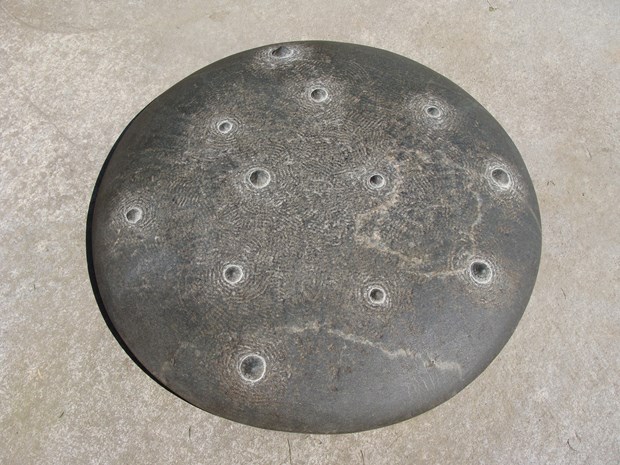
Detail -Susan Schwalb Untitled, 1980, (metalpoint with graphite and burn marks on prepared paper) © The Trustees of the British Museum

Susan Schwalb’s Untitled, 1980, (metalpoint with graphite and burn marks on prepared paper) creates an astonishing sense of drawing as a living, organic force. Rooted in the Renaissance tradition of silverpoint, practised by Albrecht Dürer, Leonardo da Vinci and Raphael, there is a flourishing, dynamic sense of becoming in Schwalb’s series of four images. The feathery, smoked and scratched marks are powerful and delicate, melding process and idea to such a degree that they become a point of ignition in the viewer’s imagination. There is an uncanny sense of movement, flickering into light and illumination, that really captures the human drive to make art. The hand-made mark often demands that we pause, question and engage our senses fully in what we are looking at, in a way that the scrolling images saturating our daily digital lives do not.  Schwalb’s work is such an invitation for active reflection.  Her four drawings suggest parts of a flower and therefore the propensity for growth, coupled with the fiery inference of potential destruction. The fascination found in a naked flame is invoked here as mark and line, fan and flume, expand the idea of Renaissance metalpoint as precision rendering. Schwalb presents a Renaissance of drawing in fluidity and abstraction. There are so many lines of potential enquiry emanating from Schwalb’s quartet, revealing what a hopeful, essential act drawing can be. The spirit of exploration and ancestry of the artist’s chosen medium evolves before your eyes, and it is a joy to see.

Liliane Lijn Hanging Gardens of Rock City 1970 (Collage of magazine cuttings touched with green crayon, on a support of a greyish photograph of the New York skyline) © The Trustees of the British Museum

Liliane Lijn’s Hanging Gardens of Rock City 1970 (Collage of magazine cuttings touched with green crayon, on a support of a greyish photograph of the New York skyline) presents a ‘utopian idyll’ of ‘green walkways suspended across the rooftops of Manhattan.’ Collage is an intuitive way of drawing that pivots between the act of cutting and sowing creative seeds of regeneration. Reconstruction of found images in this context takes New York Skyscrapers, temples of capitalism, and reappropriates them as accessible, linked green spaces. In Lijn’s hanging gardens, there’s no apocalyptic Babylon, but ancient wonder in imagination. Through a 2022 lens, Lijn’s Hanging Gardens of Rock City is a vision of what is needed today, platforms to reimagine and subvert dominant systems of power. Lijn also captures the spirit of awe and optimism in iconic New York architecture, ancient adornment repurposed for the New World, not as the domain of corporations and billionaires, but possessed of a different kind of inheritance and intention. The same year Lijn’s created her Floating Gardens of Rock City series of collages, the first Earth Day was held, a rallying point for US environmentalism and activism. Lijn’s Hanging Gardens bring an element of playfulness and ‘what if’? to this ongoing debate, gently suggesting an alternative trajectory in fantasy architecture. It is now widely acknowledged that capitalism/ consumerism has brought our planet to the brink of collapse, in the context of the Anthropocene period we are living through, Lijn’s Hanging Gardens optimistically heralds what still might be possible.

Minjung Kim (b. 1962), Mountain, 2009, ink on hanji paper © The Trustees of the British Museum Reproduced by permission of the artist

Minjung Kim’s Mountain (2009 ink on hanji paper) possesses a powerful rhythm of tonal ascension in wave upon wave of inky tidelines. Kim’s wet on wet technique is masterful in its acute understanding of material through touch. The way water absorbs, and ink reacts is part of the grounded nature of this drawing and the ethereal nature of this landscape. The singular ‘Mountain’ is made up of many successive peaks which gradually evaporate from dark to light. There is a strong lineage of traditional knowledge in this work, dating from the 1st Century BCE, in the ground of Korean Hanji paper, made from the Mulberry tree and in the artist’s reverence for the natural world. There is also the ‘Mountain’ in the mind of the viewer as an imaginative space in play.  It was interesting to see how this work was such a natural draw for people entering the ‘place and space’ themed room and how much time was spent in contemplation of the drawing. Something emanates from these magnificent waves of water, ink and paper which feels like a collective well of burgeoning consciousness. There is a sense of connectivity when looking at this work, of being part of something greater than ourselves. Kim’s drawing captures something essential about our relationship with nature, bringing the root of Eastern spirituality, Western Romanticism and wider belief in divine nature together. The energy in this work is timelessly circular and direct, something sensed and felt through the hand of the artist, the work on paper and in the heart/ mind of the viewer.

Before you read the adjacent label, Cornelia Parker’s arresting Rorschach- style blot Poison Drawing (1997, Rattlesnake venom and ink) floats darkly on the page in free association. The unsettling mirror brown stain could be dried blood clotted thoughts,unlocked from the viewer’s own psyche. Initially the singular drawing is a trigger and feels like a test of projected meaning, in the manner of the original Rorschach test, used to examine the psychological and emotional characteristics of an individual. In a linked pair of drawings, Parker’s obsession with opposites is crystallised in material venom and its antidote. It’s an interesting moral proposition that walking into the gallery, it’s the visual stain of ink and venom in Poison Drawing that first draws the eye, while the white ink and Diamond Back snake anti-venom in its twin, Antidote Drawing 1997, appears invisible. Human behaviour (and creativity) has a double face, the potential for toxicity and cure. The ambiguity of Parker’s work is part of its charm, there’s always intellect behind it. Equally the element of artistic control consistently shifts- the blot will do what it wants to do, making unexpected marks on the folded paper. The inherent danger or life-giving properties hinge on what you’re told each drawing is made of, its material truth. Here drawing meets conceptual art, like ouroboros, the serpent eating its own tail. In Parker’s own words ‘the work, as drawing, comes from the materials’ and that raw materiality, combined with concept and belief makes for endless connections and imaginings.

Adel Daoud Charbon de Chair (2014, Charcoal on cardboard) © The Trustees of the British Museum

One of the most powerful works in the exhibition, one that stopped me in my tracks and that I keep returning to, is Adel Daoud’s Charbon de Chair (2014, Charcoal on cardboard). It is a summation of the civil war in Syria, a conflict that has claimed over 500,000 lives since 2011 and of incalculable loss, but there is also a powerful feeling of resistance in this work, a visceral frenzy of marks that insists we do not forget. Despite human erasure, a process of collective amnesia mirrored in the drawing, the artist in exile and the object remain living witnesses. Like Goya’s Disasters of War or Otto Dix’s Der Krieg series of prints, there is horrific trauma and life affirming strength in every line. Daoud’s drawing and its title ‘human charcoal’ is a pure expression of human annihilation and destruction, lived experience that perhaps only drawing could give voice to. With the Syrian war still raging and current obliteration of human remains by the Russian army in Ukraine to conceal war crimes, Charbon d Chair translates to sites of war and genocide around the globe. The danger of forgetting begets compounded horror in repetition. I was reminded when looking at this work of the words of Auschwitz survivor Elie Wiesel; ‘To forget the dead would be akin to killing them a second time.’ The need for art to bear witness and act as a trigger for memory, not just in the artist’s own time but for all time, has never been greater. It is all too easy to change channels, keep scrolling, press delete or spread denial to millions on social media. Being in the intimate presence of a drawing, an immediately tactile object with its own history, that may be very different from our own, demands that we make sense of the human marks we see before us and grapple with where we stand. A great drawing makes its mark on the mind, soul and heart of the viewer and is never forgotten. The value of such work is incalculable, and I am glad that as part of this touring show, Adel Daoud’s Charbon de Chair will be seen by many more people throughout the country.

Pushing Paper – British Museum collection at Glynn Vivian, Swansea 24th September 2020. Foreground-Nja Mahdaoui The Memory Triptych (2009 Indian ink, acrylic and gold on parchment). Photograph courtesy of the British Museum.

Nja Mahdaoui’s The Memory Triptych (2009 Indian ink, acrylic and gold on parchment) is a brilliant evocation of human memory, how it shifts and evolves, realised in a fusion of drawing and sculpture. There are forms within forms in this drawing, from the tall clear glass vases containing three rhythmically charged parchments, to elements of Arabic calligraphy hidden by partially burnt, curvaceously twisting forms. The letterforms resist semantic reading, yet language, culture and identity are resounding present, not in being pinned down as absolutes, but in enabling growth and freedom of expression. The capture of this billowing movement of memory feels miraculous and precious, with gold overwritten on parchment. There is something very beautiful in what is hidden and revealed simultaneously in this work, about the way that we edit, revise and revel in memory as humans. The delicacy and refinement of Arabic calligraphy is rendered elusive, poetic and tangibly real in this multidimensional work. I would love to see works like Mahdaoui’s Memory Triptych displayed permanently within the British Muesum and partner museums, as an unexpected trigger for reflection on the evolving memory of other works in their collections.

The importance of touring collections, outside London to the rest of the UK and internationally, should not be underestimated. I was delighted to find, in the world class venue of The Pier, an exhibition who’s sensitive and thought-provoking curation made me feel connected to the world once again. Rather than being relentlessly overwhelmed by global events, the sensitive and thought-provoking curation encouraged connective reflection. Many of the chosen works restored my faith that we can in fact, out create destruction.  The marks we make remain crucial. As the amazing diversity and integrity of practice exhibited in Pushing Paper testifies, Drawing stands resoundingly as both noun and verb.

https://www.pierartscentre.com/current-upcoming-exhibition/pushing-paper-contemporary-drawing-from-1970

Christian Marclay : The Clock

Tate Modern 14 September 2018 – 20 January 2019

Installation View.Tate Modern. Christian Marclay, The Clock 2010. Single-channel video installation, duration 24 hours. Tate Photography (Matt Greenwood).

Being eclipsed, suspended and enslaved by time is our real-time immersion in modern life, moving inevitably towards eternal midnight.Christian Marclay takes what it is to be human and winds it into the mechanism of TheClock so seamlessly, with such artistry and grace, that words like ‘genius’and ‘masterpiece’ are entirely justified. After experiencing three-and-a-half-hoursof this work, I was profoundly moved, elated and frustrated that watching the full 24hrs wasn’t an option during my visit. There aren’t many works of “NOW” I’d want to spend that kind of time with, but The Clock is something else. It’s a work of art you enter into and become part of, rather than passively watch. Marclay has managed to create a work as addictive as the multidimensional concept of time and existence it encapsulates, an unrelenting and strangely beautiful meditation on time running out for us all. Despite its modern materials and contemporary masterwork status, Marclay’s Clock transcends the time it was made. It speaks of universal human experience through sound and image in a compelling, urgent way. I place ‘sound’ first, because Marclay’s craft and foundation as an artist is making objects from audio. The Clock is a highly distilled example drawn from a lifetime’s exploration, which is the real source of its genius.Fortunately for the UK, one of six limited edition copies of The Clock has now entered the Tate collection, jointly purchased with the Centre Pompidou, Paris and the Israel Museum, Jerusalem.

Originally commissioned by The White Cube, London, where it debuted in 2010, The Clock is an incredible artistic achievement in its union of concept and craft. A montage composed of over 12,000 clips, spanning 100 years of film and television,screened over 24 hours in real time may sound like a work tailor-made for film geeks. (And I won’t lie, part of my irrepressible joy in this work stems from that.) However, the way that Marclay handles this material brings wider frames of reference and association brilliantly into play. Although it is an epic work of art, film and human history, The Clock is also a very intimate experience, where your own projections/ narratives meet those of the maker(s). I heard quite a few people on exit reminiscing with friends and family, delighted, thoughtful and wondering in awe about how it was made. Marclay was aided by six assistants in finding and sorting suitable material over three years. However, the vast amount of footage needed to construct The Clock isn’t as impressive as the skill required to create cohesion and expanded meaning in the final 24 hr edit. The most powerful sense of identification inside this work isn’t ultimately based on how many film-clips you recognise, entwined with your own viewing/ life history, but with the collective human orientation towards understanding. Wonder and curiosity are as much a part of the projection as the threat of advancing time and fear of death. In human terms The Clock is an admission and a creative act of defiance, a monument to human perception and memory that makes us who and what we are.

Continue reading

Revisionism and the Art of Decay

“Poetry fettered fetters the human race. Nations are destroyed or flourish in proportion as their poetry, painting and music are destroyed or flourish” William Blake

Detail J.M. Waterhouse Hylas and the Nymphs (1896) Manchester Art Gallery.

In July I attended the opening of the Emil Nolde- Colour is Life exhibition at the Scottish National Gallery of Modern Art, the subject of a previous post. It’s an exhibition that has remained in my mind ever since, for the issues it raised as much as the art. When the show first opened in Dublin, The Independent ran with the headline; “Can you enjoy great art created by a Nazi? New Emile Nolde exhibition explores this dilemma.” William Cook’s article suggested that; “the big question for our times is whether you can condemn someone’s sexual conduct, and still enjoy their art. In the case of painter Emil Nolde, can we delight in his work even though he was an enthusiastic supporter of Adolf Hitler?” This question has been compounded by reports of wider historical revisionism in the press throughout 2018. Some based on well-meaning curatorial or civic actions, all begging further investigation.

The renaming of a 1929 Emily Carr painting by the Art Gallery of Ontario, the removal of a 19th Century nude painting by J.M. Waterhouse at the Manchester Art Gallery, the recent controversy of boycotted music by Richard Wagner aired on Israeli radio and the removal of an “Early Days” racist colonial statue in San Francisco are all potent examples, worthy of their own article.  Each one is an act of historical revisionism that raises essential questions about who owns culture. Who has the right to alter or remove historical documents, artefacts or art objects from public view and under what circumstances, if at all? In my profession all art is political, whether consciously nailing its colours to the mast or not. The expression of ideas can certainly be dangerous, depending on the ideological intent of the maker and the lens of hindsight / historical context we use to examine it. However, reading a book, seeing a play, film, art exhibition or listening to music doesn’t mean you agree with the content or the opinions of the artist(s) who created it. You have free will (as long as you live in a place that hasn’t banned the means of expression) to make up your own mind. At what point did we need to be protected from that process and for whose benefit?

Continue reading

Rembrandt- Britain’s Discovery of the Master

Rembrandt van Rijn (1606-69)
A Woman in Bed, about 1645 – 1646
Oil on canvas, 81.1 x 67.8 cm
Collection: National Galleries of Scotland, presented by William McEwan 1892
Photo: Antonia Reeve

7 July – 14 October

Scottish National Gallery

“Britain’s love affair with one of history’s greatest artists” is the celebratory focus of the Scottish National Gallery’s latest summer blockbuster. Rembrandt: Britain’s Discovery of the Master features 140 works: oil paintings, drawings and etchings by Rembrandt Van Rijin, works from his workshop and those by British artists he inspired from the 18th Century to the present day. Seeing Rembrandt’s impact on the art of William Hogarth, Joshua Reynolds, Henry Raeburn, David Wilkie, Thomas Duncan, Augustus John, James Abbot McNeill Whistler, Jacob Epstein, Leon Kossoff, William Strang, Henryk Gotlib, Eduardo Paolozzi, Frank Auerbach, John Bellany, Ken Currie and Glen Brown is one of the fascinations of the show. It is also an exhibition about historical acquisition and how an artist’s legacy is enabled. Works on loan from the National Gallery, British Museum, Dulwich Picture Gallery and the Tate, London, the National Gallery of Ireland, The Hunterian, University of Glasgow, Kelvingrove Museum and Art Gallery, Glasgow, Rijksmuseum, Amsterdam, Museum of Fine Arts, Boston, USA, and the National Gallery of Art, Washington D.C bring together familiar images, new discoveries and reflections on why Rembrandt is so revered.

Outside the Netherlands, the UK holds the largest collection of Rembrandt works, a trend that began during the reign of Charles I and reached fever pitch in the 18th Century, when prints, drawings and paintings were highly sought after by private collectors. Cataloguing the artist’s work also began at this time, an indicator of Rembrandt as currency and a practical response to market driven climate of forgers and respectful copyists. The desirability of Rembrandt’s work among collectors in the British Isles has resulted in much wider awareness of his work and most importantly, the opportunity to experience it live, having found its way into public collections. Coming eyeball to eyeball with a Rembrandt seems to level all arguments about what good or bad art is. At base he shows us what art is, what it is for and why it matters.

Continue reading

NOW

JENNYSAVILLE, SARA BARKER,CHRISTINE BORLAND, ROBIN RHODE, MARKUS SCHINWALD and CATHERINE STREET. 

JENNY SAVILLE
Rosetta II, 2005 – 2006
Oil on watercolour paper, mounted on board, 252 x 187.5cm
Private collection © Jenny Saville
Courtesy of the artist and Gagosian

March until 16 September 2018
Scottish National Gallery of Modern Art (Modern One), Edinburgh.

It’s hard to believe that the latest instalment of NOW, part of the Scottish National Gallery of Modern Art’s contemporary art programme, is the first major showing of Jenny Saville’s work in Scotland and only her third exhibition in a UK museum. It seems that for many of our finest artists, international acclaim is a pre-requisite for national acknowledgement. The Scottish National Gallery’s newly acquired Study for Branded (1992, Oil on paper, 100.3 x 74.4 cm) is amazingly the only example of Saville’s work currently in a UK public collection, made possible by the Henry and Sula Walton Fund.  Whilst the curatorial aim of the three year NOW exhibition programme is very much about placing contemporary Scottish Art in an international context, it also illuminates the national context of how we regard art and artists in the 21st century.

The purchase of multiple works from Saville’s Glasgow School of Art graduating show by collector Charles Saatchi, her participation in the Saatchi Gallery’s Young British Artists III exhibition (1994) and the Royal Academy’s exhibition Sensation: Young British Artists (1997), effectively launched Saville’s career in terms currency on the international art market. However, that’s not what gives her work its immense power, universality, or ultimate value. As five rooms of her work spanning 26 years powerfully testify, she achieves that integrity entirely on her own terms. The scale of this artist’s emotional intelligence, discipline and command of painting is truly extraordinary, crossing multiple boundaries in how we perceive the female body, art and humanity.

In the history of Western Art and the Scottish figurative tradition Saville’s work radically transforms perception of the female nude with its unflinching honesty. Presenting completely “un-idealised”, “uncompromising” images of the human body, Saville confronts us with the timeless and sometimes overwhelming truth of human vulnerability. It’s a truth which ideal Beauty has cloaked for centuries, then effectively obliterated in popular culture of the 21st Century. At base we are all flesh, magnified in Saville’s adept handling of oils, pastel and charcoal, with all the discomfort and fragility which attends mortality.

Continue reading

AGES OF WONDER

SCOTLAND’S ART 1540 TO NOW

Collected by the Royal Scottish Academy

4 November – 7 January 2018, Royal Scottish Academy, Edinburgh.

Mary Bourne RSA (b 1946) Dava Targe, Kilmartin Slate, 1994., RSA Diploma Collection Deposit, 2009.

“Only when we recognise that we are heirs can we truly be pioneers” Martyn Bennett, Musician and Composer (1971-2005)

The visual language of Neoclassical columns, white marble, gilt and pediments adorned with statues usually infers learned authority, or the political need to project it. Architectural revivals of Golden Ages past are always about the power of knowledge and how it is used, for good or ill.  When visitors enter many Western public art spaces a powerful statement is communicated by the built environment and the institutions that occupy them, as arbiters of collective aspiration, education and good taste. On the surface the National Gallery of Scotland and Royal Scottish Academy buildings also display these loaded facades.  The underground link between the two is not immediately visible to the visitor, nor is the history of artist led advocacy that binds them and created a National Collection for Scotland. The 1910 accord which brought the RSA collection under the umbrella of the NGS is echoed in Ages of Wonder, an extensive exhibition occupying all seven upper galleries, sculpture court and four lower galleries in the prominent RSA building. Effectively reclaiming the whole space for Scottish Art past and present makes a powerful statement of its own.

Self Portrait (Oil on canvas, 1844) by Thomas Duncan RSA (1807-1845)

History and tradition are richly in evidence, reflecting centuries of masculine leadership and disciplinary hierarchies, but thankfully there is significantly more on display than the pomp of the Edinburgh Arts establishment. The guts of this show are the practice of Art and the necessity of making the work of Scottish Artists visible. On entering Gallery 7 Portraiture and Presidents for example, paintings of RSA presidents and their projected status are certainly part of the display, but equally so is the human Art of portraiture. It is an immense pleasure to discover works such as James Cowie’s quietly understated portrait of Miss Barbara Graham Cowie (Oil on plywood, 1938, RSA Diploma Collection Deposit, 1946) or the intriguing man behind the presidency in Thomas Duncan’s RSA Self Portrait (Oil on canvas, 1844, Presented to the RSA by fifty Scottish artists, 1845, transferred and presented by the RSA to the NGS, 1910.) Emerging out of a pitch dark umber ground, channelling the introspective spirit of Rembrandt, we see the face of a man who we feel is not entirely without privilege, but also not without care. His prematurely receding hairline, high forehead and deep-set eyes are at one with the space he occupies. With his hand resting pensively below his chin, it’s an intellectual, charismatic vision of the self, dwarfed by the mysterious, ever-expanding depth of the canvas. His mouth contains the vaguest hint of a smile, concentrated in circular tension at either side of a mouth which is simultaneously straight and curvaceous. We feel there’s wit in that feint glimmer of a smile and that he might speak at any moment, having first greeted the viewer and met our gaze (and his mirrored self) with equal regard. The entire portrait suggests, independent of his white cuffs, signature ring and the century inhabited, that there is infinitely more to this man that what is illuminated by the posed three-quarter focus lighting. Being in the presence of this ageless 19th Century gentleman rendered in oils by his own hand, we see that we are not simply in the company of an office bearer, but an artist, demonstrating through his own crafted image that there is infinitely more to see. Like all great portraits Duncan’s conceals and reveals in unexpected ways.

There are many more gems in this show that bring Art practice centre stage and assert the value of making as an imperative. Curated by current Royal Scottish Academy (RSA) President Arthur Watson, RSA Collections Curator Sandy Wood and Honorary Academician Tom Normand, Ages of Wonder is a collaborative project of unprecedented scale. Arranged thematically by subject and discipline, the exhibition is also defined by live events, touring elements, a collecting symposium, an exhibition catalogue and book of essays. Created in partnership with the Royal Scottish Academy (RSA), National Galleries of Scotland (NGS), Universities of St Andrews, Edinburgh and Dundee, it’s an exhibition brimming with possibilities in terms of how we might perceive and celebrate Scottish Art differently. At the heart of the show is the question of how our national collections are valued, conserved, expanded, utilised and shared, locally, nationally and internationally. The question of how we value artists as a society and the nature of what we choose to build also underpin that potential.

Thomas Hamilton RSA (1754-1858) Design for the Royal High School , (Watercolour, gouache and pencil on paper, about 1825-30, RSA Diploma Collection Deposit, 1831)

The “two temples of Art” on The Mound were both designed by William Henry Playfair RSA (1789-1857) at a time when the city was reimagining itself. Between ancient “Civilization” and the progressively Modern, it’s an architectural vision of the “Athens of the North” with Edinburgh at the centre of European Enlightenment. Playfair’s contemporary, Thomas Hamilton RSA (1754-1858) also reflects this idea in his Greek Revival design for The Royal High School, Edinburgh, (Watercolour, gouache and pencil on paper, about 1825-30, RSA Diploma Collection Deposit, 1831). Hamilton’s delicate watercolour imagines a seat of learning, defined by Neoclassical sureties and a warm Mediterranean palette of forward thinking optimism. This vision of the city has its roots in the glories and mythologies of an ancient past. Taking Gallery 6 of Ages of Wonder as an example; Architecture: Hamilton, Playfair and the Making of Edinburgh certainly makes an aspirational statement about how we reimagine our collective selves within a built environment. Although firmly anchored to where the viewer stands, among the drawings, paintings, models, photographs and other archival material on display there is also a less site specific, universal and transcendent creative drive at work. In the same gallery, William H Kinnloch’s 1978 design for a house at 46 Dick Place is a fine example of a very beautifully drafted, fluidly executed watercolour, unlikely to be part of an architect’s working process today. There’s essential tension between practical, ideological and institutional elements of the show which are ripe for debate. My hope is that rather than alignment with the colonnade, the creative core of the show will be a catalyst for future collaborative events and new ways of seeing Scottish Art. There is a golden opportunity, particularly within the live elements of the exhibition, to redefine the relevance of cultural institutions, their function and the value of Art practice in the 21st Century.

Beth L Fisher RSA Burial II (Conte and charcoal on paper, 2006. RSA Diploma Collection Deposit. 2006).

Ironically the traditional techniques, training and sensitivity found in The Life School: Drawing, Anatomy and the Figure in Gallery 1, are principles that popular culture and art colleges throughout the country have largely abandoned. In this wonderous, “connected” age of technology, you would be hard pressed to find a more moving, empathic expression of grief than the rendering of human figures in Beth L Fisher’s RSA Burial II (Conte and charcoal on paper, 2006. RSA Diploma Collection Deposit. 2006). On the opposite wall Samuel John Peploe’s RSA Female Nude with Pitcher (Oil on canvas, 1895, RSA Life School Award Deposit 1895) is an equally illuminating realisation of the Feminine. Standing in the Life School Gallery seeing works like these, the Laing Bequest of Old Master drawings, the spirit of enquiry in Andrea Vesalius’s etched plates and a live Life Class taking place, it is easy to see why what is not being taught is in such increasing high demand. The RSA has always been a teaching institution and this live element is a very promising initiative. Selected students will be working directly from the model, under the guidance of tutors John Byrne, George Donald, Jennifer McRae and Robert Rivers, weekly for the duration of the show. Contemporary innovation, in terms of making and seeing, is dependent on deeper understanding of artistic discipline. Imaginative freedom, individually and collectively, is impossible without it.

Elements like the live Life School and Professor Dame Sue Black’s DBE, FRSE, HRSA lecture on Art and Anatomy give valuable insight into the practice of Art and Science that many visitors (unless they are practitioners themselves) will be unfamiliar with. The focus on Original Print and the Art of Etching in the Finlay Room also features live events with artists Frances Walker, Stuart Duffin, Paul Furneaux, Delia Baille, Marion Smith and Jessica Harrison creating work on “ES Lumsden’s historic star wheel printing press (the first piece of machinery to enter the Academy’s collections)”. Leading into The Art of Etching section, the supreme skill and artistry of John Martin’s (HRSA) apocalyptic mezzotints, with the hand of the artist present from conception to completion is another unexpected highlight. The printmaking and Life School elements of the exhibition will tour in 2018/19, extending the reach of the show beyond the capital. Hopefully this will also stimulate revival of the radical practice, established between 1840 -1932 when academicians, or “visitors”, taught in an RSA operated Life School. Although the idea of “an independent post graduate facility for elite art students” requires examination of the qualifiers, recognising and utilising the knowledge, skills and expertise of professional artists as a national asset is long overdue. Established in 1829, the RSA remains the longest established artist-run society in the country. In terms of political leadership, Art Education, training and investment in creative process it is a vital resource and a foundation of advocacy.

Image of RSA Ages of Wonder Exhibition ,Sculpture Court, The Keith Rand Gift: A Depth of Practice, Photograph courtesy of RSA Press Office.

Viewers may be diverted or overwhelmed by elements such as the 19th Century Academy: A Victorian Eye Salon hanging of works in Gallery 3. Stepping into this space with its sumptuous walls of deep claret and green velvet adjoining couches for cultivated conversation in the centre, there was also the very humorous touch at the press view of 21st Century dandy/ artist/ practitioner John Byrne being interviewed amidst the loaded hierarchy of Masters hung from floor to ceiling.  However, being temporarily dazzled by the sheer weight and density of tradition or artist as celebrity still doesn’t trump the grounded practice and connectivity of Art, driven by our innate curiosity as a species and our profound need to understand. In the Sculpture Court, The Keith Rand Gift: A Depth of Practice displays some of the contents of his studio gifted to the RSA, including drawings, inspirational organic objects, handmade tools, macquettes and full-scale works, giving insight into Rand’s thought process and crafting of objects. Part of this display is a leaf, an object from the natural world that is instantly relatable regardless of the viewer’s education or background. The visitor free associates between these man-made objects and those from the natural world, rather than receiving explanation via a label about a designated Art object. In this way we are brought into direct contact with creative process, the individual artist’s and our own.

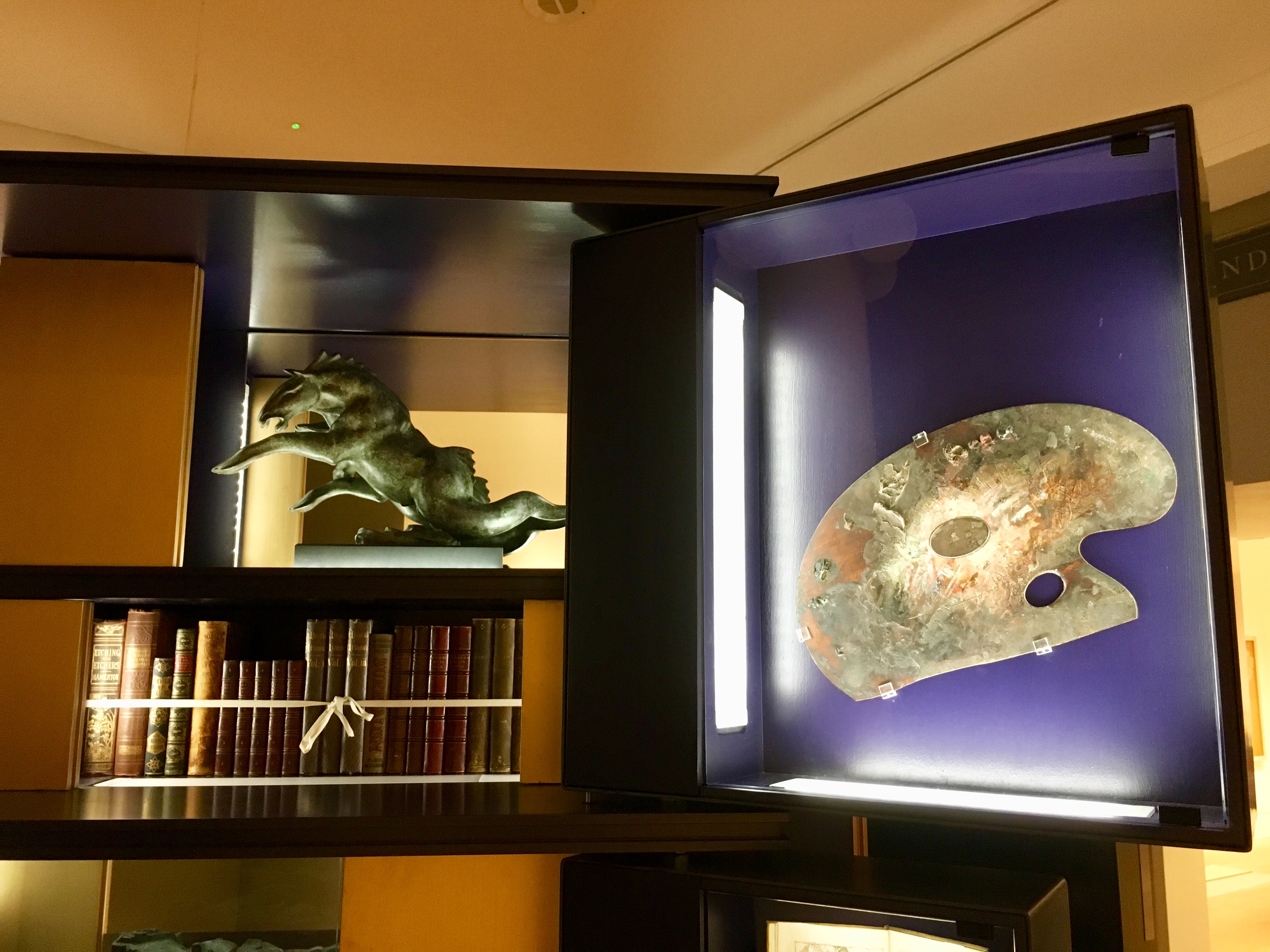
Detail of Richard Murphy’s Wunderkammer – “a new cabinet of curiosities”. Photograph courtesy of RSA Press Office.

Richard Murphy’s Wunderkammer “a new cabinet of curiosities” featuring rare books, sculpture, objects, photographs and digital Turning the Pages software is a brilliant manifestation of this principle of creative connectivity and sense of ownership. The RSA library may seem like a scholarly and remote repository but here a contemporary commission transforms what we think such a collection can be. Beautifully sleek, designed to be viewed from every angle and lit for illumination of each unique piece, the alluring three-dimensional framing invites you to come closer and be curious. Exploring the contents and the imaginative connectivity of objects across time presents a less linear view of collections /collecting and for the viewer there is freedom in that fluidity. Drawing inspiration from architect Sir John Soane’s (HRSA) donation to the RSA library in 1829 and his extraordinary London home (now a museum and itself a cabinet of wonders, well worth visiting) the juxtaposition of objects is a constant source of surprise as you move around the 21st Century cabinet. Jewel-like enamels by Phoebe Anna Traquair, an elemental watercolour on parchment From the Red Cabinet (2001) by Kate Whiteford, Hew Martin Lorimer’s small bronze Our Lady of the Isles (about 1954-1972) and a printed book bound in the publisher’s original paper (1826) of William Blake’s Illustrations for the Book of Job are just some of the treasures within and thankfully out of storage.

Sir James Guthrie PRSA Midsummer (Oil on canvas, 1892) RSA Diploma Collection Deposit 1893,

Other contemporary commissions also lead into historical works on display in surprising ways. Adjacent to Kenny Hunter’s four part bust of Sir James Guthrie PRSA is the artist’s glorious celebration of light in Midsummer (Oil on canvas, 1890) in bold, dappled impasto and a living palette of vivid green and purple. Seated beneath a low canopy of trees, three women are drinking tea, each inhabiting their own world despite the appearance of society. The combination of light and shadow brings unexpected emphasis on the inner world of each sitter, beyond the aesthetic comfort of an Impressionistic style. Hunter picks up Guthrie’s inner palette in the split sections of the portrait bust, suggesting various aspects of personality beyond the public persona.

Frances Walker RSA RSW DLitt. (b1930) Foreshore at Footdee (Oil on board, 1980)

Strangely, Gallery 4 The 21st Century: A Contemporary Academy left me feeling rather cold and dispassionate in comparison to the works of living artists relegated to the 20th Century A Nationwide Gallery (Aberdeen, Dundee, Glasgow, The Highlands and Northern Isles) in Gallery 5. Frances Walker’s Foreshore at Footdee (Oil on board, 1980) is a fine example, a supremely balanced composition of subtle greys, accented with orange, pink and green. It’s a potent statement, 37 years ahead of its time with large boulders, lumps of concrete and smoothed pebbles, punctuated by manmade detritus. The eye is drawn to human interventions and signs of industrialisation, a plastic bottle and white traces of rope or wire. The scale of transformation along the eroding shoreline dwarfs the only visible human figure silhouette in the distance, whilst the high horizon line is populated with industrial buildings. Walker’s work is informed by the tracery of human marks upon the Northern landscape. The sea is rendered as a rhythmic pattern of white lines on mid grey, drawing the viewer into the detail of a place lived and observed. The organic erosion of wind and waves is tempered with industrial paint colours in a complex dynamic of realism. This is the very altered land and seascape of the Highlands, Islands and North East of Scotland, striking in its immediacy and contemporary relevance.

Joyce W Cairns RSA RSW Hon RBA MA(RCA), Polish Journey (Oil on board, about 1998-99, RSA Diploma Collection Deposit, 1999)

Also featured in the same room is a work by Joyce W Cairns RSA RSW Hon RBA MA(RCA), Polish Journey (Oil on board, about 1998-99, RSA Diploma Collection Deposit, 1999), linked to one of the most important bodies of work ever created by any Scottish or UK Artist, War Tourist. Over a decade in the making, this extraordinary body of work was exhibited at the Aberdeen Art Gallery from 10th February to 8th April 2006 and has yet to be shown elsewhere. It is a response to war that began with the artist retracing her Father’s experiences in WWII through Europe and North Africa, leading her to Nazi concentration camps in Germany and Poland and to the contemporary experience of televised warfare seen during the Bosnian War (1992-1995), where ethnic and religious conflicts again resulted in genocide. Her meditations on major international conflicts and experience of wartime on the home front often incorporate everyday objects of remembrance. There is no other artist in the country who paints large scale figurative compositions with such skill, power and compassion. Inspired by German artists such as Dix and Beckmann whilst still a student, equalling their precision and emotional gravitas, her work is richly expressive and dreamlike in its evocation of human memory.

In Polish Journey we see a semi-autobiographical female protagonist wearing an image of the artist’s father around her neck. Her sallow skin appears stained by the knowledge leaching out of yellow cloth printed with the Star of David, used to mark and condemn Jewish victims of Hitler’s “Final Solution”. This bundle of industrially printed cloth is a chilling indicator of scale and over it is a wreath of poppies “In Remembrance”. The psychological stain on the soul in seeing sites of starvation, misery and mass murder is coupled with the solemnity of her expression and a tellingly composite uniform. The stitching of HMS Ark Royal, a modern invincible class navy flagship, grey military coat with black and red trim, German belt bearing a swastika and striped skirt aligned with the material draped like a proscenium arch above the scene, brings together the human fabric of all wars. The oppressors, the oppressed and liberating forces can transform into each other during wartime with astonishing speed and righteous self-justification. There is often a sense of the Feminine protagonist or witness in Cairns’ paintings, taking on this mantle of human shame, atrocity and bravery, enabling successive generations to see and acknowledge what we are and what we are capable of. In Cairns’ work human creation and destruction are equally present. The arrangement of other objects in the composition are an interrogation of commercial and domestic complicity hidden in plain sight. Cairn’s flips the idea of the benign, traditionally feminine still life genre completely on its head by combining it with the traditionally masculine dominance and authority of History Painting. The presence of a Zyklon B Tesch & Stabenov canister, a company who produced pest control chemicals and were implicated as suppliers to Nazi Death camps at the Nuremberg trials, is a powerful reminder of how ordinary people actively participate in persecution and genocide. Around the central figure three dolls are suspended as if hung, one in striped camp uniform is labelled with a number, another with a suitcase resembling a child arriving off a train with her name “Klara Sarah Goldstein” chalked onto her luggage. Broken dolls are part of the trajectory that projects into the viewer’s foreground. We can’t comfortably relegate this image to history or as a distant memorial, because in human terms it is ever present, absorbed into the steely blue and cadmium red palette of conflicted Nature that we are as human beings. Cairn’s deconstructs this with the passionate impetus of Expressionism and the pure compositional order of Abstraction. She is yet another artist, based predominantly in the North of Scotland for much of her career, long overdue for a major national retrospective. In contrast to the exposure afforded her male contemporaries its an oversight that needs to be rectified and perhaps the collaborative nature of this exhibition will enable that to happen. The positioning of some artists in the show, or their absence from the national collection altogether, is worthy cause for further debate. From the display of a single painting to wider acknowledgement, placing the work of our greatest living artists on a global stage is entirely possible. In Cairns’ case, I can think of no better time for an international collaboration exploring her connections with the confrontational Neue Sachlichkeit/ New Objectivity of Weimar Germany and the contemporary relevance of her practice in a “Post Truth” world.

What I took away from this exhibition was excitement in seeing human “curiosity and practice” in action, a positive statement of value in relation to Scottish Art made visible and the possibility of future investment and collaboration. Although there is more work to be done before our National Collections adequately reflect important work by Scottish Artists throughout the country, this exhibition is a significant step forwards in terms of Scottish Visual Culture entering public consciousness. The decision to make the exhibition free, therefore accessible and able to be visited multiple times is exactly as it should be, both for residents and visitors. Perhaps Ages of Wonder will also pave the way for a more balanced permanent display of Scottish Art in the capital and wider circulation of works from the National Collection around the country. People cannot discover, champion, love or be inspired by what is hidden.

www.royalscottishacademy.org

www.nationalgalleries.org

#AgesofWonder