Carolynda Macdonald River of Lost Souls (oil on linen, 113cm x 105cm) Image courtesy of the artist and Kilmorack Gallery
‘I seek to bridge a recognisable world with that of an imaginary or mythological one. I almost always include birds as the main protagonists but have increasingly brought in human characters too. This alchemy of birds and fragments of old master figurative paintings, become vehicles for the subconscious to play and facilitate self-expression.’ Carolynda Macdonald
Working previously as a Biomedical Scientist in Microbiology, Carolynda Macdonald has progressively developed her painting practice since 1982, studying life drawing, printmaking and exhibiting extensively in the UK, USA, and Australia. Now based in Edinburgh, Macdonald’s recent exhibitions, including House of Macdonald with fellow artists Alan and Rory Macdonald, affirm her emergence as a distinctive voice in Contemporary Art. Drawing on traditions of painting in Western Art, the tradition celebrated by Macdonald is freedom of expression, art which is big enough to admit multiple layers of interpretation, making ‘paintings you can fall into.’ ‘Humanity being imprinted onto Nature’ is a strong theme in her latest work, where birds are threshold subjects, guardians of the natural world and human vulnerabilities.
River of Lost Souls (oil on linen, 113cm x 105cm) contains a scene of human betrayal, the cutting of Samson’s hair by Delilah’s accomplice, a removal of his supernatural power depicted by Rubens and reimagined here within the body of a bird. The brown, russet, crimson, and flesh tones glow humanely, emerging from a dark, cool, calm before storm background by the river’s edge. The human body is tucked protectively into the bird’s feathers, a safe space where humanity, emotion, and nature, within and without, can be examined. Poised on one leg, the bird’s gaze meets ours. This recognition, the confrontation of the eye of one species meeting another’s, is deeply arresting. It is a moment of tension that brings thought and feeling bubbling to the surface, in our immediate present and in relation to a shard of visual history. The painting is a threshold space and being held within spaces where land, sky and water meet, have a particular role in Macdonald’s art. She composes images of sanctuary for her protagonists and the viewer, alive with tension and burgeoning consciousness, full of possibility. This feeling of potential, psychologically and in the realm of dreams, is incredibly subtle and potent. In River of Lost Souls, who or what gives us strength, is given new context out with the Old Testament Biblical story and an art historical canon of Old Male Masters.
There are a number of genres and art historical expectations in play here, and Macdonald inadvertently subverts them all, bringing fragments of grand Master subjects into intimate focus, honouring scientific enquiry and ornithological art with feeling, and bringing untold psychological depth to the traditionally demure arena of still life. The field of enquiry is truly expansive, painted with meticulous detail and devotion to craft. It is the joy of painting and not politics that drives Macdonald’s art. We are free to interpret meaning and lose ourselves in narratives of our own making- that’s the gift and flow within her painting. In the presence of an artistic voice that elevates the mind and spirit, we can confront difficult things and begin to heal. Macdonald describes the music of Jocelyn Pook, Lisa Gerrard and Portuguese Fado singing in such terms, and the same is true of her paintings.
Carolynda Macdonald Beacon of Hope(oil on board, 25cm x 23cm) Image courtesy of the artist and Kilmorack Gallery
Carolynda Macdonald brings her microbiologist’s eye to the pattern of life and creates different spheres of awareness in the process. In Beacon of Hope (oil on board, 25cm x 23cm) we see a feast of finely painted flowers reminiscent of Rachel Ruysch within the body of a tiny wren. Although delicately rendered, the dark bird is alert, determined and poised in readiness on a natural stone, clasping a diamond in its claw. Broken jewellery is strewn at its feet, a microcosm of detail in a mountainous landscape of macrocosmic emotions and association. There is a jewellery box inheritance opened here and an uncanny, fleshly light which plays across the surface of lake and sky in the background. The artist creates an atmosphere of profound stillness, a place of solace, contemplation and in this case, an unsettling suggestion of relationships being tested. Macdonald describes the objects in her paintings being ‘broadly drawn’ rather than autobiographical. ‘Pearls are beautiful things to paint- glowing. They can abstractly solve a painting. What a pearl is, what it means’ also comes into play. ‘Pearls are a living thing, a grain of sand, giving all these things a different life in the work.’ Sometimes the placement of objects emerge unconsciously out of a brushstroke and Macdonald is simply enjoying where the mark takes her. It is an art of instinct and precision, that allows the human condition to be explored in all its nuances, ‘including inner turmoil and vulnerability, love and hidden desires, betrayal, motherhood, and protectiveness.’
Carolynda Macdonald Fortress of Shadows (oil on board, 25 x 23cm) Image courtesy of the artist and Kilmorack Gallery.
The intimate scale of Macdonald’s wren and robin paintings draws you in, often with unexpected twists. In Fortress of Shadows (oil on board, 25 x 23cm) the female form is revealed and protected within the body of the bird, perched on a silver jewellery box. The strawberries in the right foreground link with drapery which the female protagonist draws towards her body to shield it, her hand resting on the wren’s head. They are both vessels of potential narratives. The vulnerability of this reclining nude pose, seen so often in Western Art History as exposure for a male gaze, shifts to a more heightened state of awareness within, as if the threat exists beyond the boundaries of the picture plane, with the painting as refuge. The way Macdonald positions the female body gives it protection and agency -within the painting and the viewer, to begin to explore what this internal scene means to us.
Carolynda MacdonaldThe Scream (oil on board, 25 x 22cm) Image courtesy of the artist.
The Scream (oil on board, 25 x 22cm) is another powerful example, punching far above its scale and subverting the hierarchical dominance of large-scale History Painting. The combination of elements-still life, wren and jewellery, set in what feels like an 18th Century Arcadian landscape is juxtaposed with a fragment of Goya’s resistance painting The Third of May 1808, with civilians dying before a firing squad. Perched on the lid of a jewellery box, the open-mouthed wren omits a sound, amplified by the viewer’s imagination. There is a broken, half submerged ring or tether in the water, an intriguing detail that suggests shackles being broken on multiple levels. The potency of the scream, its volume and resonance is made by association, linked to the viewer’s awareness/experience and the scene of execution. There is beauty, horror and tension in this work achieved with consummate skill. The grand history painting is a fragment on the bird’s body, perhaps suggesting the relativity of human history when staring the current Anthropocene era in the face.
Carolynda Macdonald The Garden of Solace (oil on linen, 134 x 124cm) Image courtesy of the artist.
Our perception of violence in The Garden of Solace (oil on linen, 134 x 124cm) is tempered by how Macdonald leads the eye into the painting. The curves of the brown flamingo’s neck and beak direct us towards a fragment of Eugène Delacroix’s Death of Sardanapalus contained within its body. The extreme violence and chaos of this scene is repositioned so that we can actually be still with it and begin to interpret what is brought to the surface. It is a very powerful thing to give freedom to the imagination, both in the act of painting and enabling the viewer. This self -reflexivity is precisely what art is for, individually and collectively, to actively process what it means to be human, how we relate to each other and the natural world. In The Garden of Solace, the indifferent male ruler at the apex of Delacroix’s original painting is absent and the curve of the female body which mirrors the form of the beak opposite becomes more present. There is a sense of compassion and vulnerability that completely transforms the aggression of the original scene. The psychology and emotional intelligence of this painting is breathtaking. It is a wonderful example of the complexity and strength of art in expressing what often cannot be voiced or contemplated anywhere else. The beauty of these works lies in Macdonald’s ability to create a safe, yet gently confrontational space for a range of different emotions and experiences to be acknowledged and felt. ‘Removing the figures from their original context and narrative gives them a new life.’Sanctuary (oil on linen, 91cm x 64cm) may be dream like and reassuring, the heron presenting as a guardian of the three figures within, but the clouds and water, receding in tsunami-like fashion, reveal an unsettling atmosphere which the bird resiliently withstands. The fragment of art history, Solimena’s Venus at the forge of Vulcan carries its own mythology, yet the chosen fragment and trio of resting hands makes this feel like a familial scene, rather than a distant narrative of ancient deities.
Carolynda Macdonald Sanctuary (oil on linen, 91cm x 64cm) Image courtesy of the artist and Kilmorack Gallery
There are paintings where ‘rather than keeping these human figures within the birds’, Macdonald allows ‘them to break their boundaries and occupy a space between two worlds.’ In Where Spirits Run Free (oil on linen, 91cm x 84cm) figures float off the bird’s back, into a mythic landscape and nature’s elements. There is a sense of reverie in this action and in the handling of the background which feels made of us. It belongs to the Northern Romantic tradition of beholding the landscape/ nature and all it means to us, a quality internalised in Macdonald’s art, liberating the spirit.
Carolynda Macdonald Where Spirits Run Free (oil on linen, 91cm x 84cm) Image courtesy of the artist and Kilmorack Gallery
There is also a powerful edge in paintings such asRefuge (oil on canvas, 91 x 83cm). Here the female figure breaks free from the body of the bird, hands outstretched and gazing above, beyond the picture plane. Although we feel there is something bearing down on her, she stands securely on the bird’s back. There is love in every brushstroke and we feel we are in safe hands to unpack the unseen but palpable sense of threat. The poise of the bird and the presence of nature comforts, while the true scale of humanity can be scrutinised. There is a drive towards renewal in Macdonald’s art, a calling, like the doves in her painting Kindred Spirits (oil on linen, 113 x 105cm), ‘vulnerable things coming together in a hostile landscape who have called each other to restore.’ Crossing these imaginative thresholds, we may discover strength, resilience, and the joy of possibility within ourselves and the wider world.
Carolynda Macdonald Refuge (oil on canvas, 91 x 83cm) Image courtesy of the artist.
Dovecot Studios, Edinburgh, 28 July 2023 – January 2024
Exhibition book Scottish Women Artists, alongside Beatrice Huntington’s Cellist, c.1925 Picture Phil Wilkinson / Dovecot Studios
Walking across the North Bridge in Edinburgh on my way to see the Scottish Women Artists exhibition, I saw this poster by https://artistsforwomanlifefreedom.com/ and Jack Arts.
Billboard Poster by Artists for Woman Life Freedom and Jack Arts on North Bridge, Edinburgh. Picture: Georgina Coburn.
The central question posed by artist Abbas Zahedi stopped me in my tracks. This text, and the slogan above, ‘Woman, Life. Freedom’, used by the Kurdish Women’s movement and more recently in solidarity with Iranian women and girls fighting for equality, was a stark reminder of women’s rights/human rights in retrograde globally. The internal diagram in the left-hand panel by Koushna Navabi had a sticker applied to the womb, branded like a graffiti tag, perhaps reclaiming that space of origin. More disturbingly, the right-hand panel by Hadi Falapishi appeared to have been defaced, a section torn away to obscure the standing female figure with her arms outstretched. Cultures of oppression are everywhere- some more subtle than others.
Glancing to my right, I could see the banner over the City Art Centre for yet another capital male blockbuster – Peter Howson, whose testosterone fuelled paintings simply mirror the source of war and misogyny. Arguably a retrospective by Joyce W Cairns, including her large-scale cycle of War Tourist works, could have easily occupied the same space, bringing mastery of the medium and understanding of the human condition powerfully into play. Elected the first female president of the Royal Scottish Academy in 2018, Cairns’ astonishing body of work is represented by a single painting of intimate scale (Eastern Approaches c1999) in the Scottish Women Artists exhibition, a missed opportunity for the Edinburgh art world and the world visiting Edinburgh, to see the depth and breadth it has been missing from artists based outwith the central belt.
Although there are some incredible gems in this show, including works by Phoebe Anna Traquair, Bessie MacNicol, Frances MacDonald MacNair, Hannah Frank, Beatrice Huntington, Wilhelmina Barnes Graham, Margot Sandeman, Joan Eardley, Agnes Parker Miller, Frances Walker, Alberta Whittle, Helen Flockhart and Sam Ainsley, there are also many absences in the implied national survey of Scottish Women Artists. The exhibition mainly centres on works owned by the Fleming Collection and no doubt reflects historical patterns of collection and curation, as it does contemporary cultural accounting. The very term ‘Women Artists’, or ‘Women’s Art,’ has a host of associations pinned against it and I found myself wondering about how such ideas informed what I was seeing in terms of subject matter, institutional curation, and thematic bent.
While I can have no argument with the celebratory intention of the show, who remains unknown, or unshown, and why is a topic ripe for discussion, socially, culturally, and geographically. There is also a somewhat naïve premise in the narrative of this show, an assumption of superiority over the past; ‘In an era when women lead Scotland’s galleries and art schools, it is easy to forget the prejudices and barriers their predecessors have faced.’ Really? I think the question persists about how many women today are denied the ‘opportunity to seek or develop an artistic career’, or in a wider context, if they are able to pursue any career, the value attributed and actually paid for their work. The ‘marriage bar’ to female employment may no longer exist, but the question of equality and entitlement persists, heightened by the British Class system, the current cost of living crisis and the socio-economic conditions the vast majority of women consistently find themselves in. Yes, there have been strides forward in representation, but cultural attribution of value for women, together with equality, has a very long way to go.
Walking into the show the viewer is confronted with a polarity of art historical quotes; Artemesia Gentileschi’s battle cry ‘I’ll show you what a woman can do’ (1649) and art critic John Ruskin’s ridiculous claim that ‘There never having been such a being yet as a lady who could paint’ (1858). Perhaps more useful than a ‘Yes we can!’, ‘No you can’t!’ posturing is another quote on the wall at the start of the exhibition by Dame Ethel Walker in 1958.
‘There is no such thing as a woman artist. There are only two kinds of artist- bad and good.’
In the spirit of Dame Ethel Walker, I have to say that I found some of the examples of work by Scottish Women Artists disappointing, particularly in the contemporary / final section of the show, which felt tokenistic, given the emphasis on 20th Century and earlier works. I left the gallery feeling unconvinced and wanting when I should have been punching the air. The title ‘Scottish Women Artists – 250 Years of Challenging Perception’ didn’t necessarily match what I saw on display – perhaps because it wasn’t challenging perception enough overall. Works like Alberta Whittle’s Entanglement is More Than Blood (2021-22, watercolour on paper) which articulates the complexity of identity so beautifully in its ever-questioning serpentine forms, contrasted sharply with works such as Rachel Maclean’s garish, simplistic treatment of body dysmorphia I’m Fine/Save Mi, 2021. Rug, gun tufted. Wool, polypropylene and canvas) or Sekai Machache’s Lively Blue tapestry (2023), which gains meaning through accompanying text. Based on an expressive abstract ink drawing and Machache’s investigation of the Colonial History of indigo, it is arguably not the best example of her work in comparison to the artist’s more challenging, nuanced film and photographic works.
Dovecot Tufter, Louise Trotter, adjusting Rachel Maclean I’m fine – Save Mi 2021. Picture Phil Wilkinson / Dovecot StudiosSekai Machache and Dovecot Studios Lively Blue 2023. Picture: Dovecot Studios
Sam Ainsley’s This Land is Your Land (2012, digital pigment print, on loan from Glasgow Women’s Library) with its coastline of word association and multilayered provocation, felt like a Rorschach blot test, facing and meeting forms of self-identification. It’s a work that like the best in the show, provides a trigger for questions, stories, and further explorations. Standing in front of Bessie MacNicol’s Portrait of Hornel (1896, oil on canvas, National Trust for Scotland, Broughton House and Garden) it is impossible not to feel the loss of an artistic trajectory cut short by death in childbirth. MacNicol’s paint handling and masterful, emotionally intelligent rendering of her sitter, triggers the imagination. In the context of this exhibition, what is most impressive is her resounding presence as she meets the eye of a fellow male artist as an equal, in every single mark. Her intention, all her knowing and understanding of medium and subject, her visual language distilled, still speaks 119 years after her death.
Dovecot Studios, Edinburgh, Scotland.
Scottish Women Artists: 250 Years of Challenging Perception
Picture Phil Wilkinson / Dovecot Studios
Many questions remain- what does it mean to be a Scottish artist or a Woman artist and who owns culture? Perhaps one of the most pertinent questions of all, triggered by a billboard on the way to the exhibition.
Centre for Contemporary Arts, Glasgow 17 June – 9 September 2023
Pinkie Maclure Totally Wired (Self Portrait with Insomnia Posy) 2020 63cm x 72cm, stained glass. Photograph courtesy of the artist.
Iconic award-winning artist Pinkie Maclure has been blazing a trail in visual art and music for over thirty years. Co-writing ten albums with musician and sound designer John Wills and revolutionising the art of stained glass, Maclure’s art is a potent, beautifully realised form of activism. Her ability to bring the most pressing issues and anxieties of our age into the light with power and compassion, resists dogma and triggers consciousness through imagination.
Maclure’s recent exhibitions at Homo Faber (Venice), Collect (London), the Outsider Art Fair (New York), the John Ruskin Prize (Manchester) and awards including the Sequested Prize, John Byrne Prize, Zealous Craft Prize and Jerwood Makers, have contributed to the artist’s growing international following. Represented in the National Museum of Scotland collection and private collections worldwide, Maclure’s distinctive voice as a visual artist, vocalist and musician has resounding impact. Her debut solo exhibition Lost Congregation at CCA Glasgow, is a thoroughly immersive and haunting experience. The show consists of three rooms of stained-glass, a 3D ambisonics sound installation and moving image, together with a series of live performances by the artist. In addition to new work, the exhibition is also a survey of key works from 2017-2023, including Pills for Ills, Ills for Pills(2018), addressing Britain’s opioid epidemic and Beauty Tricks (2017) a multilayered expose of the environmental and psychological cost of the beauty industry. (Discussed in a previous essay Pinkie Maclure– Beauty Trickshttps://www.kilmorackgallery.co.uk/pinkie-maclure-beaty-tricks-essay/ )
Tackling the enormous sense of grief and loss felt by many people seeing ecological collapse unfold in real time, Maclure offers a vision of hope and connectivity with Nature’s capacity for renewal. It’s this spirit that enables you to emerge from the exhibition having faced the reality of climate crisis, human displacement, and misogyny with a sense of empowerment and optimism. The central work in the show is Maclure’s installation The Soil (2023) with sound installation Dust Won’t Lie, written and sung by Pinkie Maclure with John Wills. This dark, immersive space envelops the viewer in soundscape and imagery, on the wall, projected onto the floor and in a stunning, large scale stained glass at the far end of the room. This abandoned chapel feels haunted and ethereal, but inviting, two staggered groups of cushioned pews and Maclure’s mesmerising voice, as if drawn from the earth in tonal descent, ground the participant. Tangles of dead branches and the crunch of leaves underfoot evoke a kind of passing. An expression of human experience and resilience, Somehow We Mend (2023), reveals itself in the gloom, the eye directed to the wall work by an extended branch. A red thread connects the hand of a figure to a sewn and drawn panel with words, some censored or obliterated by ink, burnt cigarette holes and a band aid.
I UNSTUCK MYSELF FROM
SOMEONE’S SHOE
PEELED BACK THE SOUL AND
WALKED OUT
ALL THE WAY TO
THE BROW OF THE HILL WHERE
THE SILK
HUNG FROM THE TREES
SOMEHOW WE MEND, SOMEHOW,
SOMEHOW WE MEND IN THE END’
Pinkie Maclure Somehow We Mend 2023, mixed media. Photograph by Alan Dimmick, courtesy of the artist.
This element of the installation is poignant and deeply affecting in its acknowledgement of lived experience, bringing the personal into what is historically held as a communal and religious space. Perception shifts in the shimmering projected light on the floor, where faces emerge and recede, like reflections in a pool of water, artist, youth, and crone goddess, digging deep beneath man-made architecture. Other elements of the soundscape provoke and soothe in contemplation, some are drawn from tradition, land and collective memory, the voices of women waulking cloth, a masculine voice in Scots song, calling children in from play, whispers, zooming traffic and the overarching statement of lament; ‘The Dust won’t lie.’ Is this because it is being stirred and disturbed, or because the earth and the dust we become speaks the ultimate truth? I find myself writing first about sound, because of the immediacy of being drawn sonically into the space, then there is light. Maclure’s large 3m x 2m stained glass is a revelation borne of all the thoughts, emotions and questions which swirl 360 degrees around the participant in the dark. In a reactionary age of fear and survival, Maclure brings much needed critical mass and ancient wisdom to the fore.
Pinkie Maclure The Soil 2023 3m x 2m, stained glass installation. Photograph by Alan Dimmick, courtesy of the artist.
Her gothic peaked triptych of stained glass is a magnificent centrepiece, largely comprised of salvaged glass from a ‘Victorian greenhouse that blew down in a storm.’ The use of material feels poetic and ironic, a composition borne of destructive weather patterns of the Anthropocene. The central figure is radiant with questioning, her head tilted, gazing upwards, a flaxen haired Joan of Arc-like protagonist, hands clasped in prayer. Gardening gloves, wellies and fishnet tights bring her down to earth and the stream of urine which becomes a flowing stratum beneath her feet anchors the human body to nature’s eternal cycles. It is Maclure’s response to the horrifying prediction reported by the UN that ‘the world could run out of topsoil in sixty years’, also drawing on the knowledge that human urine contains nitrogen, potassium and phosphorous, ‘nutrients essential to healthy plant growth.’ That saintly vision, deferring authority to a divine God is delivered squarely into our hands. We are part of the body of nature and can be agents of regeneration, rather than destruction, if we choose. At the base of the composition, plants, microbes, fossil and seed forms give a sense of propensity to growth, a cycle of life starting again in a discarded banana and mouldy pie sprouting seedlings. The fragility of glass and the fractured word ‘Frag’ ‘ile’ in the upper black and white world of the composition, meets the ‘Fragile’ complete, written red in depths of soil. The upper section dominated by humanity is filled with fractured lines and industrial wires, fallow plough lines and delicate marks like those of ink suspension in water. It feels like a dystopian future, which of course is now. The narrative unfolds in each considered element. Magic, rage, loss, critical interrogation, compassion, humility, hope, and empowerment circulate throughout the exhibition.
Future Daysies (2023) asks what will we choose to nurture as a species, a hand raised, pointing upwards, an illuminated nucleus of cell division in the upper right and a mass of potential life below, or is it just a bloody soup of destruction? The hand and the light lift the spirit in favour of resilience, with or without God, a refrain of ‘somehow we mend.’
Pinkie Maclure Two Witches (Knowledge is Power) 2021, 62cm x 100cm, stained glass. Photograph courtesy of the artist.
The idea of Future Daysies could also apply to Maclure’s Two Witches (Knowledge is Power) 2021, an unexpected vision of adolescence on the cusp of womanhood, coming into power and divining true agency. I say unexpected, because images of feminine youth, possessed of knowledge and potentiality are so rare. The words ‘knowledge is power’ written ‘in seven of the world’s most used languages’ wraps itself around the globe. Patriarchal societies excluding women are deposed by Maclure’s ‘winking owl’, ‘defecating on a freemasonry emblem’. Knowledge of the natural world is exalted in the torch attracting moths and self-determination in relation to one’s own body is celebrated in the flagpole flying a condom. It’s a powerful declaration of potential, and beauty in potential, that shines brightly in the darkest of spaces. Popular culture and oppressive regimes do not allow such expression of feminine strength and Maclure smashes the ceiling with her mighty, fragile art- it’s a wonderful thing to witness. Seeing visitors to the exhibition studying the intricate details, debate meanings and make connections with their own experiences was also a joy. This is what art is meant to do.
Completed ‘at the heights of the pandemic’ Maclure’s Totally Wired (Self Portrait with Insomnia Posy) 2020 reads as an awakening, not just from physical sleep or through a nightmare, but in the linear fracture of stained glass that rests on the artist’s forehead like a third eye. Intense blue and frenzied black drawn marks halo the portrait, with ‘the waving hands of friends on Zoom’ scattered above, ‘imprinted’ in the artist’s mind like a constellation of stars. It’s a response to horror and tragedy that reconstructs humanity, in the care and crafting of stained-glass. The split line pupils give a sense of altered perception and profound unease, contrasted with the warm toned, floral, lace textured blanket which the artist clutches to her chest. Held there too, is the comfort of Nature, a posy of herbs which in that moment is subdued by a man-made global crisis. The contradictory nature of Maclure’s art is true to life, in the profound need for confrontation and comfort. When I say comfort, I’m not talking about cosy distraction or denial, but the enduring, transformative action of hope, which lives first in the imagination.
Pinkie Maclure X-Ray Eye 2023, stained glass. Photograph courtesy of the artist
Although X-Ray Eye (2023) addresses a post truth world, the ‘twisting of words and fragmentation of social interaction’, it also recalls a strong cultural tradition of truth, in folk music and in the work of artists such as William Blake. Stephen Ellcock and Matt Osman’s book England on Fire, which features Maclure’s Green Man Searches for Wilderness (2020) taps into a seam of ancient knowing and divinity of imagination. In X-Ray Eye, Maclure’s female figure plunges head first, downward, like Blake’s The Simoniac Pope in the inferno. Though injured, she is far from helpless, flanked by opposing forces, fire and water, divided by argument, her hands pull words and assumptions apart, the fractured lead lines converging on her eye. The dominant colour within this space of exploration is the divine, sacred blue of medieval glass. Her sneakered feet straddle a portal of instinctual knowing at the apex of the composition. The body is fragmented, in a fallen position of discomfort, but there is also a will to understand that we feel will bring clarity, even in a climate of screaming opposition.
Walking away from the exhibition down Sauchiehall Street I saw a black and white poster with a lighthouse on it ‘The seas are rising and so are we’, a slogan adopted by climate activists. I had to smile, as the red, life affirming thread throughout Maclure’s extraordinary exhibition altered my perception of the world outside. ‘Somehow we mend, Somehow we mend in the end.’
Pinkie Maclure ‘Brigid in Dualchas’ (2022, stained glass and lightbox, 65cm x 62cm) Photograph by Tony Davidson, Kilmorack Gallery.
Radically transforming the art of stained glass, Pinkie Maclure’s latest work brings feminine power and the climate crisis brilliantly into focus.
Pinkie Maclure’s Brigid in Dualchas feels like a songline, tapping deep into the earth and our collective unconscious through storytelling. It is an image of origin, crisis and ultimately, hope. Illuminated in glass, a medium as fragile as humanity, Maclure’s Brigid takes full possession of beauty and rage. Rendered with consummate skill, this goddess of pre-Christian Ireland becomes conduit and cure, a contemporary icon of emboldening solidarity and potential change. All Maclure’s work presents the viewer with a knife edge of burgeoning consciousness and action, here contrasting ‘the old traditions and worship of nature with our contemporary abuse of nature and the resulting climate crisis.’
Brigid (Brighde or Bride in Scotland) is a deity of keening and healing, a protector of nature and an apt patron saint for the Anthropocene era we are living in. In a global context circa 2022, her luminous presence is a confrontation. Reappraisal of feminine power, not as ‘other’ but as an intrinsic aspect of all life and creation, has never been more urgent and cuts through all cultures and gender identification. Maclure’s Brigid is a sacred flaming red flag to reconnect with ancient, indigenous knowledge, not just to survive, but to reclaim life on this planet in all its eternal mystery and wonder.
The idea of ‘Dualchas’ in the Gaelic tradition, which ‘refers to the intimate bonds that exist between the natural world, the land and its people, transmitted through generations’ is communicated in the female figure placed centre stage, described by the artist as the goddess ‘in her element.’
Pinkie Maclure Detail- ‘Brigid in Dualchas’ (2022, stained glass and lightbox) Photograph by Tony Davidson, Kilmorack Gallery
Maclure’s composition is alive with free association. Colour radiates through layered glass in a strong, opposing palette of bloody red and divine blue, evocative of earthly and spiritual planes. Brigid is engulfed in red, a colour which drenches her arms and hands ‘Carrie’ style, while her softly glowing face, eyes closed, is pure repose. There’s great ambiguity here, between a defiant, enduring lifeforce and potential carnage being unleashed. Microbes on finely etched tree branches are underpinned by a vestige of pattern, akin to Medieval stained glass, shining beneath. The smallest details are held aloft by all that has come before, layer upon layer of concept, craft and understanding. In Maclure’s own words;
‘I sandblast, paint, fire, engrave and layer glass and relish the inherent chaos of such an unpredictable medium. The slowness of the process lets me access subconscious, dreamlike imagery and tell stories linking real-life, contemporary experiences with historical texts, characters, and events.’
Pinkie Maclure Detail- Brigid in Dualchas’ (2022, stained glass and lightbox) Photograph by Tony Davidson, Kilmorack Gallery
Pinkie Maclure’s art is a masterful union of ideas and technique which encompasses the entire spectrum of art practice. Like the figure of Brigid in Dualchas, the artist’s upward diagonal path of pure neon lightening may be framed in linear black and white geometry, but this in no way contains her. Brigid moves beyond the upper frame of the composition, pulsing with colour and energy. This petal like radiation of lead line, form and colour bring order and meaning out of chaos. It is pure Zeitgeist, but it is more than that.
The goddess is resolutely complex and complete, divine and human, seen in a Christ-like pose. Associations with the crucifixion, of suffering, sorrow and resurrection, not of God’s only son, but of the world are invoked. Saint Brigid’s feast day, 1st February, heralds spring or Imbolc, celebrating new life out of dark winter stasis. Maclure celebrates life giving creativity as an essential drive, in nature and us, linked with eternal cycles of life and death. Brigid’s clenched hands hold twigs like anode and cathode charges, grasping the mettle of all creation with open arms, much like the artist herself. Brigid in Dualchas is an image of feminine creative power beyond childbirth, in possession of self and body.
Pinkie Maclure Detail- ‘Brigid in Dualchas’ (2022 stained glass and lightbox) Photograph by Tony Davidson, Kilmorack Gallery
The stained-glass composition hinges on a ‘v’ of pubic hair, like the stem of a winged seed, the centre of a flower or a veined petal. It is an unexpected, radical bloom, presenting the female body in an uncompromising, completely organic way, ironically unseen for centuries. Maclure describes the red scratch marks on Brigid’s legs as ‘reminiscent of the graffiti you sometimes see carved into trunks of trees, reflecting the brutalisation of nature and women. Her legs are like the trunk of a tree, still standing despite decades of abuse.’ Significantly, the artist does not define the female figure with these marks. Maclure renders Brigid’s toes delicately mortal pink, her legs glowing pale green, not a deathly pallor, but one of burgeoning life and awakening. Leaves of green and yellow diffuse from her body and birds are silhouetted around a nest of blackened hair. There is nothing idealised here, jagged edges are part of the pattern and flow, held in radiant light. The fiery ignition of thought and instinct are all consuming, in making and seeing.
Maclure radically reinterprets the story of Brigid, ‘associated with perpetual, sacred flames, surrounded by a hedge which no man could cross. Men who attempted to cross were said to have been cursed to go insane, die or be crippled.’ The artist extends this idea to the current climate crisis, acknowledging the truth in the legend, of entire ecosystems. ‘Hedges are very important habitats for wildlife and for the prevention of wildfires,’ which have engulfed the planet. The element of fire, like the goddess herself is ambiguous and multifaceted, triple faced in her most ancient form.
The expression on Brigid’s face, a deeply meditative, active subconscious, calls upon us to collectively awaken and remember through ancient stories. The cathedrals of old encouraged the viewer to look up and be elevated, and in her own inimitable way, Maclure encourages us to do the same, reaching down through the foundations of belief to the site of origin, buried deep beneath the church. This is a different kind of power to that which currently blights our world, one that leads creatively towards hope.
The following poems Harvest and The Wave are responses to paintings by Joan Eardley held in the National Galleries of Scotland collection. For me, these two works encapsulate Eardley’s intent as an artist and the driven nature of creativity. I was also inspired by the following statements by Joan Eardley and Audrey Walker, which reflect dual aspects of Eardley’s personality;
‘I always identify Joan with the sea, and it is a valid identification. There is a gentle, sunlitsea one delights in, in the summer. And even in bad weather it is still a summer sea. This was the Joan I think everyone knew. This is the sea most people know. But there is a magnificent winter sea, in all its indomitable grandeur and wild, turbulent and terrifying splendour. This was Joan too.’ Audrey Walker
‘If you want experience of understanding and beauty then envy me now- but if you want happiness then don’t.’ Joan Eardley
I think Joan Eardley’s work communicates very powerfully our fundamental need as human beings to out create destruction, within ourselves and the wider world. The Wave and Harvest represent our deepest impulses, acknowledging darkness and striving towards light.
Harvest was published as part of the anthology All Becomes Art – Part One edited by Colin Herd and Sam Small (Speculative Books, Glasgow, February 2022.) All Becomes Art is a collection of new writing in response to the paintings and drawings of Joan Eardley, celebrating the centenary of her birth in 2021. Images of both paintings can be viewed on the National Galleries of Scotland website.
Harvest (oil and grit on hardboard, 1960-61)
Behind the village above the raging sea seed husks crack open like wings
The path is clear straight to the eye of the sun poised on the horizon haloed crimson white
in her fine-spun frenzy of marks blocks of shadow are broken by vanishing green and exploding yellow paint, grit and earth reaping sustenance
All life is here rendered in ecstasy the heart shimmers even as the wheel of the year turns from golden day to night
This is the moment inside this hallowed triptych when you and the world are made whole again.
The Wave (oil and grit on hardboard, February 1961)
To see the wave is to feel its fierce flowing light and a barricade of oncoming darkness loneliness ‘put away by painting’ borne on a leaden tide
Despair cuts like a WWI trench through wet sand a single, unflinchingly black rectangular mark stubborn as bitumen, delicately frayed at the edges like Rothko’s Elysium fields
The wall of water is unstoppable yet here she is, steadfast in quicksand holding back the tide for generations defiantly drawing a line that death may not cross
Beneath the industrial weight of Scots grey-blue we stand beside her in the gale, the earth our foreground and our end
The wave is a hand honed mark of burnt umber held close to the chest, the ‘i’ of Friedrich’s solitary monk placed pier edge and centre disintegrating like a pillar of dust in a hurricane, scattered like her ashes on this beach
Inevitably the wave hits, white foam gritted truth that knocks the wind out of me, scrapes me along the sea floor and leaves me gasping for breath. I feel the sum of all those days when hope vanishes and my soul scratches in a fever of life not to depart.
The following paper was originally presented live at the SSAH / Art UK Sculpture in Scotland Symposium, held at Edinburgh University in February 2019 and subsequently published in the Scottish Society for Art History Journal No 24 (2019-2020) Sculpture in Scotland issue in November 2019
Steve Dilworth in his studio, Isle of Harris. Photograph by Steve Russell Studios, courtesy of Pangolin Gallery, London
‘A chain is only as strong as its weakest link. Is sculpture a chain?’ Steve Dilworth, early sketchbook, mid 1970’s.
Since the 1970s, Steve Dilworth has been redefining sculpture in his approach to making objects and handling of materials. Dilworth’s extraordinary work crosses many boundaries in terms of how we think about sculpture and art objects. 2019 marks his 70th birthday and the 40th anniversary of the Hanging Figure, a lightning strike in the history of art and a significant point of departure in Dilworth’s practice. It was the first of his works constructed from the inside out, a union of energy, concept and material that continues to evolve in his work today. He is one of the country’s most innovative, globally significant artists and I hope that this paper will be the start of a much broader conversation about his work.
When I first encountered Dilworth’s art in 2006, I was immediately struck by how powerfully distilled it was. Since then I have continued to write articles about it, gradually coming to terms with what makes it so unique and important, not just to me, but to many people around the world. In 2014, in response to the lack of information about the artist in the public domain, I began researching Dilworth’s work with view to writing a definitive biography, a story I wanted to tell through his trajectory of objects. First, I needed to see that whole trajectory. After discussing key works with the artist, forming the skeleton of the project, I started tracing, visiting and documenting as much of his work as possible.
By the end of 2017 I had documented over 500 works, a process which became rather like mapping the family, genus and species of living things as part of an expedition. These related branches of objects became the thematic vertebrae of each chapter and the backbone of the book, which I completed in October 2018. During the three-year research phase I conducted extensive interviews with the artist, his family, peers, colleagues, private collectors, curators and public collections from the UK, Europe and the USA. What motivated me from the beginning was the question of what makes ‘a Dilworth ’and why is his work so resonant on a global scale?
Steve Dilworth ‘Heart of the Thief’ (Sandiron, coins 1993) Photograph courtesy of the artist
Steve Dilworth was born in 1949 and spent his formative years in Kingston Upon Hull, Yorkshire. His earliest memories are significantly tactile, linked strongly to the natural world and to discovery through play, a quality ever present in his studio practice. He remembers a ‘profound experience’ as ‘a young boy,[1] when he defied the taboo of a do not touch sign at the Ferens Art Gallery in Hull, running his hands over a Henry Moore bronze while nobody was looking. It was a ‘tactile experience of form’ that ‘seeped through his skin’.[2] Returning to the Ferens in 1997 for his solo exhibition Earthing Memories, Dilworth stated; ‘It is this memory that has demanded an attitude in making sculpture. It calls for an integrity while making objects which carry messages and experiences of the future child.’ [3]
As a student at Maidstone College of Art, his interpretation of sculpture went way beyond traditional carving and casting. One of his early sketchbooks, dated 17 March 1970, records his assertion that ‘Sculpture is a name describing an object. What I mean by an object’ is ‘anything which is tangible, such things as thoughts, wind, emotions etc. Therefore, it follows that my writing must be sculpture.'[4] It was an idea that was not acceptable at the time. After he had left college, a chance encounter with the Isle of Harris stayed with him and in 1983 he and his family moved permanently to the island, a landscape he has been collaborating with ever since.
Dilworth’s international reputation has been growing since the late 1980s. He is renowned for his ground-breaking work using once living and found material, often held inside outer forms of wood, bone, stone and bronze. He also incorporates elements drawn directly from land and seascape, such as calm water, storm water, mountain air, the North wind and darkness. These are elements gathered at a particular time and place, in an exacting way that sit right on an edge between concept and material, the physical and metaphysical. He also uses the concept of sound and its absence in objects such as Air Rattle (1992).
Dilworth is fascinated with intersectional points between living things and material, reality, belief and the unconscious. He is an artist who believes that his job is to ask questions rather than provide answers. There is a sense of engagement with the inherent mysteries of life in his work whether in particle physics, Nature or the Divine. Life is acknowledged in its totality in his work, even those aspects we might deny, fear or despise. In nature you cannot have growth without death and decay – that transformation of core energy and awareness is a powerful part of his work.
The human scale of his work is as grounded as it is aspirational, from intimate hand-held objects to monumental outdoor works in stone, bronze and works in the landscape using animal fat, stone, fire and peat. One of the unusual aspects of his work is that it is crafted from the inside out, using the energy of raw material as the starting point, with as much care and attention given to the internal structure as the outer form.Often what is most valuable is hidden inside where we cannot see it. We have to believe or imagine it is there. The way the outer surface is crafted communicates the value and integrity of that process of seeing. It is ‘sculpture’ as a process of recognition – of who and what we are as human beings. We may have Google-mapped the entire world, but in truth there are many things which we (rightly) still do not understand and ultimately cannot control. The objects Dilworth makes acknowledge that baseline of human vulnerability.
Steve Dilworth ‘Ark’ 2000 Bronze, Nickel, Silver, Hooded Crow. Photograph by Steve Russell Studios , courtesy of Pangolin Gallery, London.
When I first interviewed Dilworth and asked what drew him to sculpture as a discipline, he replied;
I’m an atheist and an anti- theist. Art has replaced all of that spiritual side. So what it is to me is to try to make some sort of sense of what is a nonsensical place- of what we are. It is just exploring that and trying to understand. I don’t really see it as sculpture per se, but as objects and that’s what I make. For me the fantastic thing about making objects is that you’re making real things, they’re not about something, they’re not pretending to be something else, they are actually what they are- what it is in its entirety, whether you can see it or not.[5]
That grounded insistence on ‘making real things’ is one of his defining characteristics as an artist. This is not sculpture to be placed on a plinth or mantelpiece and admired from afar, but objects that connect on a primal level with the nervous system. During the wider interview process I discovered work passed down through families as invested objects, rather than inherited investments, creating their own narratives. They are objects that contain and exude their own energy in very profound and unexpected ways. Recently when Dilworth created a memorial piece in bronze, this precious object was not for display in a home or garden but intended to be thrown into a loch. Rather than marking a final resting place or fixed point in time, it exists as fluidly as human memory. Very unusually it is an art object not of possession, but an act of acknowledgement, a ritual of grief and loss, reconnecting those human emotions to cycles in the natural world. Dilworth’s progeny of Throwing Objects from the early 1980s to the present are for lobbing into an internal landscape. Some can be defensive, others are objects of comfort and healing on multiple levels. People recognise the gravity and intent of these objects intuitively, directly through the hands.
Steve Dilworth ‘Swift’ (Dunite and swift, 2012) Courtesy of the artist and Kilmorack Gallery. Photograph by Tony Davidson
The meticulous crafting of Dilworth’s objects communicates an attitude of respect and intention. Sometimes hollows are carved that connect your fingers with a certain trajectory and people often use these as meditative or grounding objects. Holding Swift (2012), in both hands, thumbs to eyes, there is a bodily sense of alignment with your internal centre of gravity, rather like the pull of a divining rod, linked to the body of the bird inside and to the idea of flight. The object also has a mysterious, mask-like quality, drawn from the collective, unconscious tribe of us. Although it is beautifully crafted, my experience through interviews is that people are not just reacting to the surface, but holistically to the work which seems to trigger genetic memory. In the artist’s monumental works and land works there is a very fluid sense of material and archetypal connection to form.
Dilworth’s Venus Stone(2007) for example, is crafted from tonnes of black granite, however this tapered form and presence defies all expectations of stone. Rather than being fixed, immovable and earth bound, it is at one with the changing weather and seasons in reflection, evaporating into the immense sky above, becoming air. Originally it was to stand on a base that allowed it to rotate with the wind as well, forming another axis of movement. The fertile, imaginative Feminine is undeniable in Dilworth’s Venus Stone and its masculine companion work Claw, in fourteen tonnes of black granite, is equally potent and elusive as sculpture.
Steve Dilworth ‘Venus Stone’ (China black granite 2007) Photograph Courtesy of the Cass Sculpture Foundation
When Dilworth took surplus frozen blocks of sand eels, which had been harvested for fertiliser in the Western Isles and wove them into ‘a burial shroud for the sea’ (Sand Eel Weaving, 1989), he was not claiming dominion over these once living things as an individual, but transforming human created waste into a statement of reverent care. Those tiny eels are the food and energy transfer within an entire ecosystem. The smell of preservation, a temporary halt to decay and the golden silvery weave of a precious cloak affirm what we know when we look at human impact on nature all over the world. Later in Sea Chest (2009-2010), which contains a sand eel cast in bronze, the concept evolves, with the precious metal and the once living object held inside.
The Isle of Harris is a great working partner for Dilworth. It is a place where he says he can ‘still see the curve of the earth’[6] and where evidence of geological changes millions of years old are out on the surface of the landscape. It is also a place where you have to come to terms with human history and your own presence and footprint, relative to the enormity of natural forces. Acknowledged in the earliest recorded objects made by human beings, this is art integral to life and our creative renewal. In many ways, Dilworth’s work has more in common with the prehistoric Venus of Willendorf (29,500 BCE, Natural History Museum, Vienna) than he does with his contemporaries. What is often forgotten in our digital age is that the origin of art was ritual and that the process of making fulfils a different need to the branded cultural consumption that now dominates our world.
Willendorf Venus Natural History Museum, Vienna, Austria. Image: Wikipedia Commons
Dilworth taps into human ritual and collective memory, describing himself as ‘a channel’ or ‘like an idiot being given keys to the library.’[7] Some people describe him and his work as ‘shamanic’. I see it as that, only in so far as a shaman is a leader who having absorbed the entire history and culture of the tribe is a keeper of collective memories, an individual able to penetrate the modern man-made barrier between the physical and spiritual. There is a very close connection with an entire cultural ecology in indigenous shamanic practices, an approach to our place on earth as human beings which in the context of 21st-century life is urgently relevant. Dilworth’s work may look tribal, but it does not directly reference other cultural artefacts. When folklore or other narratives emerge, it is often after a work has been completed and not consciously researched. Making is the research and meaning in itself.
Joseph Beuys used materials such as fur and fat in his sculptural installations, but Beuys adopted shamanism as a role, a way of fighting rationalism as part of a wider social agenda. He constructed mythology around his practice in installation, teaching and performance, that is very different to Dilworth’s use of raw material. Comparisons are sometimes made with Damien Hirst’s work, but this is also wide off the mark in terms of craft and intention. Dilworth was confronting the use of once living material over a decade earlier and, in Dilworth’s art, it is not the shock value or mythology of the material driving the object but the essential charge within it. That charge as concept and reality first came into being in 1979 with the completion of the Hanging Figure, where the synthesis of material created transcendent circuitry. Like the positive and negative ‘parts of a battery that come together with the chemical electrolyte between, it is a store of energy and the vital spark of electricity that creatively lights the world.’[8] It is an object of life, rather than death, creation over destruction.
Steve Dilworth ‘The Hanging Figure’ (Human skeleton, bovine heart, liver, meat, horsehair, blackthorn, seagrass 1978-79) Photograph courtesy of the artist
As the artist has stated; ‘All things contain energy. It is self-evident, and by changing their shape or position you can alter the energy or strengthen it. You end up making power objects and that is ultimately what sculpture is for me. It is not primarily visual art. An artist creates music, art or whatever but it transcends the material. Otherwise it is worthless.’[9]
The origin of Dilworth’s contemporary art practice is the unity of energy, concept and material inside this work. The Hanging Figure is a contentious and deeply humane piece which importantly raises many more questions than it answers. It is a fusion of human and animal, composed from a human skeleton (a decalcified box of bones bought from an anatomical supplier) and an unravelled calf including a bovine heart, liver and meat, bound together by horse hair, blackthorn and sea grass. It ‘represents […] a deepening exploration of the energies and origins of raw materials that have shaped all of the artist’s subsequent work.’[10] ‘Sea grass and blackthorn was used to bind, strengthen and articulate the spine; a knot tied left to right and right to left, creating a rhythm of lines, 300 in all connected to different parts of the body.’[11] Dilworth cites the ‘authenticity of the material, the energy of it’ being extremely important in the making of the object.[12]
‘If an object is anything it must contain its own power and be independent of time and place.’[13] ‘What you’re trying to do is make three dimensional poetry by weaving these elements, by changing the form and the density, you try to create an object that is stronger and more powerful than the space it occupies.’[14]
Although the exterior of the figure looks female, the skeleton is male, an interesting dynamic in terms of human psychology, identity and gender. The integration of animal and human feels true to evolution and of the way that deep rooted aspects of self can be suppressed in contemporary life. It is a work that makes the uncomfortable reality of what it is to be human visible again. However, it is more than a memento mori. Although reminiscent of ancient burial rites and mummification on the surface – this is not a funereal work. The Hanging Figure posed ‘deep question marks’[15] for the artist during the process of making and it remains one of his most polarising works, due to its raw, undeniable union of concept, energy and material. It is a work that has been exhibited in the UK, Europe and America. Sold in 2011 to the Richard Harris collection in Chicago, it’s a work that should never have left this country.
Taking the lessons of the Hanging Figure forward meant crafting objects the right way, with the right materials and intention, through the self-confessed ‘imperfect’ channel of the artist. This idea breaks new ground in Darkness I &II (1988) where the concept and technique are resoundingly equal. Two 14 x 12cm lidded caskets, made from lead, copper, brass, ancient bog oak and darkness are objects of human gravitas in pyramid form. The internal lead chamber of each vessel has a certain weighted logic, in capturing and containing darkness, as concept, energy and material. Regardless of the age, or our beliefs, the idea of darkness carries physical, psychological and emotional weight. There is also an edge of absurdity in trying to capture it. During an interview on Harris in 2014, Dilworth described the process of collecting the core material;
I chose the darkest time of the year in midwinter between the moons and I walked up the valley away from any natural light – the perfect natural darkness and sealed it up… What I like about that is darkness is quite tangible – steering perilously close to canisters of London Fog, but it is a material, on the edge of where concept becomes material. I find those barriers fascinating. I do realise there is a risk involved in it, in the work being overtaken completely by the idea, but I’m very serious about it.[16]
During one of our interviews on Harris, Dilworth described the process in bringing calm water to the energetic centre of an object;
I could go and get it again at an appropriate moment, but it is a pretty rare moment to get the sea that calm. I do save it- just in a plastic bottle, not kept in anything special, that would turn it into something else. I take some water out of the calm water bottle, put it into a flask and then syringe, fill it, squirt it out so it is rinsed with [calm water] and start again. With air, I would [also] rinse it out. Sometimes the air is gathered by sucking in, in a ritual and sometimes as a vacuum, but the intention is to get it as right as I can. Not just opening the two on the off chance of getting some into it. It must have a degree of integrity to it. You have to try, even if it isn’t perfect. That’s what it has to be. You do your best given what you’ve got at the time.[17]
Steve Dilworth ‘StormCentre’ (African blackwood, air taken from the centre of a storm depression, 1993) Photograph courtesy of the artist.
A distant cousin of Darkness I & II, Storm Centre (1993) (Fig.6) is another example of taking a seemingly intangible element from Nature and transforming it experientially. The outer form is made from African blackwood and contains a core of pure silver, holding a phial of air taken from the centre of the Braer storm in January 1993, the most intense extratropical cyclone ever recorded over the northern Atlantic Ocean. Dilworth described collecting the core material during an interview on Harris; ‘You have this particular moment when it’s utterly still, deep in the depression of the storm, an uncomfortable place to be. It was quite opportunist, when the storm hit I thought- I’ll just collect that.’[18] When I first saw this work I knew nothing about its origins – it ‘reminded me of a metronome with the pendulum arm removed, all time and rhythmic life stopped in calm violence. What struck me was the idea of containment, the healing properties of silver within and the close, straight grain of one of the hardest, densest woods on earth. If you placed this material in the emotionally conductive element of water, it would sink. Now when I think of Storm Centre I think of the emotive, atomic nature of that stilled core substance of palpable air, alive in the mind, inverted to a point, deep in the annihilating eye of the storm, expanding’ beyond the periphery. It’s an alignment of nature, intention and thought, an object truly “greater than the space it occupies.”’[19]
Dilworth’s objects carry no prescribed message, meaning or written explanations and there are only isolated instances of the artist using titles or text as a means of critical reflection. Ordinarily the titles of his work simply state the core material as the point of ignition. In 21st century art practice Dilworth is a rarity, a conceptual artist who consistently reminds us of the primacy of touch – ancient in origin, there at the birth of art as ritual and part of our genetic memory as human beings. His work brings us face to face with Nature and our own natures, in unexpected, often challenging and revelatory ways. The core energy of his work is the human drive to out-create destruction, individually and as a species, which is why his work is so pertinent, here, now, and for all time.
[1] S. Dilworth, Earthing Memories Exhibition Catalogue, Ferens Art Gallery, Kingston Upon Hull 1997
[2] S. Dilworth, Earthing Memories (n.1)
[3] S. Dilworth, Earthing Memories (n.1).
[4] S. Dilworth, note in sketchbook dated 17 March 1970
[5] S. Dilworth in conversation with Georgina Coburn, Isle of Harris. 25/08/2006.
[6] S. Dilworth in conversation with Georgina Coburn, Isle of Harris, 18/05 2015.
[7] S. Dilworth in conversation with Georgina Coburn, Isle of Harris. 20/05/2016.
[8] G. Coburn, ‘Chapter 5 Diversions in Natural History’, in manuscript for Journeyman – The Art of Steve Dilworth.p.6.
Rembrandt van Rijn (1606-69) A Woman in Bed, about 1645 – 1646 Oil on canvas, 81.1 x 67.8 cm Collection: National Galleries of Scotland, presented by William McEwan 1892 Photo: Antonia Reeve
7 July – 14 October
Scottish National Gallery
“Britain’s love affair with one of history’s greatest artists” is the celebratory focus of the Scottish National Gallery’s latest summer blockbuster. Rembrandt: Britain’s Discovery of the Master features 140 works: oil paintings, drawings and etchings by Rembrandt Van Rijin, works from his workshop and those by British artists he inspired from the 18th Century to the present day. Seeing Rembrandt’s impact on the art of William Hogarth, Joshua Reynolds, Henry Raeburn, David Wilkie, Thomas Duncan, Augustus John, James Abbot McNeill Whistler, Jacob Epstein, Leon Kossoff, William Strang, Henryk Gotlib, Eduardo Paolozzi, Frank Auerbach, John Bellany, Ken Currie and Glen Brown is one of the fascinations of the show. It is also an exhibition about historical acquisition and how an artist’s legacy is enabled. Works on loan from the National Gallery, British Museum, Dulwich Picture Gallery and the Tate, London, the National Gallery of Ireland, The Hunterian, University of Glasgow, Kelvingrove Museum and Art Gallery, Glasgow, Rijksmuseum, Amsterdam, Museum of Fine Arts, Boston, USA, and the National Gallery of Art, Washington D.C bring together familiar images, new discoveries and reflections on why Rembrandt is so revered.
Outside the Netherlands, the UK holds the largest collection of Rembrandt works, a trend that began during the reign of Charles I and reached fever pitch in the 18th Century, when prints, drawings and paintings were highly sought after by private collectors. Cataloguing the artist’s work also began at this time, an indicator of Rembrandt as currency and a practical response to market driven climate of forgers and respectful copyists. The desirability of Rembrandt’s work among collectors in the British Isles has resulted in much wider awareness of his work and most importantly, the opportunity to experience it live, having found its way into public collections. Coming eyeball to eyeball with a Rembrandt seems to level all arguments about what good or bad art is. At base he shows us what art is, what it is for and why it matters.
March until 16 September 2018 Scottish National Gallery of Modern Art (Modern One), Edinburgh.
It’s hard to believe that the latest instalment of NOW, part of the Scottish National Gallery of Modern Art’s contemporary art programme, is the first major showing of Jenny Saville’s work in Scotland and only her third exhibition in a UK museum. It seems that for many of our finest artists, international acclaim is a pre-requisite for national acknowledgement. The Scottish National Gallery’s newly acquired Study for Branded (1992, Oil on paper, 100.3 x 74.4 cm) is amazingly the only example of Saville’s work currently in a UK public collection, made possible by the Henry and Sula Walton Fund. Whilst the curatorial aim of the three year NOW exhibition programme is very much about placing contemporary Scottish Art in an international context, it also illuminates the national context of how we regard art and artists in the 21st century.
The purchase of multiple works from Saville’s Glasgow School of Art graduating show by collector Charles Saatchi, her participation in the Saatchi Gallery’s Young British Artists III exhibition (1994) and the Royal Academy’s exhibition Sensation: Young British Artists (1997), effectively launched Saville’s career in terms currency on the international art market. However, that’s not what gives her work its immense power, universality, or ultimate value. As five rooms of her work spanning 26 years powerfully testify, she achieves that integrity entirely on her own terms. The scale of this artist’s emotional intelligence, discipline and command of painting is truly extraordinary, crossing multiple boundaries in how we perceive the female body, art and humanity.
In the history of Western Art and the Scottish figurative tradition Saville’s work radically transforms perception of the female nude with its unflinching honesty. Presenting completely “un-idealised”, “uncompromising” images of the human body, Saville confronts us with the timeless and sometimes overwhelming truth of human vulnerability. It’s a truth which ideal Beauty has cloaked for centuries, then effectively obliterated in popular culture of the 21st Century. At base we are all flesh, magnified in Saville’s adept handling of oils, pastel and charcoal, with all the discomfort and fragility which attends mortality.
The Scottish National Gallery of Modern Art’s latest exhibition A New Era: Scottish Modern Art 1900-1950 examines how Scottish artists “responded to the great movements of European modern art, including Fauvism, Cubism, Surrealism and Abstraction.” Featuring over 100 works by 51 artists, drawn from public and private collections in the UK, it’s a show that shines a light on Scottish Modernism. The bold “New Era” of Scottish Modern Art is perhaps a time when a broader range of artists are publicly recognised, less for their relativity to European “Masters” and more for what they uniquely bring to our understanding of the period and ourselves.
There are many forces past and present in art training, collecting, curation and politics which define the “most progressive” artists of this period- or any other. Even after SNGMA’s Modern Scottish Women (2015) exhibition, the overarching cultural statement of progressiveness in this show is predominantly male. In the context of a period in Scottish Art where female artists weren’t permitted to attend life class at the ECA until after 1910, (effectively barring them from elevated professional status) the representative ratio of 7 female to 44 male Scottish Modernists isn’t surprising. As early policy towards female art college staff demonstrates, you only had an artistic profession until marriage and motherhood forced you to resign. The promising careers of some female artists were also cut short by becoming widows during WWI and WWII, being the sole breadwinner and raising children on their own. When Scottish Colourists “JD Fergusson (1874-1961) and SJ Peploe (1871-1935) experienced first-hand the radical new work produced in Paris by artists such as Pablo Picasso and Henri Matisse,” their position was of relative privilege aligned with professional status and gender. Leaving the country to have contact with the European Avant- Garde was pivotal in terms of how their work developed, but what interested me most in this exhibition was grappling with the nature of that liberation.
William Watson PEPLOE (1869-1933) Orchestral: Study in Radiation, about 1915 Collection: National Galleries of Scotland, purchased 1990 Drawing, pen, brush and ink on card, 28 x 23.6 cm
Rapid industrialisation, the carnage of two World Wars and the collapse of Western civilization were potent catalysts for the radical art movements of the early 20th Century. Too often the canonical roll call of famous creative male geniuses, with talent delivered from on high, clouds perception of how vital an act of survival, resistance and change Art can be. It’s true that the radicalism of Scottish Modernists springs from a more conservative foundation than that found in Paris in the early 20th Century. William Watson Peploe’s Orchestral: Study in Radiation (c.1915 Pen, brush and ink on card, 28 x 23.6cm Scottish National Gallery of Modern Art, Edinburgh: Purchased 1990) springs to mind, with its explosive waves of sound and angular shards of beautifully composed beige and black. It infused with manners, despite the obvious energy Peploe celebrates.
I’ve always found the label “Scottish Colourist” a very complex proposition. As a uniquely Scottish group, the implied expressive freedom and celebration of colour (on every level) feels muted. To these contemporary, Antipodean eyes, the self-conscious, reductive pink fleshiness of JD Fergusson’s nudes feel strangely at odds with the idea of unbridled female sexuality he is often celebrated for. He is above all true to himself, seen in the emboldened black lines and heightened abstraction of Étude Rhythm (1910, Oil on board, 60.9 x 49.9cm The Fergusson Gallery, Perth & Kinross Council: Presented by the J. D. Fergusson Art Foundation 1991). It’s an image of sex in terms of male dominance, form and light; a stained-glass convergence of masculine desire, heat and energy, receding to the edges of the frame in crimson, fragmented blue and green. The female form is the background locus of desire, with the male form literally thrust centre stage, curiously adopting abstraction for modesty in a moment of climatic immersion. Although a daring work for 1910 in subject matter and style, there is something maskingly self-referential about it, which holds the image in the time it was made, rather than transcending it.
One of the unexpected highlights of the show was gaining an appreciation of Fergusson’s strength of composition, founded on associations of his own making. What was so compelling wasn’t looking for the influence of French painting on his work, but seeing how Fergusson addresses his own radicalisation, emotionally, psychologically and technically, led by human relationships. The dominant Feminine in his life was his partner, pioneering dancer and choreographer Margaret Morris, seen in Éastre (Hymn to the Sun) (1924 (cast 1971) Brass, 41.8 x 22 x 22.5cm, Scottish National Gallery of Modern Art, Edinburgh: Purchased 1972). It’s a symbolic and representational work- a realisation of the Saxon Goddess of Spring and a portrait bust of Morris. Highly polished, rounded brass forms, create circular bursts of radiance and refracted light. It’s an object of love, worship and renewal, as Modern as a Brancusi sculpture and as ancient as the mythology that inspired it.
In La Terrasse Café d’ Harcourt (1908, Oil on canvas, 108.6 x 122cm Scottish National Gallery of Modern Art, Edinburgh: On loan from a Private Collection) relationships between men and women are cast with skill and intrigue, in black silhouette, between rose pink blooms and ripening, acidic green lit tables. Standing at the centre of the composition is a young woman in a large, curved hat regarding the artist/ viewer and holding her own in the scene. Aligned with the rose at her breast is the face of a man in the background, like a mirror image of the artist. We can’t see her eyes, they are characteristically in shadow, but her stance tells us that she feels his gaze and 110 years later, so do we. The serpentine sweep of line and form draws us seductively to the heart of the painting and in that moment of connection, Fergusson creates the most exquisitely balanced composition, based on the primacy of his attraction. In painterly terms it’s faultless and as our gaze expands beyond the central protagonist, relationships between the surrounding couples begin to emerge, spinning their own narratives.
In At My Art Studio Window (1910, Oil on canvas, 157.5 x 123cm The Fergusson Gallery, Perth & Kinross Council: Presented by the J. D. Fergusson Art Foundation 1991) the female model holds the frame/ canopy aloft with a burst of yellow- green rounded foliage behind her. She is rendered as part of cyclical Nature. Fergusson’s attention is drawn to the torso, the rounded breasts and belly, accented by a crimson sway of mark extending to her thighs. It’s an interesting, veilled mark, which at first feels like reluctance to go a step too far, to paint her entire body with equal definition. The effect is a strange smear, at odds with the rest of the paint handling, but accentuating womanly fertility. Like all of Fergusson’s women, attitude through body language is the primary means of communication, rather than facial expression. Here it’s the tilt of the head beholding the artist/ viewer and the way she supports the picture plain like an internal caryatid, dominating the frame. As a professional model she’s naturally at ease with the full-frontal positioning of the body, stepping into the metaphorical light of the artist’s studio. However, there’s something essentially decorative and therefore contradictory in Fergusson’s vision of the Feminine, a pink patterned accent of desire seen in so many of his paintings, drawing the masculine eye. She is Fergusson’s type of woman and muse, but she is also cast as an undeniable force of Nature.
Conflicting forces of Nature, human nature and industrialisation are the catalyst for all artistic “isms” of the 20th Century. Stephen Gilbert’s Dog, (c.1945 Oil on paper laid on board, 71 x 51cm Private Collection) an expression of pure Zeitgeist in stark, canine form, ravaged by hunger and living on instinct. It’s a painting reminiscent of the Australian artist Albert Tucker, notably his Images of Modern Evil series, painted during the WWII blackouts in Melbourne. Base human instinct comes to the fore in the darkness and psychological onslaught of an age defined by industrial scale warfare, genocide and the atomic bomb. Merlyn Evans’ Cyclops, (early 1940s Serpentine stone, 28 x 45 x 13cm Private Collection), is a modernist manifestation of Classical mythology and collective fears. This works encapsulates the true origin of horror, a monstrous hybrid of man and industrial geometry, consuming humanity.
Eric Robertson (1887-1941) Cartwheels, c.1920 Oil on canvas, 103 x 144cm Collection: National Galleries of Scotland, purchased 2007 Image: Antonia Reeve
Eric Robertson (1887-1941), an artist who served in the Friends Ambulance Unit during WWI, navigates his own path through the horrors of war. Shellburst (c.1919 Oil on canvas, 71.2 x 83.8cm City Art Centre, Edinburgh Museums and Galleries: Purchased 1976) has a particularly British, Vorticist aesthetic, finding beauty and dynamism, even here on the battlefield. It is a strange, stilled painting, perhaps an exercise in self-preservation with the stylised, corkscrew auditory whirl of falling bombs overhead and the geometrical trajectory of the blast. There’s a sense of placing a template of controlled design over the annihilating violence, with the curvature of soldier’s helmets and bodies leaning into the earth for protection. Cartwheels (Cartwheels, c.1920 Oil on canvas, 103 x 144cm Scottish National Gallery of Modern Art, Edinburgh: Purchased 2007) depicts a group of young people enjoying a day out in a Scottish Mountain landscape, shafts of shifting light and the shorthand spin of legs animating the scene. Robertson’s protective aesthetics are akin to his wartime battlefield scene, albeit with an injection of peacetime Joy de vivre, in the eternally grounded presence of the mountain.
Painter, printmaker and sculptor William McCance (1894-1970) together with fellow artist and partner Agnes Miller Parker (1895-1980) based themselves in London during the 1920’s. McCance’s sculpture Abstract Cat (c.1922-24 Clayslip, glazed, 9.4 x 15.2 x 8.6cm Scottish National Gallery of Modern Art, Edinburgh: Presented by Dr Margaret McCance 1992) echoes Franz Marc in its claw-like curved geometry and natural feline suppleness. Using the cheapest material available and of a hand-held scale, it is an expression of potential. His series of carved lino blocks, including a study for the adjacent painting Mediterranean Hill Town, (1923, Oil on canvas, 92.1 x 61cm Dundee City Council (Dundee’s Art Galleries and Museums) give fascinating insight into his interdisciplinary practice. McCance’s Study for aColossal Steel Head (1926 Black chalk on paper, 53.8 x 37.8cm Scottish National Gallery of Modern Art, Edinburgh: Purchased 1988) dehumanises the traditional portrait bust, whilst the narrative of masculine sexuality in The Awakening (1925, Oil on board, 61 x 46cm Scottish National Gallery of Modern Art, Edinburgh: Purchased 2007) is a more humane vision of self-discovery. The influence of Cubism via Picasso and Picabia is easily seen in McCance’s work. However, it’s the artist’s visual grappling with contradictory impulses and aspects of self, finding his line in an increasingly fragmented Modern world, that really speaks.
As “a pioneer of British Abstraction”, Wilhelmina Barns-Graham’s Upper Glacier, (1950 Oil on canvas, 39.4 x 62.9cm Courtesy of the British Council Collection) goes further, directing the Modernist gaze inside Nature in a work composed of thin washes and vibrant drawn marks. The artist’s direct experience of the Grindwald Glaciers in Switzerland is realised in shifting ice greens, blues and smoothed, interlocking forms. Barns-Graham describes the way that she was naturally led to a different way of seeing by the landscape;
“The likeness to glass transparency combined with solid, rough ridges made me wish to combine in a work all angles at once, from above, through and all round, as a bird flies, a total experience.”
The total experience of art is also expressed in Eduardo Paolozzi’s Table Sculpture (Growth), (1949 Bronze, 83 x 60.5 x 39cm Scottish National Gallery of Modern Art, Edinburgh: Purchased 1988). It’s the multidimensional concept of creative process, above and below everyday consciousness, pierced by thought and practical action. Hand-made tools are the legs of the table, holding the structure up and joining the unconscious layer below to what is seen or experienced above the surface. It feels like the visionary integration of traditionally separate realms of heaven and earth, transgressed by imagination in solid bronze.
Charles Pulsford’s (1912-89) Three Angels, (1949 Oil on board, 91.4 x 174cm Scottish National Gallery of Modern Art, Edinburgh: Purchased 2012) is a particularly arresting image. It feels like standing on the post-war wreckage of the earth, with a triptych of figures, wings enfolding their bodies like sarcophagi, set against an Armageddon cadmium red sky. The central figure encompasses a trinity of circular light. A clashing palette red, green and black outlines and the sequence of figures have an assaultive quality, like Francis Bacon’s Three Studies for Figures at the Base of a Crucifixion (1944) halted in petrification. As described in the accompanying exhibition text, the poet Norman MacCaig also identified the apocalyptic quality of the painting in an unpublished poem, “Three Angels (a picture) April 1952. It begins; “Three in a row and each one mad/ looking with innocence upon/ the smiling, cruel and gaily sad/their witless eyes beam down/ on struggling song and word and stone/ each bears a blinding crown…” Pulsford creates a deeply confrontational image of hope and deliverance stripped away by the harsh reality of survival post WWII. Heaven has crashed to earth and the unnerving solidity of these winged visions communicates the collective trauma. It’s an image with no national borders around it.
There’s an eerie feeling of suspension in Edward Baird’s (1904-49) Unidentified Aircraft (over Montrose), (1941-42, Oil on canvas, 71.1 x 91.4cm Glasgow Life (Glasgow Museums) on behalf of Glasgow City Council: Purchased 1943), not just in the hovering clouds or in the anticipatory, upturned gaze of the central protagonists. The church spire pointing towards the heaven and the island world of the town, connected to our foreground space by a bridge (which is also the painting) is held protectively in the mind. Bands of white and deep blue ultramarine define a moment of wilful preservation from the ongoing threat of German bombers. The unease created by the cut-off figures, decapitated and disarmed, is accentuated by a single raised hand and the head of the central figure. With the neck uncomfortably tilted back, it appears as if this were a collaged Christ from a Northern Renaissance crucifixion and simultaneously, an everyman civilian or soldier about to fall into shadow. The human subject is emotively pushed right to the edge, beneath the picture plane. This isn’t just looking up but within, a response rooted in the psychic resistance of Surrealism, not as a style, but a way of seeing and surviving. Sitting between the mouths of two rivers, the Scottish town of Montrose was targeted as a training ground for fighter pilots. However, Baird’s painting also suggests a struggle which eclipses the locality. It is the faithful, heightened reality of Surrealism that Baird employs in this image of human fear, resistance and comfort. It’s not just a scene of Montrose, but an image of the world.
From James Cowie’s sublime Evening Star, (c.1940-44 Oil on canvas, 137.5 x 133.4cm, Aberdeen Art Gallery & Museums Collections) to the monochrome abstraction of William Turnball’s Untitled (Aquarium) (1950, Oil on canvas, National Galleries of Scotland), the exhibition offers many surprises, found in the works of known artists and in new discoveries. With many Scottish artists working outside Scotland during this turbulent period, bringing them together is a crucial step in terms of reappraisal. Rather than being cast in eternal relativity, perhaps Scottish Art and artists can finally step out of the shadows and stand where they have always been, consciously and unapologetically, on a world stage.
“Only when we recognise that we are heirs can we truly be pioneers” Martyn Bennett, Musician and Composer (1971-2005)
The visual language of Neoclassical columns, white marble, gilt and pediments adorned with statues usually infers learned authority, or the political need to project it. Architectural revivals of Golden Ages past are always about the power of knowledge and how it is used, for good or ill. When visitors enter many Western public art spaces a powerful statement is communicated by the built environment and the institutions that occupy them, as arbiters of collective aspiration, education and good taste. On the surface the National Gallery of Scotland and Royal Scottish Academy buildings also display these loaded facades. The underground link between the two is not immediately visible to the visitor, nor is the history of artist led advocacy that binds them and created a National Collection for Scotland. The 1910 accord which brought the RSA collection under the umbrella of the NGS is echoed in Ages of Wonder, an extensive exhibition occupying all seven upper galleries, sculpture court and four lower galleries in the prominent RSA building. Effectively reclaiming the whole space for Scottish Art past and present makes a powerful statement of its own.
Self Portrait (Oil on canvas, 1844) by Thomas Duncan RSA (1807-1845)
History and tradition are richly in evidence, reflecting centuries of masculine leadership and disciplinary hierarchies, but thankfully there is significantly more on display than the pomp of the Edinburgh Arts establishment. The guts of this show are the practice of Art and the necessity of making the work of Scottish Artists visible. On entering Gallery 7 Portraiture and Presidents for example, paintings of RSA presidents and their projected status are certainly part of the display, but equally so is the human Art of portraiture. It is an immense pleasure to discover works such as James Cowie’s quietly understated portrait of Miss Barbara Graham Cowie (Oil on plywood, 1938, RSA Diploma Collection Deposit, 1946) or the intriguing man behind the presidency in Thomas Duncan’s RSA Self Portrait (Oil on canvas, 1844, Presented to the RSA by fifty Scottish artists, 1845, transferred and presented by the RSA to the NGS, 1910.) Emerging out of a pitch dark umber ground, channelling the introspective spirit of Rembrandt, we see the face of a man who we feel is not entirely without privilege, but also not without care. His prematurely receding hairline, high forehead and deep-set eyes are at one with the space he occupies. With his hand resting pensively below his chin, it’s an intellectual, charismatic vision of the self, dwarfed by the mysterious, ever-expanding depth of the canvas. His mouth contains the vaguest hint of a smile, concentrated in circular tension at either side of a mouth which is simultaneously straight and curvaceous. We feel there’s wit in that feint glimmer of a smile and that he might speak at any moment, having first greeted the viewer and met our gaze (and his mirrored self) with equal regard. The entire portrait suggests, independent of his white cuffs, signature ring and the century inhabited, that there is infinitely more to this man that what is illuminated by the posed three-quarter focus lighting. Being in the presence of this ageless 19th Century gentleman rendered in oils by his own hand, we see that we are not simply in the company of an office bearer, but an artist, demonstrating through his own crafted image that there is infinitely more to see. Like all great portraits Duncan’s conceals and reveals in unexpected ways.
There are many more gems in this show that bring Art practice centre stage and assert the value of making as an imperative. Curated by current Royal Scottish Academy (RSA) President Arthur Watson, RSA Collections Curator Sandy Wood and Honorary Academician Tom Normand, Ages of Wonder is a collaborative project of unprecedented scale. Arranged thematically by subject and discipline, the exhibition is also defined by live events, touring elements, a collecting symposium, an exhibition catalogue and book of essays. Created in partnership with the Royal Scottish Academy (RSA), National Galleries of Scotland (NGS), Universities of St Andrews, Edinburgh and Dundee, it’s an exhibition brimming with possibilities in terms of how we might perceive and celebrate Scottish Art differently. At the heart of the show is the question of how our national collections are valued, conserved, expanded, utilised and shared, locally, nationally and internationally. The question of how we value artists as a society and the nature of what we choose to build also underpin that potential.
Thomas Hamilton RSA (1754-1858) Design for the Royal High School , (Watercolour, gouache and pencil on paper, about 1825-30, RSA Diploma Collection Deposit, 1831)
The “two temples of Art” on The Mound were both designed by William Henry Playfair RSA (1789-1857) at a time when the city was reimagining itself. Between ancient “Civilization” and the progressively Modern, it’s an architectural vision of the “Athens of the North” with Edinburgh at the centre of European Enlightenment. Playfair’s contemporary, Thomas Hamilton RSA (1754-1858) also reflects this idea in his Greek Revival design forTheRoyal High School, Edinburgh, (Watercolour, gouache and pencil on paper, about 1825-30, RSA Diploma Collection Deposit, 1831). Hamilton’s delicate watercolour imagines a seat of learning, defined by Neoclassical sureties and a warm Mediterranean palette of forward thinking optimism. This vision of the city has its roots in the glories and mythologies of an ancient past. Taking Gallery 6 of Ages of Wonder as an example; Architecture: Hamilton, Playfair and the Making of Edinburgh certainly makes an aspirational statement about how we reimagine our collective selves within a built environment. Although firmly anchored to where the viewer stands, among the drawings, paintings, models, photographs and other archival material on display there is also a less site specific, universal and transcendent creative drive at work. In the same gallery, William H Kinnloch’s 1978 design for a house at 46 Dick Place is a fine example of a very beautifully drafted, fluidly executed watercolour, unlikely to be part of an architect’s working process today. There’s essential tension between practical, ideological and institutional elements of the show which are ripe for debate. My hope is that rather than alignment with the colonnade, the creative core of the show will be a catalyst for future collaborative events and new ways of seeing Scottish Art. There is a golden opportunity, particularly within the live elements of the exhibition, to redefine the relevance of cultural institutions, their function and the value of Art practice in the 21st Century.
Beth L Fisher RSA Burial II (Conte and charcoal on paper, 2006. RSA Diploma Collection Deposit. 2006).
Ironically the traditional techniques, training and sensitivity found in The Life School: Drawing, Anatomy and the Figure in Gallery 1, are principles that popular culture and art colleges throughout the country have largely abandoned. In this wonderous, “connected” age of technology, you would be hard pressed to find a more moving, empathic expression of grief than the rendering of human figures in Beth L Fisher’s RSA Burial II (Conte and charcoal on paper, 2006. RSA Diploma Collection Deposit. 2006). On the opposite wall Samuel John Peploe’s RSA Female Nude with Pitcher (Oil on canvas, 1895, RSA Life School Award Deposit 1895) is an equally illuminating realisation of the Feminine. Standing in the Life School Gallery seeing works like these, the Laing Bequest of Old Master drawings, the spirit of enquiry in Andrea Vesalius’s etched plates and a live Life Class taking place, it is easy to see why what is not being taught is in such increasing high demand. The RSA has always been a teaching institution and this live element is a very promising initiative. Selected students will be working directly from the model, under the guidance of tutors John Byrne, George Donald, Jennifer McRae and Robert Rivers, weekly for the duration of the show. Contemporary innovation, in terms of making and seeing, is dependent on deeper understanding of artistic discipline. Imaginative freedom, individually and collectively, is impossible without it.
Elements like the live Life School and Professor Dame Sue Black’s DBE, FRSE, HRSA lecture on Art and Anatomy give valuable insight into the practice of Art and Science that many visitors (unless they are practitioners themselves) will be unfamiliar with. The focus on Original Print and the Art of Etching in the Finlay Room also features live events with artists Frances Walker, Stuart Duffin, Paul Furneaux, Delia Baille, Marion Smith and Jessica Harrison creating work on “ES Lumsden’s historic star wheel printing press (the first piece of machinery to enter the Academy’s collections)”. Leading into The Art of Etching section, the supreme skill and artistry of John Martin’s (HRSA) apocalyptic mezzotints, with the hand of the artist present from conception to completion is another unexpected highlight. The printmaking and Life School elements of the exhibition will tour in 2018/19, extending the reach of the show beyond the capital. Hopefully this will also stimulate revival of the radical practice, established between 1840 -1932 when academicians, or “visitors”, taught in an RSA operated Life School. Although the idea of “an independent post graduate facility for elite art students” requires examination of the qualifiers, recognising and utilising the knowledge, skills and expertise of professional artists as a national asset is long overdue. Established in 1829, the RSA remains the longest established artist-run society in the country. In terms of political leadership, Art Education, training and investment in creative process it is a vital resource and a foundation of advocacy.
Image of RSA Ages of Wonder Exhibition ,Sculpture Court, The Keith Rand Gift: A Depth of Practice, Photograph courtesy of RSA Press Office.
Viewers may be diverted or overwhelmed by elements such as the 19th Century Academy: A Victorian Eye Salon hanging of works in Gallery 3. Stepping into this space with its sumptuous walls of deep claret and green velvet adjoining couches for cultivated conversation in the centre, there was also the very humorous touch at the press view of 21st Century dandy/ artist/ practitioner John Byrne being interviewed amidst the loaded hierarchy of Masters hung from floor to ceiling. However, being temporarily dazzled by the sheer weight and density of tradition or artist as celebrity still doesn’t trump the grounded practice and connectivity of Art, driven by our innate curiosity as a species and our profound need to understand. In the Sculpture Court,The Keith Rand Gift: A Depth of Practicedisplays some of the contents of his studio gifted to the RSA, including drawings, inspirational organic objects, handmade tools, macquettes and full-scale works, giving insight into Rand’s thought process and crafting of objects. Part of this display is a leaf, an object from the natural world that is instantly relatable regardless of the viewer’s education or background. The visitor free associates between these man-made objects and those from the natural world, rather than receiving explanation via a label about a designated Art object. In this way we are brought into direct contact with creative process, the individual artist’s and our own.
Detail of Richard Murphy’s Wunderkammer – “a new cabinet of curiosities”. Photograph courtesy of RSA Press Office.
Richard Murphy’s Wunderkammer “a new cabinet of curiosities” featuring rare books, sculpture, objects, photographs and digital Turning the Pages software is a brilliant manifestation of this principle of creative connectivity and sense of ownership. The RSA library may seem like a scholarly and remote repository but here a contemporary commission transforms what we think such a collection can be. Beautifully sleek, designed to be viewed from every angle and lit for illumination of each unique piece, the alluring three-dimensional framing invites you to come closer and be curious. Exploring the contents and the imaginative connectivity of objects across time presents a less linear view of collections /collecting and for the viewer there is freedom in that fluidity. Drawing inspiration from architect Sir John Soane’s (HRSA) donation to the RSA library in 1829 and his extraordinary London home (now a museum and itself a cabinet of wonders, well worth visiting) the juxtaposition of objects is a constant source of surprise as you move around the 21st Century cabinet. Jewel-like enamels by Phoebe Anna Traquair, an elemental watercolour on parchment From the Red Cabinet (2001) by Kate Whiteford, Hew Martin Lorimer’s small bronze Our Lady of the Isles (about 1954-1972) and a printed book bound in the publisher’s original paper (1826) of William Blake’s Illustrations for the Book of Job are just some of the treasures within and thankfully out of storage.
Sir James Guthrie PRSA Midsummer (Oil on canvas, 1892) RSA Diploma Collection Deposit 1893,
Other contemporary commissions also lead into historical works on display in surprising ways. Adjacent to Kenny Hunter’s four part bust of Sir James Guthrie PRSA is the artist’s glorious celebration of light in Midsummer (Oil on canvas, 1890) in bold, dappled impasto and a living palette of vivid green and purple. Seated beneath a low canopy of trees, three women are drinking tea, each inhabiting their own world despite the appearance of society. The combination of light and shadow brings unexpected emphasis on the inner world of each sitter, beyond the aesthetic comfort of an Impressionistic style. Hunter picks up Guthrie’s inner palette in the split sections of the portrait bust, suggesting various aspects of personality beyond the public persona.
Frances Walker RSA RSW DLitt. (b1930) Foreshore at Footdee (Oil on board, 1980)
Strangely, Gallery 4 The 21st Century: A Contemporary Academy left me feeling rather cold and dispassionate in comparison to the works of living artists relegated to the 20th Century A Nationwide Gallery (Aberdeen, Dundee, Glasgow, The Highlands and Northern Isles) in Gallery 5. Frances Walker’s Foreshore at Footdee (Oil on board, 1980) is a fine example, a supremely balanced composition of subtle greys, accented with orange, pink and green. It’s a potent statement, 37 years ahead of its time with large boulders, lumps of concrete and smoothed pebbles, punctuated by manmade detritus. The eye is drawn to human interventions and signs of industrialisation, a plastic bottle and white traces of rope or wire. The scale of transformation along the eroding shoreline dwarfs the only visible human figure silhouette in the distance, whilst the high horizon line is populated with industrial buildings. Walker’s work is informed by the tracery of human marks upon the Northern landscape. The sea is rendered as a rhythmic pattern of white lines on mid grey, drawing the viewer into the detail of a place lived and observed. The organic erosion of wind and waves is tempered with industrial paint colours in a complex dynamic of realism. This is the very altered land and seascape of the Highlands, Islands and North East of Scotland, striking in its immediacy and contemporary relevance.
Joyce W Cairns RSA RSW Hon RBA MA(RCA), Polish Journey (Oil on board, about 1998-99, RSA Diploma Collection Deposit, 1999)
Also featured in the same room is a work by Joyce W Cairns RSA RSW Hon RBA MA(RCA), Polish Journey (Oil on board, about 1998-99, RSA Diploma Collection Deposit, 1999), linked to one of the most important bodies of work ever created by any Scottish or UK Artist, War Tourist. Over a decade in the making, this extraordinary body of work was exhibited at the Aberdeen Art Gallery from 10th February to 8th April 2006 and has yet to be shown elsewhere. It is a response to war that began with the artist retracing her Father’s experiences in WWII through Europe and North Africa, leading her to Nazi concentration camps in Germany and Poland and to the contemporary experience of televised warfare seen during the Bosnian War (1992-1995), where ethnic and religious conflicts again resulted in genocide. Her meditations on major international conflicts and experience of wartime on the home front often incorporate everyday objects of remembrance. There is no other artist in the country who paints large scale figurative compositions with such skill, power and compassion. Inspired by German artists such as Dix and Beckmann whilst still a student, equalling their precision and emotional gravitas, her work is richly expressive and dreamlike in its evocation of human memory.
In Polish Journey we see a semi-autobiographical female protagonist wearing an image of the artist’s father around her neck. Her sallow skin appears stained by the knowledge leaching out of yellow cloth printed with the Star of David, used to mark and condemn Jewish victims of Hitler’s “Final Solution”. This bundle of industrially printed cloth is a chilling indicator of scale and over it is a wreath of poppies “In Remembrance”. The psychological stain on the soul in seeing sites of starvation, misery and mass murder is coupled with the solemnity of her expression and a tellingly composite uniform. The stitching of HMS Ark Royal, a modern invincible class navy flagship, grey military coat with black and red trim, German belt bearing a swastika and striped skirt aligned with the material draped like a proscenium arch above the scene, brings together the human fabric of all wars. The oppressors, the oppressed and liberating forces can transform into each other during wartime with astonishing speed and righteous self-justification. There is often a sense of the Feminine protagonist or witness in Cairns’ paintings, taking on this mantle of human shame, atrocity and bravery, enabling successive generations to see and acknowledge what we are and what we are capable of. In Cairns’ work human creation and destruction are equally present. The arrangement of other objects in the composition are an interrogation of commercial and domestic complicity hidden in plain sight. Cairn’s flips the idea of the benign, traditionally feminine still life genre completely on its head by combining it with the traditionally masculine dominance and authority of History Painting. The presence of a Zyklon B Tesch & Stabenov canister, a company who produced pest control chemicals and were implicated as suppliers to Nazi Death camps at the Nuremberg trials, is a powerful reminder of how ordinary people actively participate in persecution and genocide. Around the central figure three dolls are suspended as if hung, one in striped camp uniform is labelled with a number, another with a suitcase resembling a child arriving off a train with her name “Klara Sarah Goldstein” chalked onto her luggage. Broken dolls are part of the trajectory that projects into the viewer’s foreground. We can’t comfortably relegate this image to history or as a distant memorial, because in human terms it is ever present, absorbed into the steely blue and cadmium red palette of conflicted Nature that we are as human beings. Cairn’s deconstructs this with the passionate impetus of Expressionism and the pure compositional order of Abstraction. She is yet another artist, based predominantly in the North of Scotland for much of her career, long overdue for a major national retrospective. In contrast to the exposure afforded her male contemporaries its an oversight that needs to be rectified and perhaps the collaborative nature of this exhibition will enable that to happen. The positioning of some artists in the show, or their absence from the national collection altogether, is worthy cause for further debate. From the display of a single painting to wider acknowledgement, placing the work of our greatest living artists on a global stage is entirely possible. In Cairns’ case, I can think of no better time for an international collaboration exploring her connections with the confrontational Neue Sachlichkeit/ New Objectivity of Weimar Germany and the contemporary relevance of her practice in a “Post Truth” world.
What I took away from this exhibition was excitement in seeing human “curiosity and practice” in action, a positive statement of value in relation to Scottish Art made visible and the possibility of future investment and collaboration. Although there is more work to be done before our National Collections adequately reflect important work by Scottish Artists throughout the country, this exhibition is a significant step forwards in terms of Scottish Visual Culture entering public consciousness. The decision to make the exhibition free, therefore accessible and able to be visited multiple times is exactly as it should be, both for residents and visitors. Perhaps Ages of Wonder will also pave the way for a more balanced permanent display of Scottish Art in the capital and wider circulation of works from the National Collection around the country. People cannot discover, champion, love or be inspired by what is hidden.


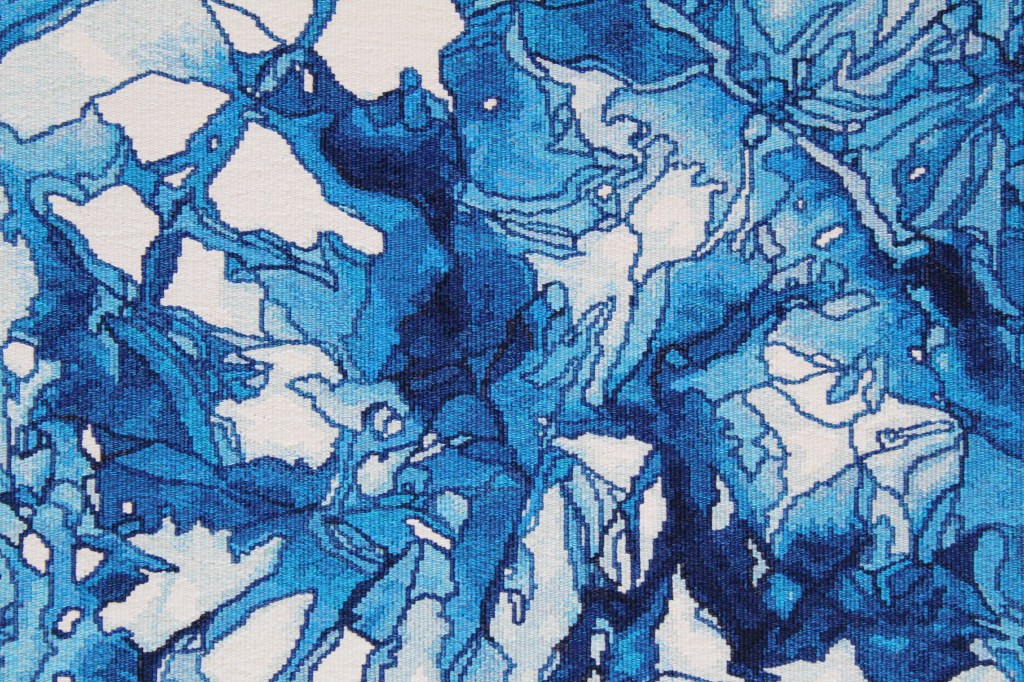


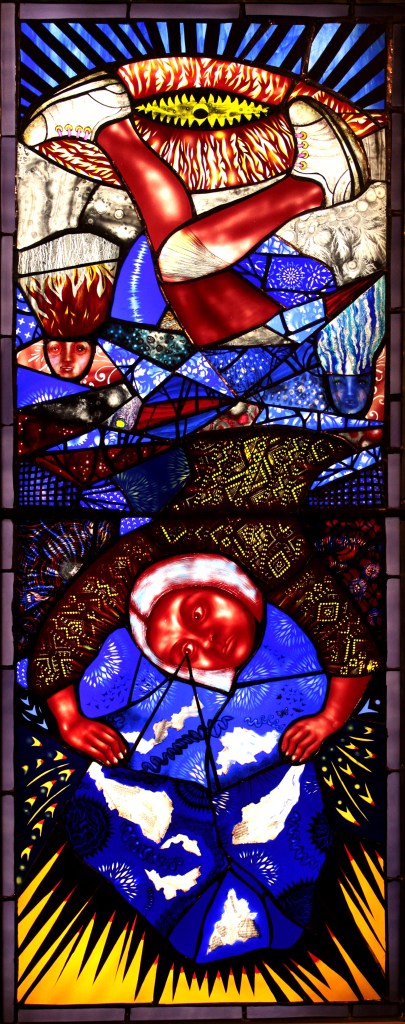

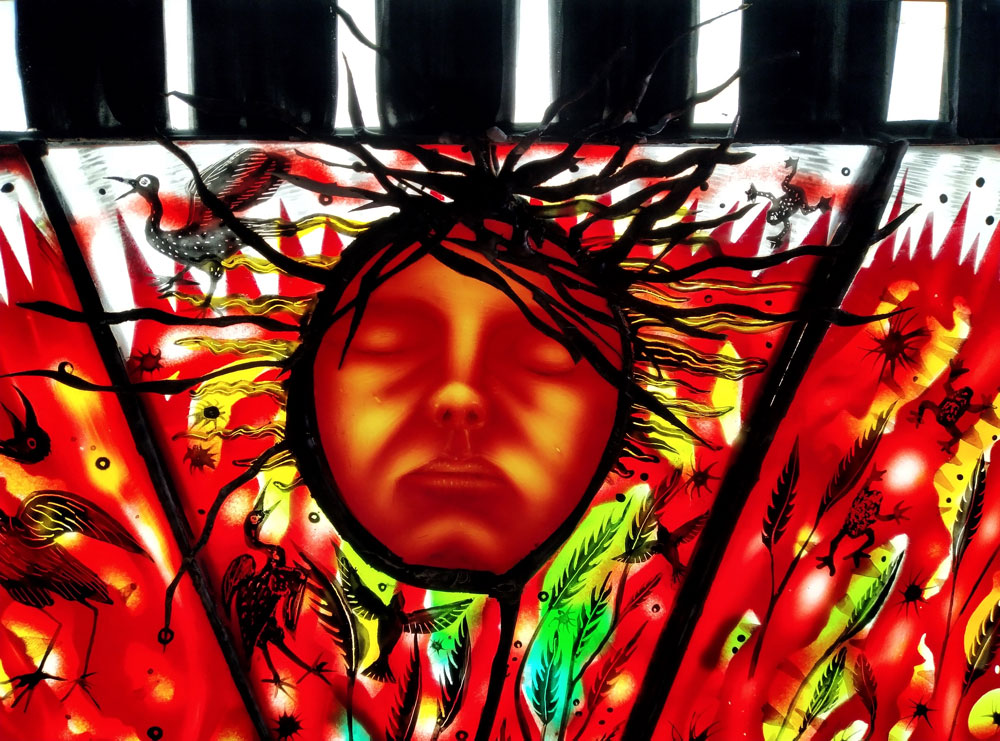


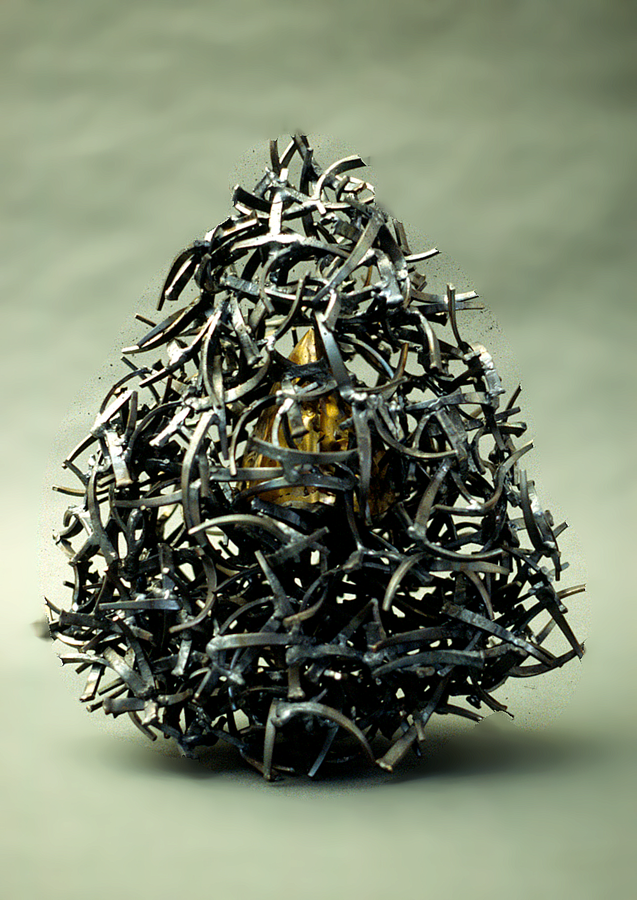

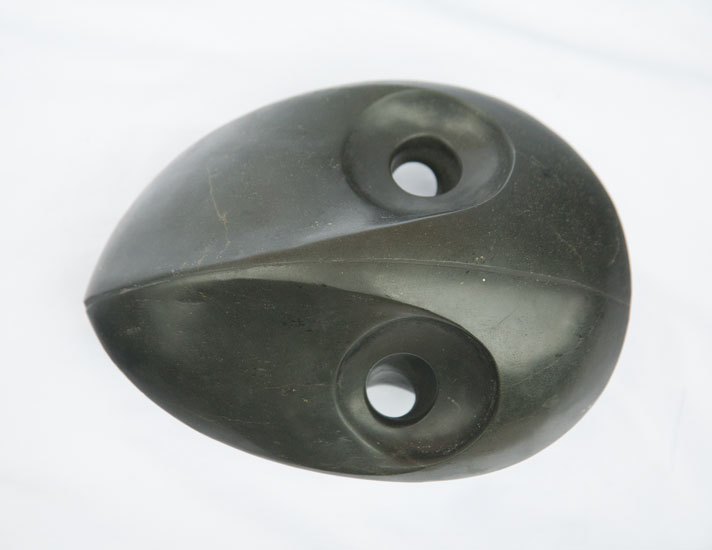


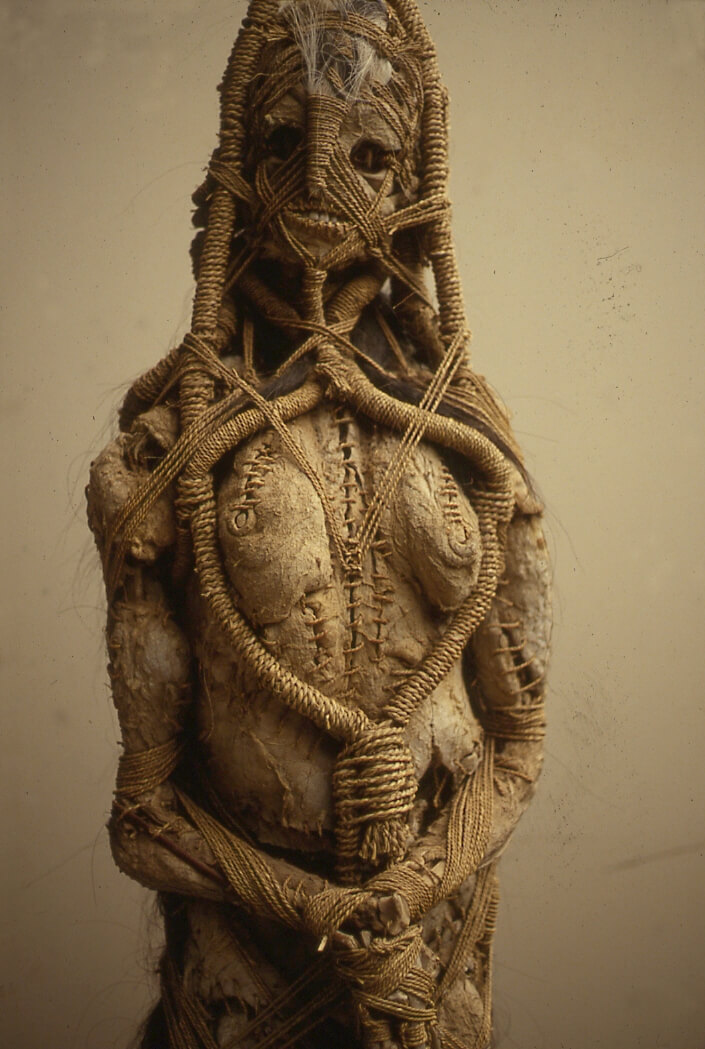


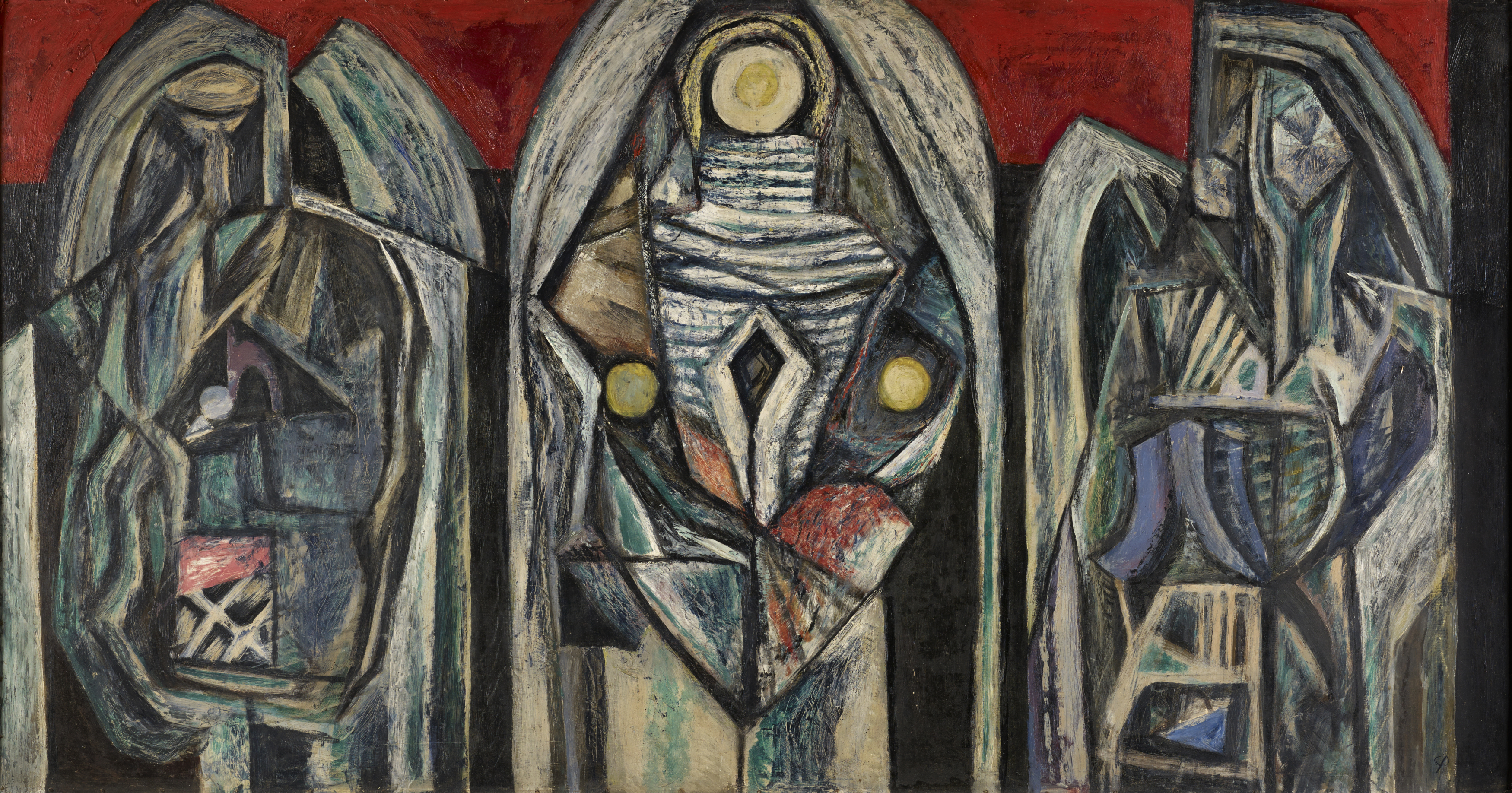


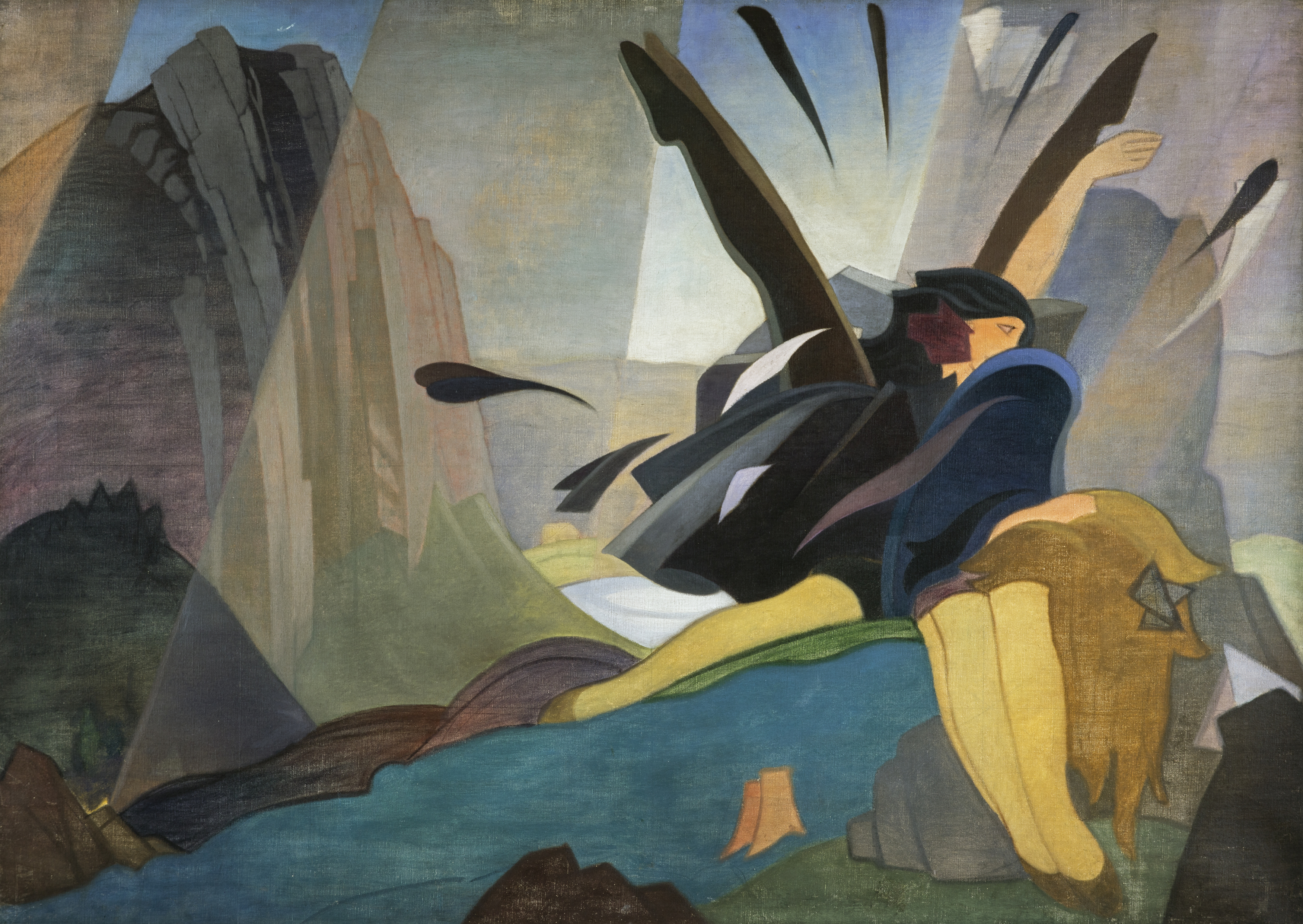


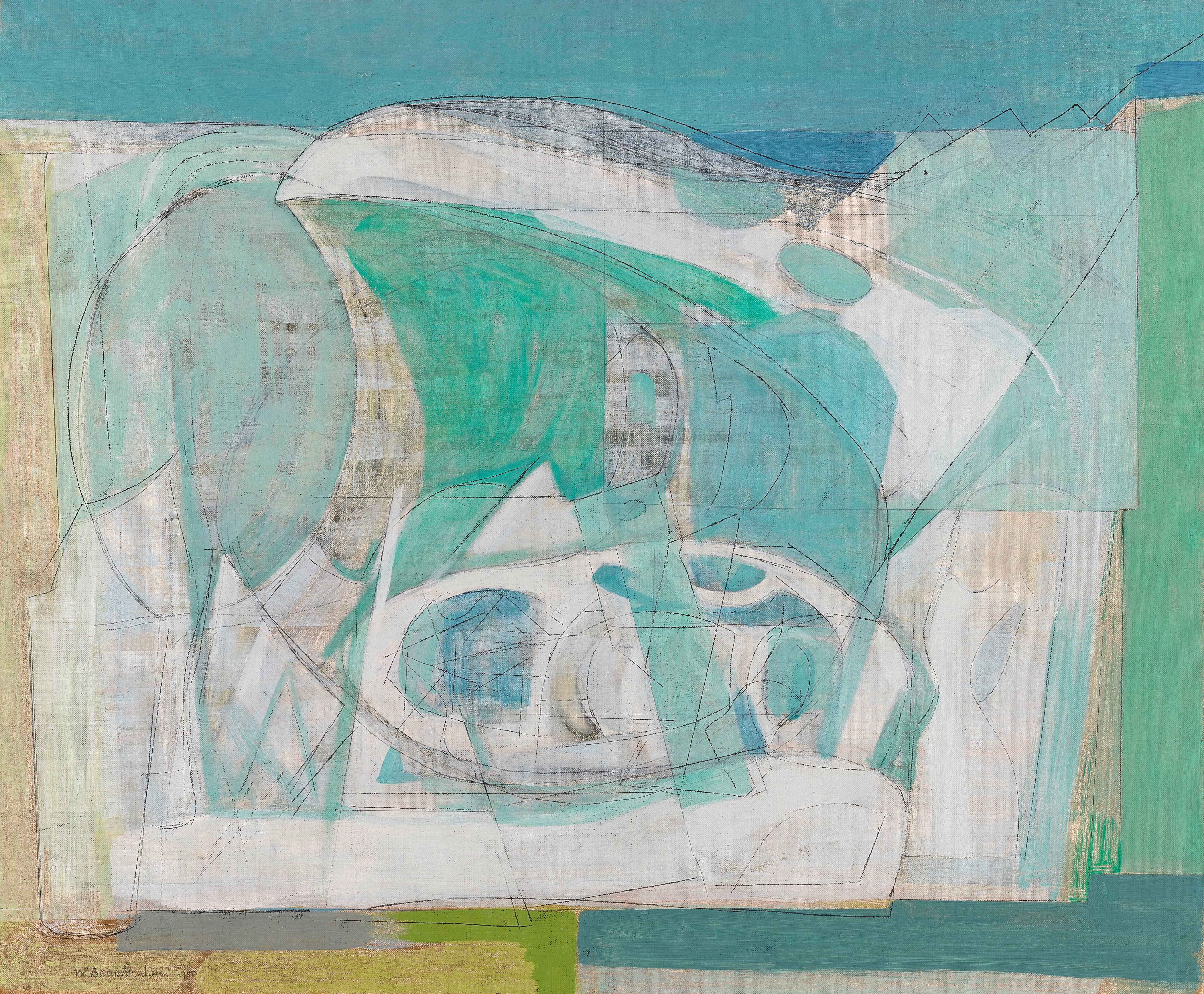


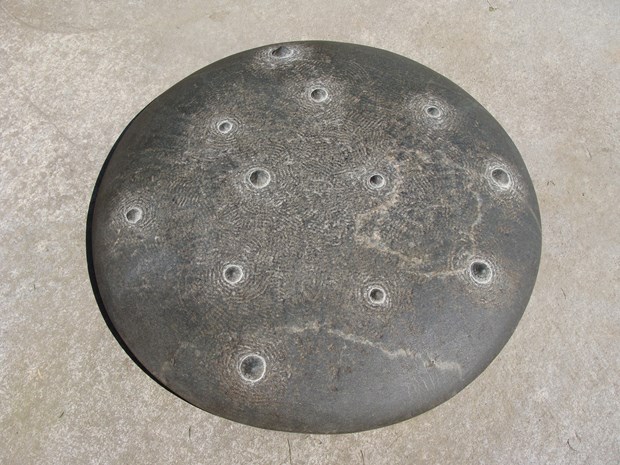


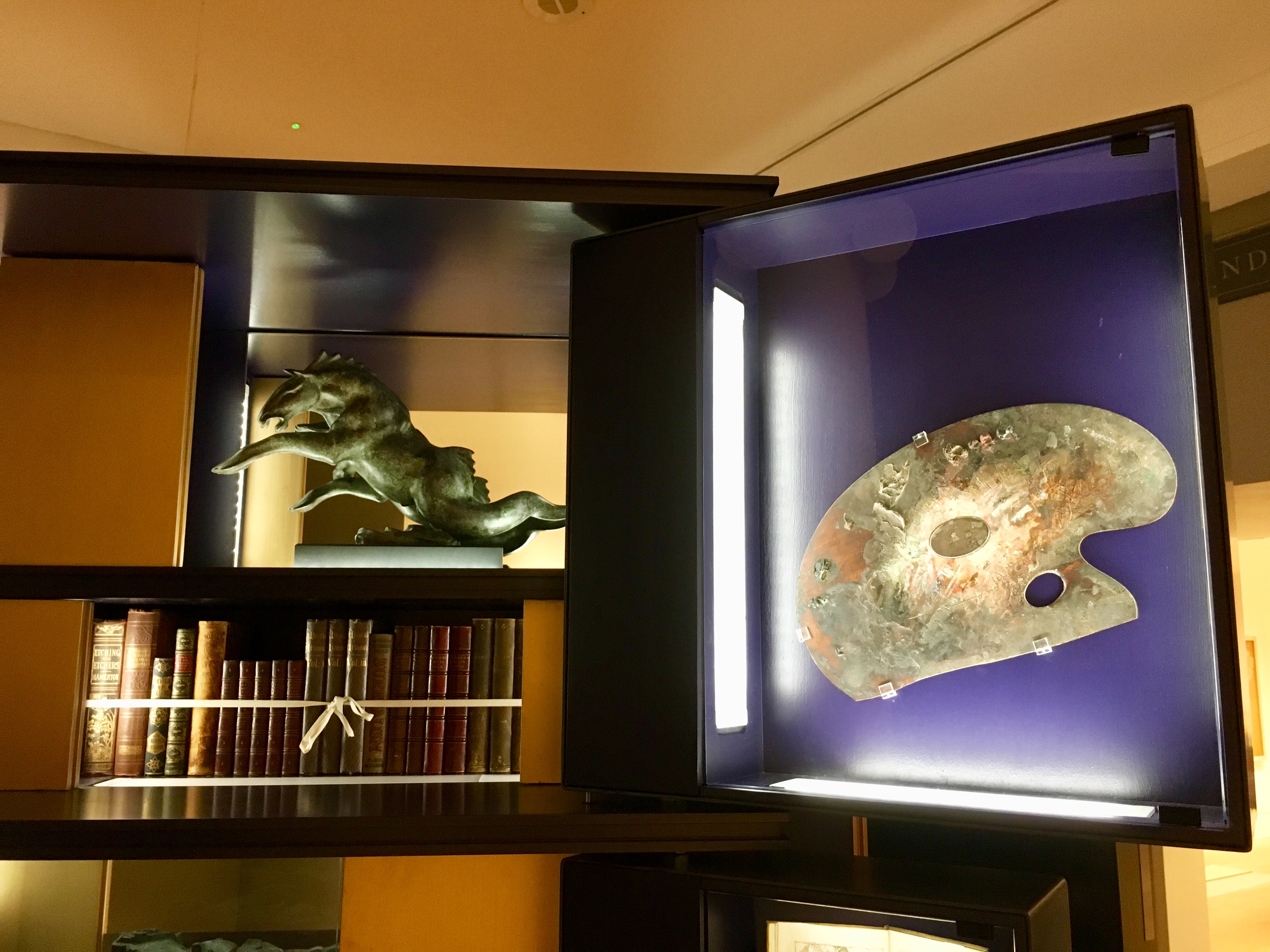


 georginacoburnarts