

Photograph by Tony Davidson, Kilmorack Gallery.
Radically transforming the art of stained glass, Pinkie Maclure’s latest work brings feminine power and the climate crisis brilliantly into focus.
Pinkie Maclure’s Brigid in Dualchas feels like a songline, tapping deep into the earth and our collective unconscious through storytelling. It is an image of origin, crisis and ultimately, hope. Illuminated in glass, a medium as fragile as humanity, Maclure’s Brigid takes full possession of beauty and rage. Rendered with consummate skill, this goddess of pre-Christian Ireland becomes conduit and cure, a contemporary icon of emboldening solidarity and potential change. All Maclure’s work presents the viewer with a knife edge of burgeoning consciousness and action, here contrasting ‘the old traditions and worship of nature with our contemporary abuse of nature and the resulting climate crisis.’
Brigid (Brighde or Bride in Scotland) is a deity of keening and healing, a protector of nature and an apt patron saint for the Anthropocene era we are living in. In a global context circa 2022, her luminous presence is a confrontation. Reappraisal of feminine power, not as ‘other’ but as an intrinsic aspect of all life and creation, has never been more urgent and cuts through all cultures and gender identification. Maclure’s Brigid is a sacred flaming red flag to reconnect with ancient, indigenous knowledge, not just to survive, but to reclaim life on this planet in all its eternal mystery and wonder.
The idea of ‘Dualchas’ in the Gaelic tradition, which ‘refers to the intimate bonds that exist between the natural world, the land and its people, transmitted through generations’ is communicated in the female figure placed centre stage, described by the artist as the goddess ‘in her element.’
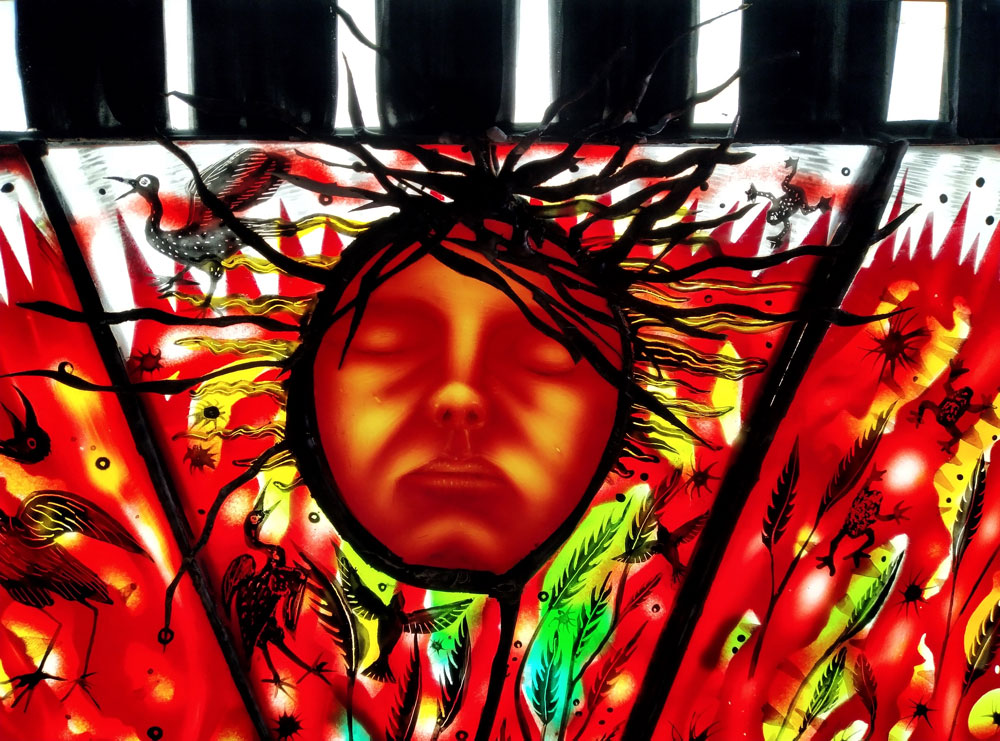
Photograph by Tony Davidson, Kilmorack Gallery
Maclure’s composition is alive with free association. Colour radiates through layered glass in a strong, opposing palette of bloody red and divine blue, evocative of earthly and spiritual planes. Brigid is engulfed in red, a colour which drenches her arms and hands ‘Carrie’ style, while her softly glowing face, eyes closed, is pure repose. There’s great ambiguity here, between a defiant, enduring lifeforce and potential carnage being unleashed. Microbes on finely etched tree branches are underpinned by a vestige of pattern, akin to Medieval stained glass, shining beneath. The smallest details are held aloft by all that has come before, layer upon layer of concept, craft and understanding. In Maclure’s own words;
‘I sandblast, paint, fire, engrave and layer glass and relish the inherent chaos of such an unpredictable medium. The slowness of the process lets me access subconscious, dreamlike imagery and tell stories linking real-life, contemporary experiences with historical texts, characters, and events.’

Photograph by Tony Davidson, Kilmorack Gallery
Pinkie Maclure’s art is a masterful union of ideas and technique which encompasses the entire spectrum of art practice. Like the figure of Brigid in Dualchas, the artist’s upward diagonal path of pure neon lightening may be framed in linear black and white geometry, but this in no way contains her. Brigid moves beyond the upper frame of the composition, pulsing with colour and energy. This petal like radiation of lead line, form and colour bring order and meaning out of chaos. It is pure Zeitgeist, but it is more than that.
The goddess is resolutely complex and complete, divine and human, seen in a Christ-like pose. Associations with the crucifixion, of suffering, sorrow and resurrection, not of God’s only son, but of the world are invoked. Saint Brigid’s feast day, 1st February, heralds spring or Imbolc, celebrating new life out of dark winter stasis. Maclure celebrates life giving creativity as an essential drive, in nature and us, linked with eternal cycles of life and death. Brigid’s clenched hands hold twigs like anode and cathode charges, grasping the mettle of all creation with open arms, much like the artist herself. Brigid in Dualchas is an image of feminine creative power beyond childbirth, in possession of self and body.

Photograph by Tony Davidson, Kilmorack Gallery
The stained-glass composition hinges on a ‘v’ of pubic hair, like the stem of a winged seed, the centre of a flower or a veined petal. It is an unexpected, radical bloom, presenting the female body in an uncompromising, completely organic way, ironically unseen for centuries. Maclure describes the red scratch marks on Brigid’s legs as ‘reminiscent of the graffiti you sometimes see carved into trunks of trees, reflecting the brutalisation of nature and women. Her legs are like the trunk of a tree, still standing despite decades of abuse.’ Significantly, the artist does not define the female figure with these marks. Maclure renders Brigid’s toes delicately mortal pink, her legs glowing pale green, not a deathly pallor, but one of burgeoning life and awakening. Leaves of green and yellow diffuse from her body and birds are silhouetted around a nest of blackened hair. There is nothing idealised here, jagged edges are part of the pattern and flow, held in radiant light. The fiery ignition of thought and instinct are all consuming, in making and seeing.
Maclure radically reinterprets the story of Brigid, ‘associated with perpetual, sacred flames, surrounded by a hedge which no man could cross. Men who attempted to cross were said to have been cursed to go insane, die or be crippled.’ The artist extends this idea to the current climate crisis, acknowledging the truth in the legend, of entire ecosystems. ‘Hedges are very important habitats for wildlife and for the prevention of wildfires,’ which have engulfed the planet. The element of fire, like the goddess herself is ambiguous and multifaceted, triple faced in her most ancient form.
The expression on Brigid’s face, a deeply meditative, active subconscious, calls upon us to collectively awaken and remember through ancient stories. The cathedrals of old encouraged the viewer to look up and be elevated, and in her own inimitable way, Maclure encourages us to do the same, reaching down through the foundations of belief to the site of origin, buried deep beneath the church. This is a different kind of power to that which currently blights our world, one that leads creatively towards hope.
Pinkie Maclure artist’s website: https://www.pinkiemaclure.net/


 georginacoburnarts