
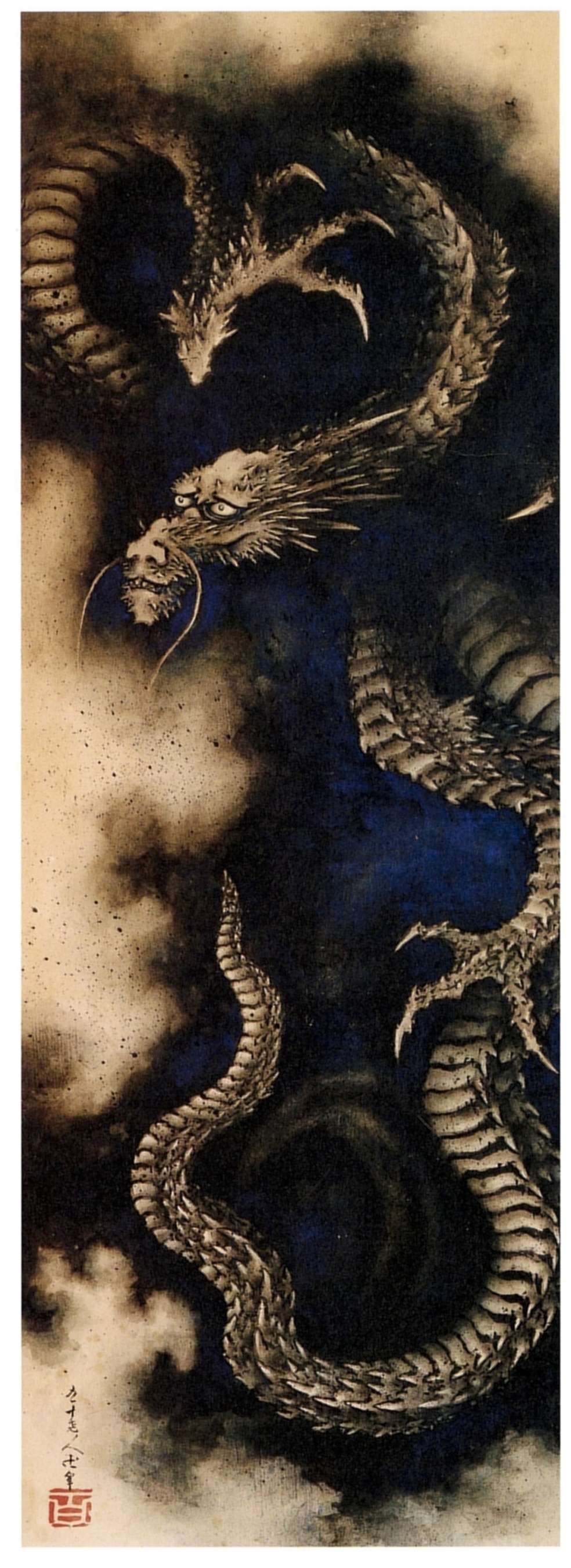
Dragon rising above Mt Fuji. Hanging scroll, ink and slight colour on silk, 1849. Hokusaikan, Obuse. On display from 25 May – 2 July.
Eden Court Cinema and in cinemas nationwide from 4 June 2017
Although I’m a firm believer that the best way to experience any work of Art is being present in the same space, clearly this isn’t always possible. As I and many others won’t have the opportunity to travel to London this summer, I was very excited to see that the British Museum’s current exhibition Hokusai Beyond the Great Wave (25th May to 13th August) was to be broadcast in cinemas. Having attended similar exhibition related events, re-examining the work of Rembrandt, Van Gogh, Goya and Bosch, I was very much looking forward to rediscovering Hokusai up close on a big screen. He’s an artist whose work will be familiar to many people reproduced in poster form, but is less well known in terms of the substance, scope and subtlety of his Art. Seeing exhibitions presented on screen brings a different scale of viewing into play, at times allowing the audience to get closer than would ever be permissible in a gallery or museum, especially where fragile works on paper are concerned. Dependent on selective editing of original works, choice of interviewees, depth of commentary and the final documentary edit, filmed exhibitions can be truly insightful, inspirational, even revelatory experiences. As a continuous record of human thoughts, actions and aspirations lived visually, Art History demands constant reappraisal, not just within academic circles but in the public domain. The collective cinema experience arguably reaches a wider audience than any Art Historian ever could, either in print or on television and coordinated international distribution by More2Screen is huge step forward in terms of accessibility. Art reveals everything humanity is capable of, bringing us face to face with who we are right now (or could be) as part of an ever-expanding field of reference. The cross-border collaboration and investment necessary to stage such an exhibition, in the museum and on screen, reflects this shared inheritance, following in the footsteps of an artist who bridges East and West.
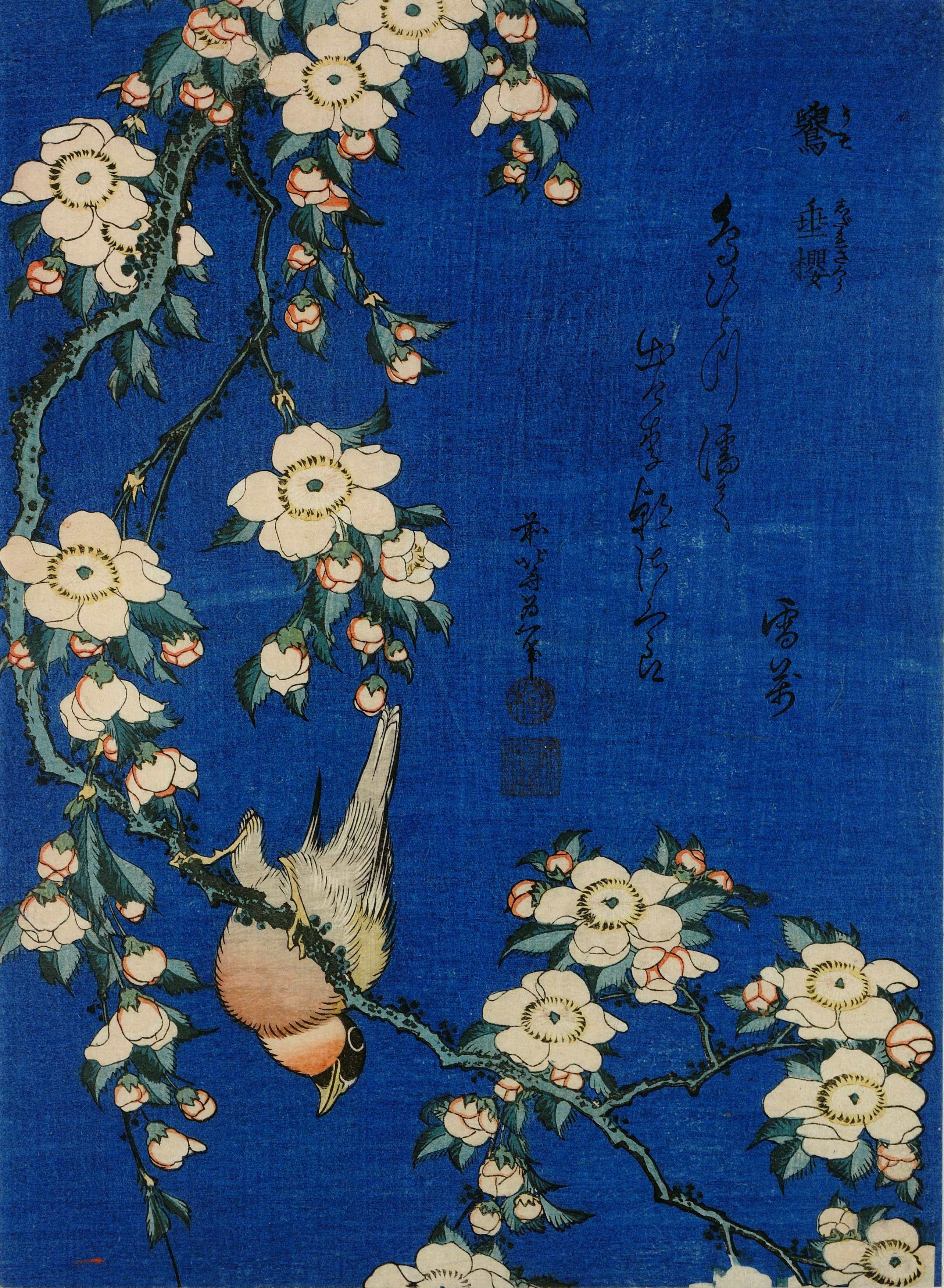
Weeping cherry and bullfinch. Colour Woodblock. c. 1834 © The Trustees of the British Museum.
Katsushika Hokusai (1760-1849) is an artist of profound and lasting influence on global visual culture. When we have the opportunity to see his work up close, we begin to appreciate why in the truth and immediacy of our own responses. Although the film and exhibition will be a natural draw for anyone interested in painting, drawing, illustration, Manga, animation, design, Japanese history and culture, I think many more people would find the thinking and craft behind familiar images, examined afresh with the latest technology, a complete revelation. Some of the filmed images drew gasps from the audience! In tiniest accents of colour and variation of mark “Paint is not paint anymore but plumage”. Hokusai has ducks swimming through paper, capturing the essence and spirit of the animal. His composition of a bullfinch about to take flight from a branch of cherry blossom is breathtakingly exquisite in its simplicity and connectedness, which is also the source of its beauty. Hokusai is an artist who continues to generate immediate, heartfelt responses in viewers across time and an important question to ask is why? He has much to teach contemporary artists, in many ways challenging not only how we view and value creative practice, but how Western 21st Century popular culture perceives the creative “I”, the aging process and the relationships between Humanity, Nature and Spiritually. The appropriation of Hokusai’s Great Wave as an emoji is often interpreted reductively in a Western corporate / urban context as an individual emotive response or a branded illustration of activity and aspiration. However, as a visual symbol it has far more expansive capabilities on the artist’s own terms. Hokusai’s entire ethos of making, way of seeing the world and himself, is still a revolutionary wave of thought and practice. In the context of global affairs circa 2017, this renewed focus on his work and way of being in the world could not be timelier.

Dragon in rain clouds. Hanging scroll, ink and colour on paper, 1849. Musée national des arts asiatiques Guimet, Paris, given by Nobert Lagane. On display from 25 May – 13 August.
The British Museum exhibition Hokusai: Beyond the Great Wave includes prints, paintings and illustrated books from the last 30 years of Hokusai’s life on loan from public and private collections in Europe, Japan and the USA. To have these exhibited together with works from the British Museum collection is exceedingly rare and due to light sensitivity, some works can only be displayed for a limited time. In the interests of conservation, the museum will rotate half of the works with the exhibition closing between 3rd and 6th July to facilitate the changeover- an excellent excuse for a second visit if you happen to live nearby or visit London regularly! The show is the result of curatorial collaboration with Dr Shūgō Asano, “leading Hokusai scholar and Director of the Abeno Harukas Art Museum, Osaka, where a similar exhibition Hokusai – Fuji o koete will be shown from 6 October – 19 November 2017.” Hokusai: Beyond the Great Wave is also “underpinned by research undertaken by the British Museum and Dr Angus Lockyer, Lecturer in the Department of History at SOAS University of London”, as part of an Arts and Humanities Research Council (AHRC) funded project Late Hokusai: Thought, Technique, Society(April 2016-March 2019) “focusing on Hokusai’s last three decades”. The exhibition is a remarkable achievement, demonstrating the importance and value of continuing art historical research, education and international collaboration, bringing new perspectives to work of global importance. It is also the culmination of a 10 year ambition shared by Tim Clark, head of the Japanese section in the Department of Asia at the British Museum and Art Historian/ Hokusai scholar Roger Keyes to honour the consummate skill, artistry and vision of the artist in presenting his finest works. The Mitsubishi Corporation Japanese Galleries (Rooms 92–94 in the British Museum) containing objects from ancient porcelain and Samurai armour to Manga comic books, compliment the blockbuster exhibition focus on one of Japan’s finest artists.

British Museum presents: Hokusai. Screen shot courtesy of More2Screen.
For cinema audiences worldwide, the 90 minute documentary British Museum presents: Hokusai co-produced with NHK (Japan Broadcasting Corporation) with support from the Japan Foundation and Mitsubishi Corporation, enables viewers to examine and enjoy the artist’s work as never before using 8K Ultra HD video technology. The first part of the film directed by Patricia Wheatley looks at the artist’s life, work, techniques and context ,drawing on the perspectives of contemporary British and Japanese artists, while the second part directed by James Norton is a private view of selected works from the British Museum exhibition with commentary from Art Historian Andrew Graham Dickson, artists Grayson Perry, Kate Malone, Maggi Hambling, curator Tim Clark and art historian Roger Keyes who has studied Hokusai’s prints for over 50 years.
Learned credentials aside -what impressed me most, particularly as an art historian, were the genuine, immediate emotional responses to the artist’s work which communicated with such excitement, enthusiasm and actual tears, why this artist’s work is so important, enduring and meaningful to so many people around the world. Not because the artist is a name, a brand, a fortune in the auction house, or part of a canon, but because his work still speaks resoundingly for itself, transcending the time in which it was made and the artist’s persona. Speaking personally about the effect, influence and sheer joy of his work to camera, Maggi Hambling, Grayson Perry and Hokusai scholar Roger Keyes reveal much about the three pillars of Hokusai’s practice; Nature, Humanity and Spirituality, suggesting multiple pathways into his Art. My only disappointment was that there weren’t more standalone views of works in the exhibition, simply to be able to spend more time with them! There’s a balance to be struck between specialist commentary and unguided access to an artist’s work, but overall the documentary succeeds in helping to “relocate Hokusai from niche to world stage.” This is largely due to the natural dynamics at work in Hokusai’s Art, his rapport and regard in relation to everyday subjects and Nature, which people can readily relate to, complimented by the passion, honesty and devotion expressed by the interviewees. Film presents a unique opportunity for direct interpretative responses to original works as opposed to receiving an illustrated lecture. Whilst editing certainly shapes our view, there is perhaps more scope to come to terms with Arts as Humanities in a broader sense. Something that often strikes me in academic circles is the tendency to write about Art in a way that says more about the writer than their subject, the spark of what drew the author or commentator to the visual artist in the first place is regrettably absent. Thankfully here, that vital energy connecting the artist, work and viewer to something greater than themselves alone is heartily celebrated on screen, one of the very best ways to encourage people to seek out the original work for themselves and make their own connections with it.

Roger Keyes’ devoted study of Hokusai’s work is truly inspirational and his response to works in the exhibition deeply moving. This is not the artist as a brand or style but something more lasting and authentic, fully integrated into life. In the words of Keyes from the age of 6 to Hokusai’s death at the age of 90 “he never gave up”, never stopped making work and considered in each vital decade of life that the best was yet to come. In Western popular culture, we’ve become accustomed to a permanent state of denial of death and aging. Age is increasingly seen as a burden rather than an asset to society or another stage of positive growth, experience and maturity. Japanese belief in the 60 year zodiac cycle whereby aged 60 one enters a new phase with renewed purpose, informed Hokusai’s conviction that everything he’d done up to the age of 70 “wasn’t worthy of notice”. The iconic work Under the Great Wave off Kanagawa (Colour woodblock, 1831. Acquisition supported by the Art Fund. © The Trustees of the British Museum) known to many as The Great Wave and the most famous of his series Thirty-six Views of Mount Fuji, was simply another beginning. The intention to continue to draw and paint in his 80’s, 90’s, even beyond 100, never wavered and this spirit of renewal through creativity is inspired.
Although in the West creativity is often percieved, branded and marketed as a product of ego justified by the right to individual expression, Hokusai’s Self orientation was defined by his religious beliefs and connectivity to a more expansive reality. When I look at Under the Great Wave off Kanagawa I don’t see the fishermen cowering in their boats in the face of a potential maritime disaster. Perhaps influenced by the Western Romantic tradition grasping the Great Wave as a Sturm und Drang force of Nature, I see them bowing in reverence, held in awe and stillness, meeting the sheer power and wonder of Nature. That frozen moment of consciousness in the unfurling wave connects to the eternally sacred presence of Mount Fuji which is the subject, vanishing point and spiritual core of the whole series. The feeling of motion and belief caught within the image is anchored to the mountain and although the crest of the wave looks like a giant, animal-like claw that could easily crush the boats below, an attitude of worship permeates the entire composition. Toweringly sublime Prussian blue and white touching the mountain peak, with subtle background washes conveying an attitude of contemplation. In Hokusai’s Great Wave, Human scale is completely dwarfed by Nature and whilst this could be a fearful admission of vulnerability, it is the relationship between all the elements of the image, as part of an entire system or cosmology, which Hokusai enables us to feel. The force of the momentous wave is being itself; an overwhelming presence certainly, but also part of the ebb and flow of life forever suspended before our eyes, in our minds and the universe. As artist Maggi Hambling very perceptively observes on camera, today when confronted by Nature people are inclined to “take a photograph of themselves standing in front of it” rather than being fully present. Belonging to Nichiren sect of Buddhism, Hokusai demonstrates a progressive way of being throughout his life’s work.

Clear day with a southern breeze (‘Red Fuji’) from Thirty-six Views of Mt Fuji. Colour woodblock, 1831. © The Trustees of the British Museum. On display from 25 May – 13 August.

Clear day with a southern breeze (‘Pink Fuji’) from Thirty-six Views of Mt Fuji. Colour woodblock, 1831. . Musée national des arts asiatiques Guimet, Paris. On display from 25 May – 13 August.
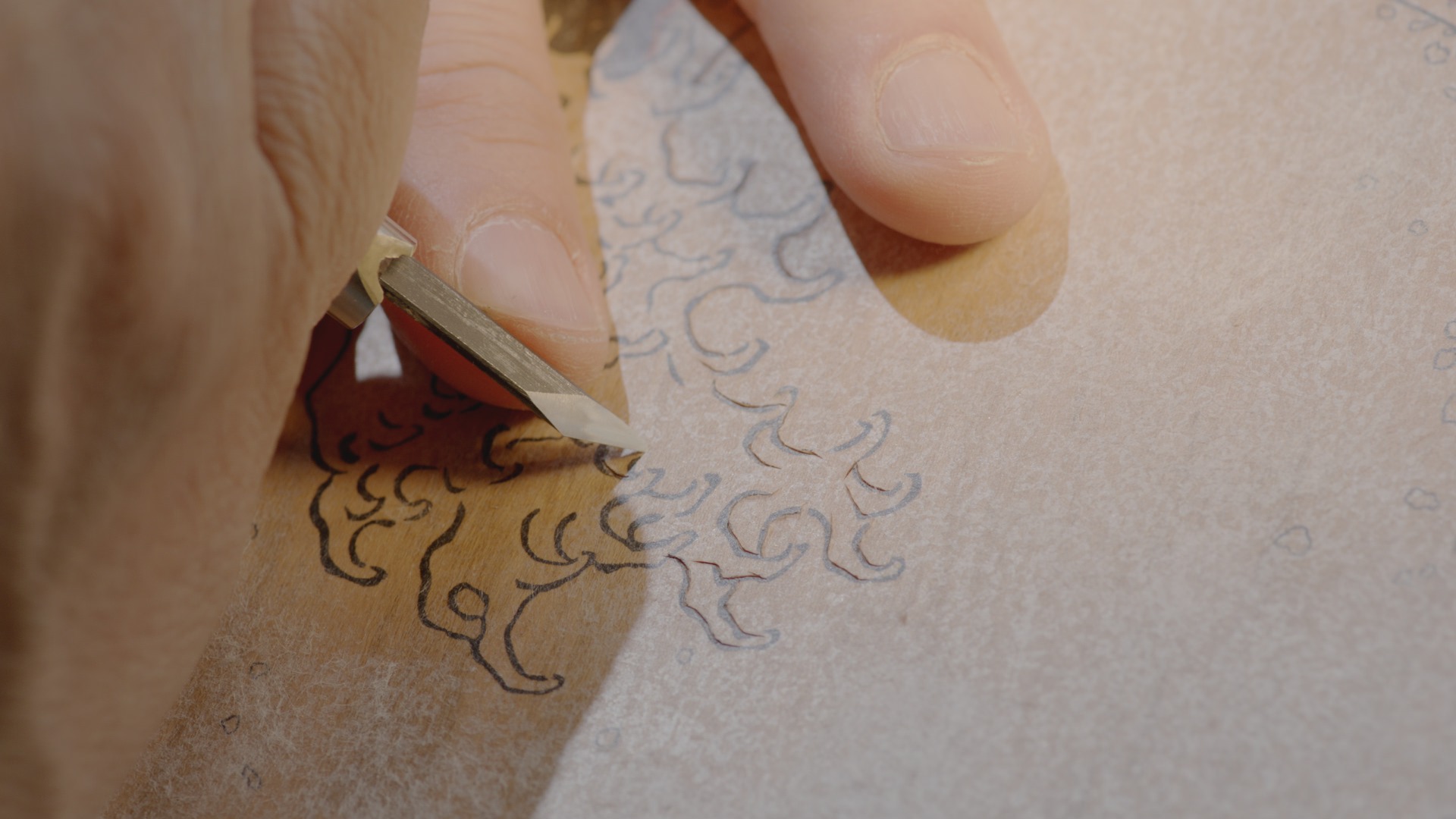
Apprenticed to a wood carver as a young man, by the age of 18 Hokusai was under the tutorage of Master ukiyo-e printmaker Katsukawa Shunshō. What isn’t often appreciated in a digital age is the complexity and artistry of original printmaking in terms of crafting the image and it was wonderful to see footage of this as part of the documentary. There is physicality in carving a woodblock that in Japanese Art demands more than starkly gouged strength of line. There is supreme delicacy in broken lines conveying the qualities and feeling of movement in air, clouds and water. Hokusai’s early woodblock prints reveal multi-layered treatment using 3 or 4 blocks with varied inking techniques to achieve an incredibly nuanced effect. Clear day with a southern breeze (‘Pink Fuji’) from Thirty-six Views of Mt Fuji. (Colour woodblock, 1831. Musée national des arts asiatiques Guimet, Paris) and Clear day with a southern breeze (Red Fuji) (Colour woodblock, 1831. © The Trustees of the British Museum), demonstrate the artist’s finely rendered treatment of tone, hue and texture contrasted with mass reproduction in heavier blocks of colour and greater uniformity of line. The art of “capturing the brush line in wood” and “the subtlety of the ink mark with pigment running out” so “prized in calligraphy” presents an interdisciplinary understanding of the artist’s chosen medium, linked to a wider cultural and spiritual perception of the world. In Pink Fuji the forest isn’t treated as a flat graphic pattern but vibrates with life in multi-layered marks and the inking process. True to his Faith there is life in all things, “animal and mineral”, sublime gradients of colour and light in the landscape, in the smallest insect, birds, blossoms and the eternal snow-capped mountain. Hokusai’s stunning Thunder Storm print achieves a highly animated flash/ “strobe effect” to rival CGI We can hear the thunder reverberating as the trees incline with air pressure and people take shelter from the oncoming storm and lightening, achieved with the highly directional light and bleached colour palette.
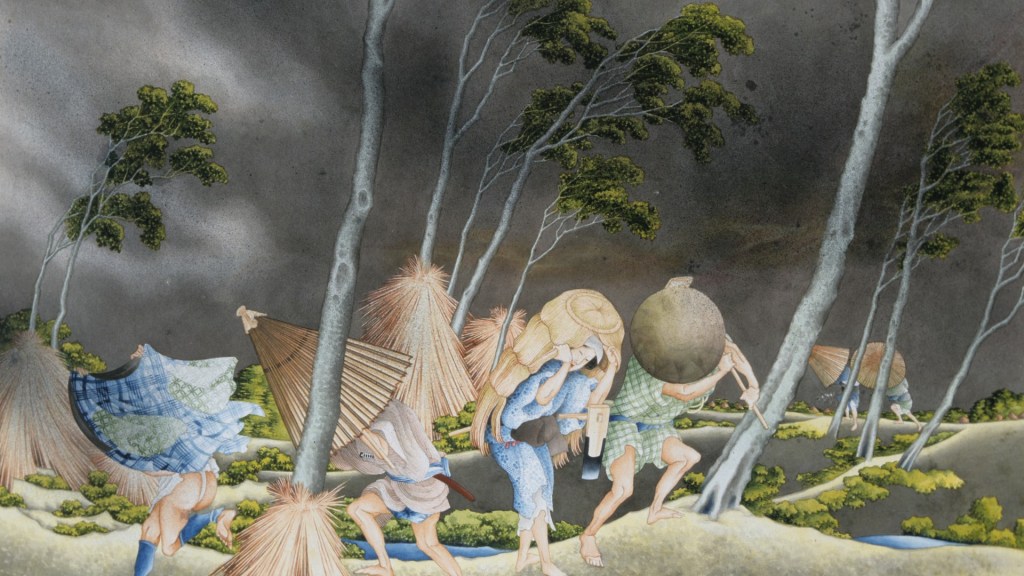
British Museum presents: Hokusai. Thunder Storm Print. Screenshot courtesy of More2Screen.
It is not surprising that in the mid Nineteenth Century, when Japanese colour wood block ukiyo-e prints by artists including Hiroshige, Kunisada and Hokusai began to be exported to Europe as mass reproductions that they caused a sensation. Artists such as Van Gogh, Monet, Manet, Whistler and Picasso saw the world of European perspective reimagined, influencing the course of Western Art History with the bolder form of inking several steps removed from the artist’s exacting hand. In our own century technology has further smoothed variations of line and mark to the point where studio based computer generated animation often feels like uniform plastic. Hokusai’s understanding of the woodblock process realises the concept that “only a human hand has the awareness to make such a mark in the world”. His illustrated book 100 Views of Mount Fuji in three volumes (I 1834, II 1835, III 1849) expands this idea, stretching the image in terms of perspective and composition in dynamic response to his chosen subject as the spiritual anchor of the ‘Floating World’. During the Edo period in Japan (1615-1868) mass-produced prints of famous actors and actresses, courtesans, landscapes, legends and folk tales were extremely popular. Hokusai’s apprenticeship in ukiyo-e carving and printing techniques grounded him in a Craft with a social dimension, combining the mythic with the everyday. As highlighted in the documentary two streams of Hokusai’s practice, his book illustrations and random drawings without narrative combined are precursors of modern Manga.

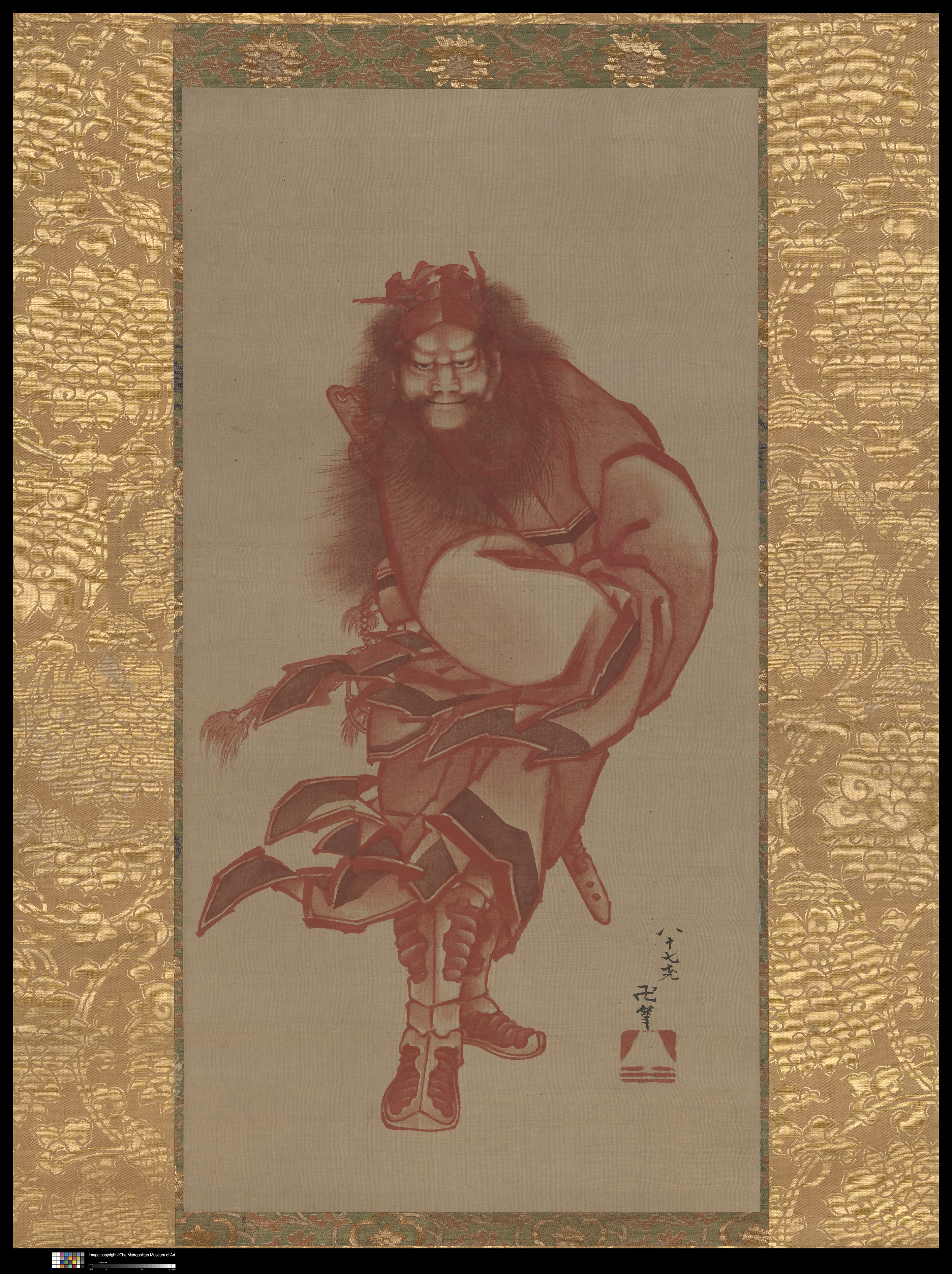
Shōki painted in red. Hanging scroll, ink and red pigment on silk, 1846. Metropolitan Museum of Art, gift of Mrs Charles Stewart Smith. On display from 25 May – 13 August.
Moving fluidly between Nature, Humanity and the supernatural, the artist’s paintings and prints of ghosts, mythological creatures and deities are among the exhibition’s filmed highlights. Shōki painted in red (Hanging scroll, ink and red pigment on silk, 1846. Metropolitan Museum of Art, gift of Mrs Charles Stewart Smith. On display from 25 May – 13 August) a demon-queller who offers protection against smallpox stands steadfast, an expression of powerful benevolence and determination on his face. His character is reassuring to the viewer, perceived in the fiery overlapping folds of his robe which animate his advance mentally and physically into our foreground. Ready for battle but not showing his hands which are hidden in the billowing sleeves of his robe, there’s a feeling of heated anticipation in every bold, assured mark. The heroism of the figure isn’t communicated by a drawn sword but is carried inwardly, allowing the audience to feel unconsciously protected. The seal on the lower right takes the pictorial form of an erupting volcano which also informs our view of the figure and his strength as protector. Emotionally and psychologically the image operates way beyond illustration.

Kohada Koheiji from One Hundred Ghost Tales. Colour woodblock, 1833. Purchase funded by the Theresia Gerda Buch bequest in memory of her parents Rudolph and Julie Buch. © The Trustees of the British Museum. On display from 25 May – 13 August.
Hokusai’s wonderful vision of Kohada Koheiji from One Hundred Ghost Tales (Colour woodblock, 1833. Purchase funded by the Theresia Gerda Buch bequest in memory of her parents Rudolph and Julie Buch. © The Trustees of the British Museum. On display from 25 May – 13 August) sees the mosquito net pared down like pink flesh from the bone with the skeletal ghost of a murdered/ drowned husband peering over an edge between worlds. Although most of the flesh is decayed from his face revealing expressively stark bone, beyond the ghoulishness we know he has been wronged. His bare teeth mirror the squared form of Buddhist beads around his neck as he stares down at his wife and her lover completely out of frame, the tale empathically alive in the viewer’s imagination. This quality of allowing the viewer to complete the image expansively in their own minds is one of Hokusai’s greatest gifts to audiences past, present and future.

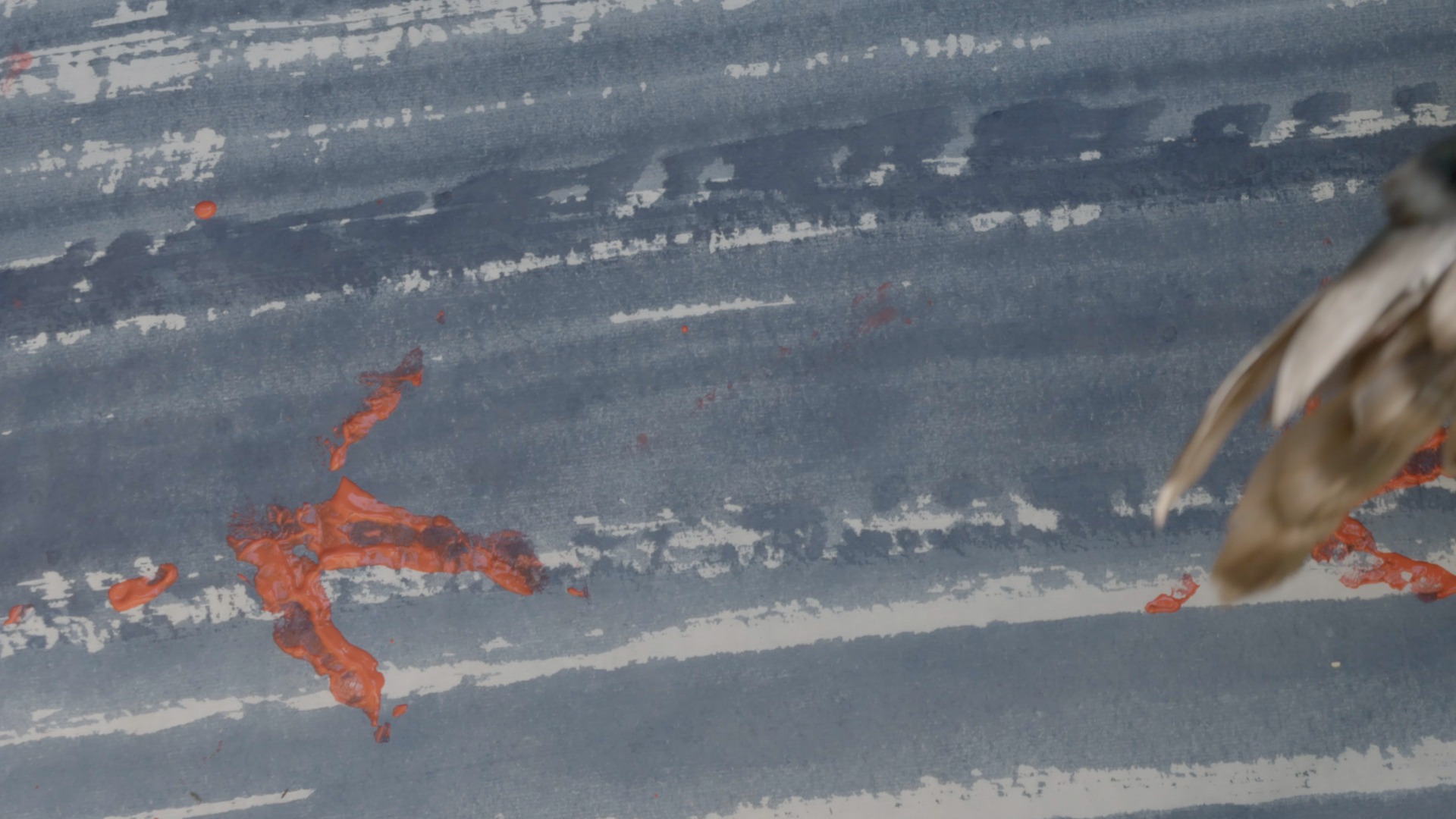
British Museum presents: Hokusai. Chicken Feet Screen Shot courtesy of More2Screen.
Hokusai’s work also reveals humour and a lively personality, demonstrating his Art by action painting blue ink onto a long sheet of paper, then dipping the feet of a rooster in red pigment and having it walk across it, announcing the visualised concept of autumn leaves falling on the Takusai River to his wowed audience. “He could draw onto a grain of rice”, was “childlike” in the playful spontaneity of drawing subjects called out at parties, collaborated with other artists and writers and as early as 1822 was experimenting with a hybridised style of European perspective in paintings commissioned by Dutch officials. Formal trading relations began in 1609 between the Netherlands and Japan and this influence informed Hokusai’s melding of Eastern and Western perspectives. As artist David Hockney keenly observes during interview, Hokusai understood that in depicting space “on a flat surface everything is abstraction.” This relates not just to pictorial elements of perspective, line and colour as part of formal composition, but the holistic spirit behind those human marks. Van Gogh felt a kinship with the devotional in Japanese art, attuned to what he saw as the Divine in Nature and everyday labour. Writing to his brother Theo from Arles, 15 July 1888 he stated that; “all my work is based to some extent on Japanese art”, seeing it as part of a shared lineage, which he describes in September 1888 like that of “the Primitives”, “the Greeks “and “our old Dutchmen, Rembrandt, Potter, Hals, Vermeer, Ostade, Ruisdael. It doesn’t end.” [1]When Van Gogh uses the word “primitives” in this context it is a mark of authenticity, Humankind’s unique creative drive to make sense of the world and ourselves, with the hope and possibility of reimagining and renewing both.

Self-portrait, aged eighty-three. Drawing in a letter, ink on paper, 1842. Nationaal Museum van Wereldculturen, Leiden. On display from 25 May – 13 August.
The soul of this artist is belief, the rejuvenation of name changes throughout his life accompanying his development as a man and artist. Hokusai is the “North Star” a fixed point in the heavens within and without, the “North studio” of Craft and identity who becomes the “old man-crazy to paint”. He wasn’t struck by the legendary lightning strike of egoistic talent but by Nature as the vital spark of his own inner nature. We see that communicated in his progressive work, reaching its zenith between the ages of 70 and 90 when he frees himself, engaging fully with the connectivity of every vibrating mark, making approaching death simply another threshold. He becomes the Dragon rising above Mt Fuji. (Hanging scroll, ink and slight colour on silk, 1849. Hokusaikan, Obuse. On display from 25 May – 2 July.) Equally there’s humility in his drawn self-portraits such as Self-portrait, aged eighty-three. (Drawing in a letter, ink on paper, 1842. Nationaal Museum van Wereldculturen, Leiden. On display from 25 May – 13 August) with no affectations towards nobility or greatness. Hokusai isn’t afraid to depict himself as an old man and flawed human being, delighting in the expanded possibilities of perception through experience, even in reduced circumstances and the abject poverty he suffered in later life. There’s joy, reverence and power in his Art which speaks to people very directly, regardless of belief. Like the work of Rembrandt, it’s the artist’s humanity which irrepressibly shines through.
There are many pathways into and extending beyond Hokusai’s Art in the way we interact with the world and in relation to further research. The documentary includes a tantalising glimpse of the work of his daughter Eijo “(art name Ōi, about 1800-after 1857) an artist in her own right who “quit an unsuccessful marriage” “to care for her aged father” working “with and alongside him.” Given that Manga is a female dominated Art Form this also begs further investigation in the public domain. There is so much for visitors to the exhibition and cinema audiences to explore and contemplate in relation to Hokusai’s extraordinary, prolific and varied work. If you can’t get to the British Museum in London then get yourself to the nearest cinema screening, for the price of a cinema ticket you’ll be very glad you did!
[1] Inspiration from Japan, Van Gogh Museum, Amsterdam www.vangoghmuseum.nl/en/stories/inspiration-from-japan
British Museum Exhibition website: http://www.britishmuseum.org/whats_on/exhibitions/hokusai.aspx
More2Screen: http://www.more2screen.com/events/hokusai-british-museum/








 georginacoburnarts