
Tate Modern 25 April – 25 October 2024

‘The whole work, called art, knows no borders or nations, only humanity.’
Der Blaue Reiter Almanac 1911
In many ways Expressionists: Kandinsky, Münter and The Blue Rider feels like a miraculous, timely gift. This is a stunning show, full of life affirming energy and new discoveries, largely drawn from works preserved by Gabriele Münter through both world wars and donated to the Municipal Gallery at the Lenbachhaus, Munich in 1957. The brief flowering of Der Blaue Reiter group resulted in art so dazzling that it still burns brightly and imprints the soul. It is exhilarating to feel the colour, sense of possibility and pure elation in works such as Kandinsky’s Munich- Before the City (1908, oil paint on board) and sobering to contemplate what followed. World wars, toxic nationalism, the systematic denial of freedom of expression, persecution, exile, and genocide. The 1937 Entartete Kunst /Degenerate Art exhibition staged by the Nazis in Munich included works by Wassily Kandinsky, Paul Klee, Franz Marc, and Lyonel Feininger as objects of ridicule and persecution. Walking through the Expressionists exhibition, seeing the celebration of self-expression with a future of the artist as target, made me reflect on currents at work in the world today.
I felt overwhelmingly uplifted by the vision of creative individuals throughout this exhibition, their art as rich and vibrant as the day it was made. I also felt their collective belief in internationalism and freedom of expression eroding in real time beneath my feet. The tension between what could be and the global precipice we now stand upon, perhaps made this show even more urgent and brilliant, a real beacon of light and colour. There is a spirit of resilience, fellowship and joy permeating this show, an energy which is felt in every mark and in the fluidity between artistic disciplines, encompassing visual art, sculpture, photography, theatre, dance, and music. Exploration of place, the city of Munich and the Murnau countryside are beautifully woven into the story of Der Blaue Reiter group, their collaborations, passions, and support of each other. This ‘transnational community’ of artists; French, German, Swiss, Russian, and American, gravitated towards the spiritual in Art, experimented with symbolism, abstraction and explored complexity of identity in ways that make life circa 2024 feel retrograde.
There are impressive and deeply moving works by familiar artists, Wassily Kandinsky, Franz Marc, Gabriele Münter, Paul Klee and Robert Delaunay, however it is the work of lesser-known artists that are a revelation. Among them Erma Bossi, Elisabeth Epstein and Marianne Werefkin, and works by unknown artists from Asia and North Africa. The influence of non-Western art on members of Der Blaue Reiter group is visually striking and begs further investigation. Images from the 1910 Masterpieces of Muhammadan Art exhibition in Munich, which included 3600 works drawn from European collections, and Gabriele Münter’s photographs of Tunisia are examples of this interest in “primitive art” and the “vast Orient.” The 1900’s European lens and Imperial language is dated, but as a Photograph of a leather Safavid bookbinding lacquered in gold, 16th century c1910 and Nobleman on a tiger hunt North Indian / Rajasthan 19th century reverse glass painting demonstrate, these are ‘masterpieces’ with resounding voices of their own. Seeing a facsimile of Shishi Lion, early 19th century, attributed to Katsushika Hokusai as part of Der Blaue Reiter Almanac display and Franz Marc’s Tiger (1912), there is an inner spirit unleashed and understood in both that has nothing to do with stylistic imitation.

The emergence of distinct creative voices and personalities within Der Blaue Reiter group is one of the great delights of this show. Erma Bossi’s Circus (1909, oil paint on card) places the viewer in the elliptical spin of a live performance. The mesmerising rhythm of movement in horse and rider, within the colourful interior space of a circus tent, draws the viewer into a self-reflexive space. Bossi makes us part of the foreground view of three clowns, inferring that rather than just passively watching, we too are part of the act.

Elisabeth Epstein’s Self Portrait (1911, oil on card) is another wonderful discovery and like Bossi’s Circus, a trigger for seeking out more of her work. Born in Ukraine, Epstein defied the conventions of her day, left her husband and son, and moved to Moscow, Paris, and Munich to develop her art. In this bold composition, she fills the picture frame, a naked shoulder bringing a sense of vulnerability to the figure, while her arms are folded diagonally across her body, like a protective barrier to her inner world. Emotionally contradictory colours of cool greens and blues with warm yellow and pink flesh tones make this self portrait a fascinating, ambiguous vision of self. The confidence in paint handling, masterful composition and dark, articulate outlines of the face and body, present a deeply centred image of a woman absorbed in the process of becoming her true creative self.
Lenbachhaus Munich, Donation of Gabriele Münter, 1957 © DACS 2023
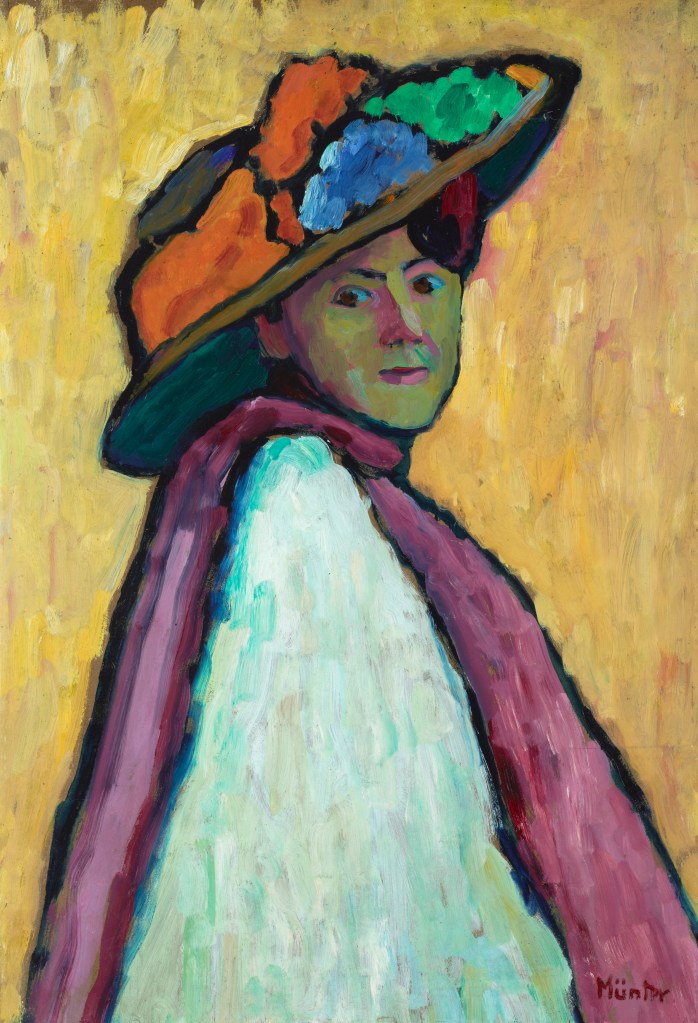
Two images of Marianne Werefkin, Gabriele Münter’s portrait of the artist (1909) and Werefkin’s fierce self-portrait aged 50 (1910) provide an intriguing, extreme contrast of character. The artist’s projected inner self is sharply juxtaposed with the kindly, fashionable woman in Münter’s portrait. Coming from a position of privilege, Werefkin was fortunate to have financial independence and supported other artists in her circle. Her statement ‘I am not a man I am not a woman. I am I’ chimes perfectly with the incandescent, red eyed confrontation of her self-portrait, actively challenging the viewer. She is one of the most interesting members of the group, her paintings and drawings one of the highlights of the show. Werefkin’s dynamic sketchbooks (d3 undated) are filled with jewel-like colour and her line radiates life. The beautiful trance-like silhouettes of The Skaters (1911, Tempera on paper on board) and her extraordinary composition of loss, light and anguish The Storm (c. 1907, Tempera on paper on cardboard) are deeply contemplative works, drawing on ancient, spiritual traditions of image making in this medium.

The Murnau countryside was an environment that elevated all of Werefkin’s insight, skill and creative energy. Watching people move towards and be absorbed by The Prayer (1910, tempera on paper on board) is a tangible, emotive example of the Divine synonymous with Nature. The sense of elevation comes not just from line and form which cradles elements of nature and human architecture together, but in deep blues and greens that convey the mountains growing and the spire extending into the realm of those peaks. In the foreground, a white bearded man and a female figure kneel before an alcove statue of the crucifixion. It is an image that has specific religious associations, however it is also open in the same way the sky is, to imagination and interpretation. The Red Tree (1910, tempera on paper on board) is another magnificent example, where a lone figure sits beneath fiery, vibrant growth, dwarfed by the mountain and staring into the hut or chapel as a gateway. It is a captivating, radiant hymn to Nature and the artist’s own nature, an irrepressible combination of dynamic elements which communicates a state of connection with forces greater than oneself.

Tragically Franz Marc died from his injuries at the Battle of Verdun in 1916, but his sacred vision of the natural world is one which will hopefully strike a chord with a whole new generation of viewers at Tate Modern. The visible impact of his work on visitors to the exhibition was heartening, smiles of recognition, joy, excitement, an inner light illuminating people’s faces, particularly as they entered a room of large scale works In the Rain, The Tiger and Doe in the Monastery Garden, a breathtaking trio on a single wall. Marc’s fractured style is that of a prism, a kaleidoscopic, distilled vision that makes his paintings so distinctive and magnetic.
In the Rain (1912, oil on canvas) depicts Marc, his wife and their dog, sheltering in a deluge. The figures are alone in their thoughts and in this shimmering field of colour and light we can see Marc’s commitment to a different state of being. ‘I’m striving to intensify my feeling for the organic rhythm of all things, trying to feel myself pantheistically in the quivering and flow of blood in nature, in trees, animals, the air…’ This also manifests in Marc’s notes and exploration of colour theory including Arthur Schopenhauer’s On Vision and Colours (1816), the writings of physiologist Ernst Wilhelm Von Brucke and meteorologist Wihelm Von Bezold. Viewing Marc’s Deer in the Snow (1911) through a prism in the exhibition, opens different dimensions of the artist’s practice and sheds new light on his approach to painting. ‘Only the prism has become indispensable to me…Nearly every painting requires an alteration of its use; sometimes it appears nigh on impossible. It serves the purpose of checking adjacent colours for their purity.’

Marc’s acute sensitivity to light and darkness assumes a spiritual dimension, seen in two paintings which dance with colour in different ways. In Doe in the Monastery Garden (1912, oil on canvas) the animal’s head is inclined towards a higher power, a glimpse of lunar blue in the high left corner. Inclining curves are felt in the trees and foliage, with high contrasts of green and red in dynamic counterpoint. There is unity and a sense of balance in play in the painting as a Gesamkunstwerk, an all-embracing synthesis, which here imbues a sense of inner calm. Whatever your beliefs- a holy spirit is present as a bridge between human architecture and nature.
In stark contrast Deer in the Woods (1912, oil on canvas) depicts darkness as a dominant force in the inclining tree, which menacingly compresses the deer’s body into a position of concealment and fear. We feel the threat, that something is coming. Fronds reach out and the air stirs in the high right corner like an apparition. Our emotions and sense of danger are heightened by the dominance of red in the painting and the angular bisection of the canvas by the tree trunk, which curiously also holds a distorted oval of white light.
Der Blaue Reiter group’s curiosity about many different ways of seeing, the art of different cultures and ages, the intense relationship between colour and sound, the investigation of colour theory from Goethe’s Theory of Colours (1810), Issac Newton and Schopenhauer, the belief in internationalism and the ‘inner necessity of art’ has much to teach us in a world hell bent on materiality and linear progress. There is above all else hope in the Expressionists’ experimental, collaborative engagement with the world which sent me back out into ours with a fighting spirit of optimism. There are times when colour and light does not win, but here in Tate Modern an alternative presents itself, and what a glorious endorsement of the human spirit it is.
 georginacoburnarts