PINKIE MACLURE LOST CONGREGATION

Centre for Contemporary Arts, Glasgow 17 June – 9 September 2023

Pinkie Maclure Totally Wired (Self Portrait with Insomnia Posy) 2020 63cm x 72cm, stained glass. Photograph courtesy of the artist.

Iconic award-winning artist Pinkie Maclure has been blazing a trail in visual art and music for over thirty years. Co-writing ten albums with musician and sound designer John Wills and revolutionising the art of stained glass, Maclure’s art is a potent, beautifully realised form of activism. Her ability to bring the most pressing issues and anxieties of our age into the light with power and compassion, resists dogma and triggers consciousness through imagination.

Maclure’s recent exhibitions at Homo Faber (Venice), Collect (London), the Outsider Art Fair (New York), the John Ruskin Prize (Manchester) and awards including the Sequested Prize, John Byrne Prize, Zealous Craft Prize and Jerwood Makers, have contributed to the artist’s growing international following. Represented in the National Museum of Scotland collection and private collections worldwide, Maclure’s distinctive voice as a visual artist, vocalist and musician has resounding impact. Her debut solo exhibition Lost Congregation at CCA Glasgow, is a thoroughly immersive and haunting experience. The show consists of three rooms of stained-glass, a 3D ambisonics sound installation and moving image, together with a series of live performances by the artist. In addition to new work, the exhibition is also a survey of key works from 2017-2023, including Pills for Ills, Ills for Pills (2018), addressing Britain’s opioid epidemic and Beauty Tricks (2017) a multilayered expose of the environmental and psychological cost of the beauty industry. (Discussed in a previous essay Pinkie MaclureBeauty Tricks https://www.kilmorackgallery.co.uk/pinkie-maclure-beaty-tricks-essay/ )

Pinkie Maclure Beauty Tricks 2017, stained glass Photograph courtesy of Kilmorack Gallery

Tackling the enormous sense of grief and loss felt by many people seeing ecological collapse unfold in real time, Maclure offers a vision of hope and connectivity with Nature’s capacity for renewal. It’s this spirit that enables you to emerge from the exhibition having faced the reality of climate crisis, human displacement, and misogyny with a sense of empowerment and optimism. The central work in the show is Maclure’s installation The Soil (2023) with sound installation Dust Won’t Lie, written and sung by Pinkie Maclure with John Wills. This dark, immersive space envelops the viewer in soundscape and imagery, on the wall, projected onto the floor and in a stunning, large scale stained glass at the far end of the room. This abandoned chapel feels haunted and ethereal, but inviting, two staggered groups of cushioned pews and Maclure’s mesmerising voice, as if drawn from the earth in tonal descent, ground the participant. Tangles of dead branches and the crunch of leaves underfoot evoke a kind of passing. An expression of human experience and resilience, Somehow We Mend (2023), reveals itself in the gloom, the eye directed to the wall work by an extended branch. A red thread connects the hand of a figure to a sewn and drawn panel with words, some censored or obliterated by ink, burnt cigarette holes and a band aid.

I UNSTUCK MYSELF FROM

SOMEONE’S SHOE

PEELED BACK THE SOUL AND

WALKED OUT

ALL THE WAY TO

THE BROW OF THE HILL WHERE

THE SILK

HUNG FROM THE TREES

SOMEHOW WE MEND, SOMEHOW,

SOMEHOW WE MEND IN THE END’

Pinkie Maclure Somehow We Mend 2023, mixed media.
Photograph by Alan Dimmick, courtesy of the artist.

This element of the installation is poignant and deeply affecting in its acknowledgement of lived experience, bringing the personal into what is historically held as a communal and religious space. Perception shifts in the shimmering projected light on the floor, where faces emerge and recede, like reflections in a pool of water, artist, youth, and crone goddess, digging deep beneath man-made architecture. Other elements of the soundscape provoke and soothe in contemplation, some are drawn from tradition, land and collective memory, the voices of women waulking cloth, a masculine voice in Scots song, calling children in from play, whispers, zooming traffic and the overarching statement of lament; ‘The Dust won’t lie.’ Is this because it is being stirred and disturbed, or because the earth and the dust we become speaks the ultimate truth? I find myself writing first about sound, because of the immediacy of being drawn sonically into the space, then there is light. Maclure’s large 3m x 2m stained glass is a revelation borne of all the thoughts, emotions and questions which swirl 360 degrees around the participant in the dark. In a reactionary age of fear and survival, Maclure brings much needed critical mass and ancient wisdom to the fore.

Pinkie Maclure The Soil 2023 3m x 2m, stained glass installation.
Photograph by Alan Dimmick, courtesy of the artist.

Her gothic peaked triptych of stained glass is a magnificent centrepiece, largely comprised of salvaged glass from a ‘Victorian greenhouse that blew down in a storm.’ The use of material feels poetic and ironic, a composition borne of destructive weather patterns of the Anthropocene. The central figure is radiant with questioning, her head tilted, gazing upwards, a flaxen haired Joan of Arc-like protagonist, hands clasped in prayer. Gardening gloves, wellies and fishnet tights bring her down to earth and the stream of urine which becomes a flowing stratum beneath her feet anchors the human body to nature’s eternal cycles. It is Maclure’s response to the horrifying prediction reported by the UN that ‘the world could run out of topsoil in sixty years’, also drawing on the knowledge that human urine contains nitrogen, potassium and phosphorous, ‘nutrients essential to healthy plant growth.’ That saintly vision, deferring authority to a divine God is delivered squarely into our hands. We are part of the body of nature and can be agents of regeneration, rather than destruction, if we choose. At the base of the composition, plants, microbes, fossil and seed forms give a sense of propensity to growth, a cycle of life starting again in a discarded banana and mouldy pie sprouting seedlings. The fragility of glass and the fractured word ‘Frag’ ‘ile’ in the upper black and white world of the composition, meets the ‘Fragile’ complete, written red in depths of soil. The upper section dominated by humanity is filled with fractured lines and industrial wires, fallow plough lines and delicate marks like those of ink suspension in water. It feels like a dystopian future, which of course is now. The narrative unfolds in each considered element. Magic, rage, loss, critical interrogation, compassion, humility, hope, and empowerment circulate throughout the exhibition.

Future Daysies (2023) asks what will we choose to nurture as a species, a hand raised, pointing upwards, an illuminated nucleus of cell division in the upper right and a mass of potential life below, or is it just a bloody soup of destruction? The hand and the light lift the spirit in favour of resilience, with or without God, a refrain of ‘somehow we mend.’

Pinkie Maclure Two Witches (Knowledge is Power) 2021, 62cm x 100cm, stained glass.
Photograph courtesy of the artist.

The idea of Future Daysies could also apply to Maclure’s Two Witches (Knowledge is Power) 2021, an unexpected vision of adolescence on the cusp of womanhood, coming into power and divining true agency. I say unexpected, because images of feminine youth, possessed of knowledge and potentiality are so rare. The words ‘knowledge is power’ written ‘in seven of the world’s most used languages’ wraps itself around the globe. Patriarchal societies excluding women are deposed by Maclure’s ‘winking owl’, ‘defecating on a freemasonry emblem’. Knowledge of the natural world is exalted in the torch attracting moths and self-determination in relation to one’s own body is celebrated in the flagpole flying a condom. It’s a powerful declaration of potential, and beauty in potential, that shines brightly in the darkest of spaces. Popular culture and oppressive regimes do not allow such expression of feminine strength and Maclure smashes the ceiling with her mighty, fragile art- it’s a wonderful thing to witness. Seeing visitors to the exhibition studying the intricate details, debate meanings and make connections with their own experiences was also a joy. This is what art is meant to do.

Completed ‘at the heights of the pandemic’ Maclure’s Totally Wired (Self Portrait with Insomnia Posy) 2020 reads as an awakening, not just from physical sleep or through a nightmare, but in the linear fracture of stained glass that rests on the artist’s forehead like a third eye. Intense blue and frenzied black drawn marks halo the portrait, with ‘the waving hands of friends on Zoom’ scattered above, ‘imprinted’ in the artist’s mind like a constellation of stars. It’s a response to horror and tragedy that reconstructs humanity, in the care and crafting of stained-glass. The split line pupils give a sense of altered perception and profound unease, contrasted with the warm toned, floral, lace textured blanket which the artist clutches to her chest. Held there too, is the comfort of Nature, a posy of herbs which in that moment is subdued by a man-made global crisis. The contradictory nature of Maclure’s art is true to life, in the profound need for confrontation and comfort. When I say comfort, I’m not talking about cosy distraction or denial, but the enduring, transformative action of hope, which lives first in the imagination.
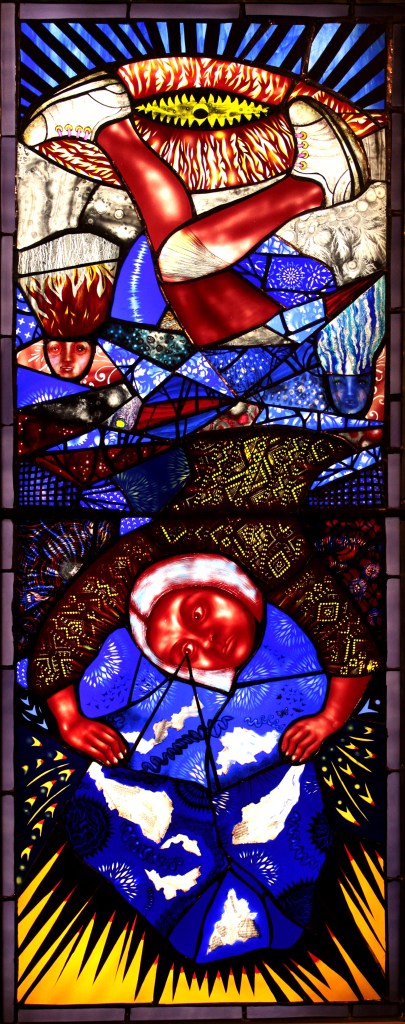
Pinkie Maclure X-Ray Eye 2023, stained glass.
Photograph courtesy of the artist

Although X-Ray Eye (2023) addresses a post truth world, the ‘twisting of words and fragmentation of social interaction’, it also recalls a strong cultural tradition of truth, in folk music and in the work of artists such as William Blake. Stephen Ellcock and Matt Osman’s book England on Fire, which features Maclure’s Green Man Searches for Wilderness (2020) taps into a seam of ancient knowing and divinity of imagination. In X-Ray Eye, Maclure’s female figure plunges head first, downward, like Blake’s The Simoniac Pope in the inferno. Though injured, she is far from helpless, flanked by opposing forces, fire and water, divided by argument, her hands pull words and assumptions apart, the fractured lead lines converging on her eye. The dominant colour within this space of exploration is the divine, sacred blue of medieval glass. Her sneakered feet straddle a portal of instinctual knowing at the apex of the composition. The body is fragmented, in a fallen position of discomfort, but there is also a will to understand that we feel will bring clarity, even in a climate of screaming opposition.

Walking away from the exhibition down Sauchiehall Street I saw a black and white poster with a lighthouse on it ‘The seas are rising and so are we’, a slogan adopted by climate activists. I had to smile, as the red, life affirming thread throughout Maclure’s extraordinary exhibition altered my perception of the world outside. ‘Somehow we mend, Somehow we mend in the end.’

Pinkie Maclure’s Lost Congregation continues at the Centre for Contemporary Arts, Glasgow until 9 September 2023. https://www.cca-glasgow.com/programme/lost-congregation

Beauty and Rage – Pinkie Maclure’s ‘Brigid in Dualchas’

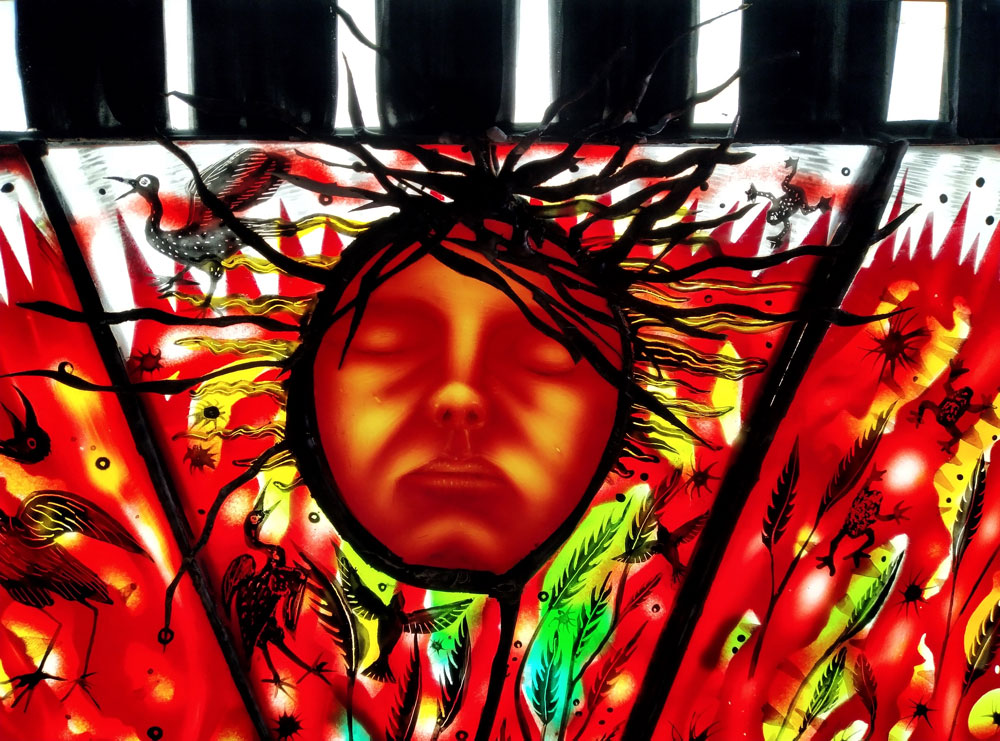
Pinkie Maclure ‘Brigid in Dualchas’ (2022, stained glass and lightbox, 65cm x 62cm)
Photograph by Tony Davidson, Kilmorack Gallery.

Radically transforming the art of stained glass, Pinkie Maclure’s latest work brings feminine power and the climate crisis brilliantly into focus.

Pinkie Maclure’s Brigid in Dualchas feels like a songline, tapping deep into the earth and our collective unconscious through storytelling. It is an image of origin, crisis and ultimately, hope. Illuminated in glass, a medium as fragile as humanity, Maclure’s Brigid takes full possession of beauty and rage. Rendered with consummate skill, this goddess of pre-Christian Ireland becomes conduit and cure, a contemporary icon of emboldening solidarity and potential change. All Maclure’s work presents the viewer with a knife edge of burgeoning consciousness and action, here contrasting ‘the old traditions and worship of nature with our contemporary abuse of nature and the resulting climate crisis.’

Brigid (Brighde or Bride in Scotland) is a deity of keening and healing, a protector of nature and an apt patron saint for the Anthropocene era we are living in. In a global context circa 2022, her luminous presence is a confrontation.  Reappraisal of feminine power, not as ‘other’ but as an intrinsic aspect of all life and creation, has never been more urgent and cuts through all cultures and gender identification. Maclure’s Brigid is a sacred flaming red flag to reconnect with ancient, indigenous knowledge, not just to survive, but to reclaim life on this planet in all its eternal mystery and wonder.

The idea of ‘Dualchas’ in the Gaelic tradition, which ‘refers to the intimate bonds that exist between the natural world, the land and its people, transmitted through generations’ is communicated in the female figure placed centre stage, described by the artist as the goddess ‘in her element.’

Pinkie Maclure Detail- ‘Brigid in Dualchas’ (2022, stained glass and lightbox)
Photograph by Tony Davidson, Kilmorack Gallery

Maclure’s composition is alive with free association. Colour radiates through layered glass in a strong, opposing palette of bloody red and divine blue, evocative of earthly and spiritual planes. Brigid is engulfed in red, a colour which drenches her arms and hands ‘Carrie’ style, while her softly glowing face, eyes closed, is pure repose. There’s great ambiguity here, between a defiant, enduring lifeforce and potential carnage being unleashed. Microbes on finely etched tree branches are underpinned by a vestige of pattern, akin to Medieval stained glass, shining beneath. The smallest details are held aloft by all that has come before, layer upon layer of concept, craft and understanding. In Maclure’s own words;

‘I sandblast, paint, fire, engrave and layer glass and relish the inherent chaos of such an unpredictable medium. The slowness of the process lets me access subconscious, dreamlike imagery and tell stories linking real-life, contemporary experiences with historical texts, characters, and events.’

Pinkie Maclure Detail- Brigid in Dualchas’ (2022, stained glass and lightbox)
Photograph by Tony Davidson, Kilmorack Gallery

Pinkie Maclure’s art is a masterful union of ideas and technique which encompasses the entire spectrum of art practice. Like the figure of Brigid in Dualchas, the artist’s upward diagonal path of pure neon lightening may be framed in linear black and white geometry, but this in no way contains her. Brigid moves beyond the upper frame of the composition, pulsing with colour and energy. This petal like radiation of lead line, form and colour bring order and meaning out of chaos. It is pure Zeitgeist, but it is more than that.

The goddess is resolutely complex and complete, divine and human, seen in a Christ-like pose. Associations with the crucifixion, of suffering, sorrow and resurrection, not of God’s only son, but of the world are invoked. Saint Brigid’s feast day, 1st February, heralds spring or Imbolc, celebrating new life out of dark winter stasis. Maclure celebrates life giving creativity as an essential drive, in nature and us, linked with eternal cycles of life and death. Brigid’s clenched hands hold twigs like anode and cathode charges, grasping the mettle of all creation with open arms, much like the artist herself. Brigid in Dualchas is an image of feminine creative power beyond childbirth, in possession of self and body.

Pinkie Maclure Detail- ‘Brigid in Dualchas’ (2022 stained glass and lightbox)
Photograph by Tony Davidson, Kilmorack Gallery

The stained-glass composition hinges on a ‘v’ of pubic hair, like the stem of a winged seed, the centre of a flower or a veined petal. It is an unexpected, radical bloom, presenting the female body in an uncompromising, completely organic way, ironically unseen for centuries. Maclure describes the red scratch marks on Brigid’s legs as ‘reminiscent of the graffiti you sometimes see carved into trunks of trees, reflecting the brutalisation of nature and women. Her legs are like the trunk of a tree, still standing despite decades of abuse.’ Significantly, the artist does not define the female figure with these marks. Maclure renders Brigid’s toes delicately mortal pink, her legs glowing pale green, not a deathly pallor, but one of burgeoning life and awakening. Leaves of green and yellow diffuse from her body and birds are silhouetted around a nest of blackened hair. There is nothing idealised here, jagged edges are part of the pattern and flow, held in radiant light. The fiery ignition of thought and instinct are all consuming, in making and seeing.

Maclure radically reinterprets the story of Brigid, ‘associated with perpetual, sacred flames, surrounded by a hedge which no man could cross. Men who attempted to cross were said to have been cursed to go insane, die or be crippled.’ The artist extends this idea to the current climate crisis, acknowledging the truth in the legend, of entire ecosystems. ‘Hedges are very important habitats for wildlife and for the prevention of wildfires,’ which have engulfed the planet. The element of fire, like the goddess herself is ambiguous and multifaceted, triple faced in her most ancient form.

The expression on Brigid’s face, a deeply meditative, active subconscious, calls upon us to collectively awaken and remember through ancient stories. The cathedrals of old encouraged the viewer to look up and be elevated, and in her own inimitable way, Maclure encourages us to do the same, reaching down through the foundations of belief to the site of origin, buried deep beneath the church. This is a different kind of power to that which currently blights our world, one that leads creatively towards hope.

Pinkie Maclure artist’s website: https://www.pinkiemaclure.net/

Cut and Paste – 400 Years of Collage

29 June – 27 October 2019

Scottish National Gallery of Modern Art (Modern Two)

Eileen Agar The Lotus Eater (1939, Collage, watercolour and ink on paper) National Galleries of Scotland, Edinburgh. Purchased 1979.

Cut and Paste: 400 Years of Collage is the first survey exhibition of collage ever to take place anywhere in the world, featuring over 250 works from the sixteenth century to the present day. There is an astonishing range of practice on display, including works by Hannah Höch, Annegret Soltau, Claude Cahun, Pauline Boty, Natalia Goncharova, Valentine Penrose, Toyen, Edith Rimmington, Eileen Agar, Linder, Penny Slinger, Carolee Schneemann, Cindy Sherman, Nancy Grossman, Deborah Roberts, Pablo Picasso, Henri Matisse, Juan Gris, Joan Miró, Max Ernst, George Grosz, Raoul Hausmann, Eduardo Paolozzi, Max Bucaille, Roland Penrose, Joseph Cornell, Kurt Schwitters, Joseph Beuys, Robert Rauschenberg, Andy Warhol, Peter Blake, John Stezaker, Christian Marclay and Terry Gilliam. Give yourself ample time to explore them and to take in the accompanying show Beyond Realism at Modern One, featuring some of the NGS’s finest Surrealist works.

In many ways this ground-breaking reappraisal of collage couldn’t have happened anywhere else. The NGS collection is blessed with significant acquisitions, long term loans and bequests from astute collectors such as Gabrielle Keiller, artists Roland Penrose and Eduardo Paolozzi, providing an excellent foundation for deeper exploration of the artform. Joined by works from the Tate, the Victoria and Albert Museum, The Estorick Collection of Modern Italian Art, Stephen Ongpin Fine Art, The Mayor Gallery, The Fry Art Gallery, Bernard Jacobson Gallery, Annely Juda Fine Art, Galerie Thaddaeus Ropac, Alison Jacques Gallery, Richard Saltoun Gallery, England & Co, a/political, the University of St Andrews and private collectors, the exhibition is a fantastic opportunity for discovery of previously unseen work. Works from the Murray Family collection, UK and USA, featuring Pauline Boty, Edith Rimmington, Max Bucaille, Franz Roh and Toyen are outstanding.

Cut and Paste isn’t about defining collage but celebrating that there are many more ways to see, revealed primarily in the work of lesser known artists who are among the highlights of the show. These previously neglected works demand greater visibility and more research. The language of ‘revolutionary cubist masterpieces’ by male artists like Picasso persists, yet in the wider context of the show, they become relative to other equally revolutionary masterworks by artists yet to enter public consciousness. Although the exhibition’s chronological layout would have been better served by collage -like juxtaposition of art from different periods confronting each other, there are so many vital examples of this art form speaking resoundingly for themselves that they cannot be ignored. It’s incredibly gratifying and hopeful to connect with pioneering works by women and other marginalised artists, doubly so in what feels like an increasingly fragmented world circa 2019. Part of what collage does incredibly well, often in testing times, is provide an unbridled form of expression and much needed protest.

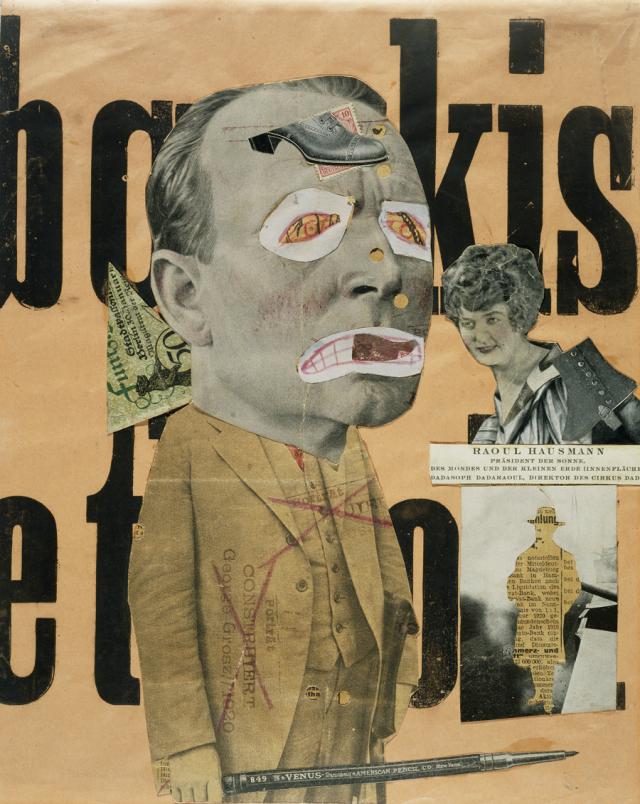
Raoul HAUSMANN (b.1886) The Art Critic, 1919-20 Lithograph and printed paper on paper Collection: Tate © ADAGP, Paris and DACS, London 2018

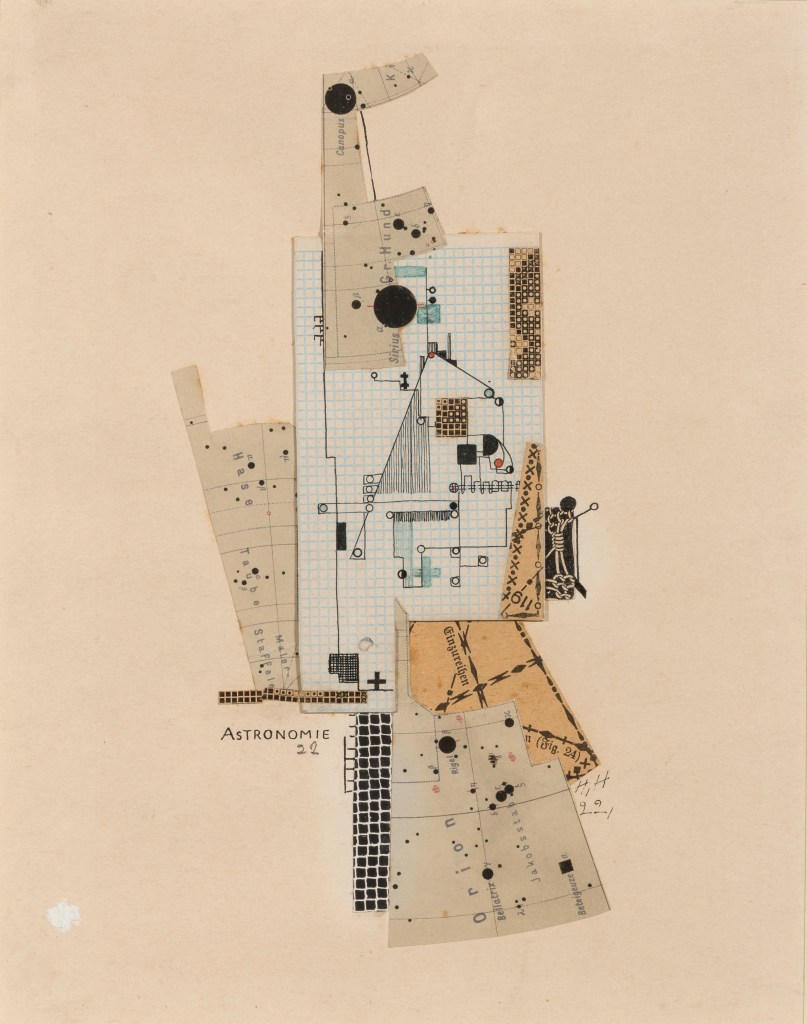
Admittedly collage is an artform close to my heart in history and practice. The process itself is liberating in its free association, formed from materials immediately to hand and permitting everything in a spirit of playfulness and experimentation. That impetus tests what could be- creatively and culturally. At its best, it’s an art of ‘disruption’ and active dissent that reminds us of how essential art is in everyday life. The grotesque central figure in Raoul Hausmann’s The Art Critic (1919-20, lithograph and printed paper collage on paper) depicts an entire society whose opinions can be bought. The artist cuts straight to the heart of an increasingly absurd displacement of power during the Weimar period, a time not unlike our own in the corruption of ‘post-truth’ politics and ‘fake news’ rhetoric. Seeing John Heartfield’s response to the rise of Nazism in 1930’s Germany affirms the power of collage as vital satire and political resistance. Equally the work of Hannah Höch, presents the viewer with counteraction to gender stereotypes. In Astronomie (1922, Collage, gouache and ink on paper, The Mayor Gallery, London) Höch uses grid elements from crochet, knitting and embroidery design as the basis for a more expanded vision of the feminine- as human and therefore equal. In Höch’s work, ideas of design, domestic and cosmic intertwine. Craft and fine art practice become inseparable in a union of ideas and technique.

Hannah Höch Astronomie (1922, Collage, gouache and ink on paper) The Mayor Gallery, London.
Hannah Höch From the Collection: From an Ethnographic Museum (1929, Collage and gouache on paper) National Galleries of Scotland, Edinburgh

From the Collection: From an Ethnographic Museum (1929, Collage and gouache on paper, National Galleries of Scotland, Edinburgh) is a very sophisticated example of how much simple ‘cut and paste’ can reveal and how it can be used to collectively question the status quo. The ‘other’ in this work is cultural and feminine. The head of a Nigerian Benin sculpture is radically turned, fused with the eye of a woman from a fashion magazine and a child’s body, resting on a lion’s foot of power and a contradictory stump of domestic furniture. Framed in a starkly modern, geometric space, the human form doesn’t feel accidental or randomly placed, but designed as a question mark on multiple levels. The expression of this figure, like a mythic Susannah confronting the invasive, violating gaze of the elders, challenges generations of Western Art making. This confrontation with ‘masters’ expands to hierarchies of power in relation to gender, race, cultural identity and social engineering. I’ve always thought of this small, radical figure as a powerful feminist totem of resistance.  Höch’s critical eye is sharp as a scalpel and expansively aware, beyond the individual maker.

The attitude of collage is pivotal in that respect, ripping, tearing or cutting to heighten awareness of reality, or point to an alternative reality. Like Carlo Carra’s Atmospheric Swirls- A Bursting Shell (1914, ink and collage on paper), created in response to the first Balkan War 1912-13, the best examples of this artform are those that explode preconceptions, creating a perceptive shift of some kind. When Carolee Schneemann created Body Collage (1967, 16mm film transferred to digital format 3:30 mins) her ‘intention was not to simply collage [her] body (as an object) but to enact movement so that the collage image would be active found, not predetermined or posed.’ This is a statement against the passivity of looking (or being cast as the passive object), initiating change. As Penny Slinger (b 1947) states very eloquently, ‘collage is not just a technique; it represents an approach to reality.’

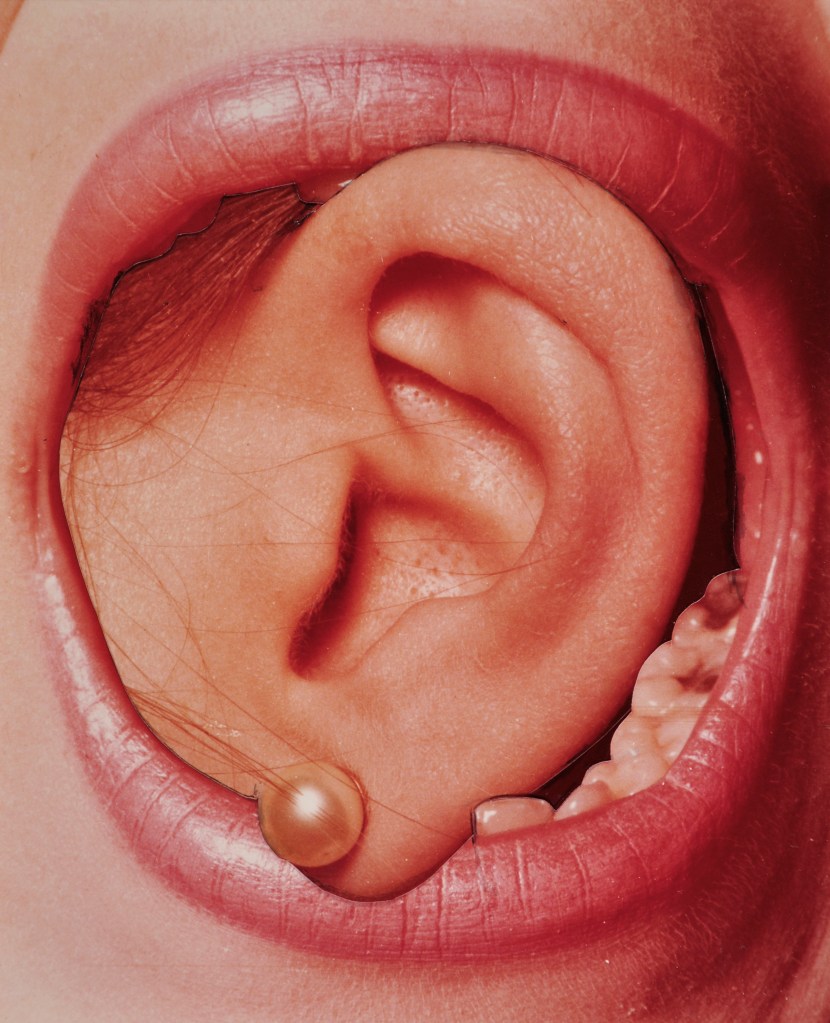
Penny Slinger I Hear What You Say (1973, Photomontage ) Penrose Collection, Sussex

Slinger’s photomontage sequence I Hear What You Say | I See What You Mean | Read My Lips (1973) interrogates our approach as viewers/ consumers by collaging parts of the body, creating contradictory frames within frames of internal reference. Initially this fleshy exposure seems to mirror the crudeness of advertising. However, these collaged elements are positioned to play with the idea of being able to read, hear, see and interpret the feminine. The ambiguity of desire and control is juxtaposed with direct means of communication. Using increasingly sexualised visual language to reclaim meaning is a tactic employed by many contemporary artists, often with momentary effect. Here the question is more subliminal, encircling the viewer in their own truth of body and mind, the possibility or impossibility of being seen, heard or understood inside the dominant culture. Linder’s Pretty Girl (1977, magazine and collage) juxtaposes images of soft-core pornography and household appliances, bringing them equally into the foreground as ‘objects of desire.’ Linder’s collage instantly makes its point, infiltrating and subverting the language of mass media consumption. This is art with something to say, above and beyond artistic persona, celebrity or brand.

Kurt Schwitters (1887-1948) articulated how the practice of collage redefines the artist;  ‘The medium is as unimportant as myself. Essential is the forming. Because the medium is unimportant, I take any material whatsoever if the picture demands it. When I adjust materials of different kinds to one another, I have taken a step in advance of mere oil painting, for in addition to playing off colour against line, form against form etc. I play material against material.’

That material can also be material reality. This provocation of possibility is what excites me most about this artform, from the fantastical collage novels of Max Ernst to the stitch form self-portraiture of Annegret Soltau.

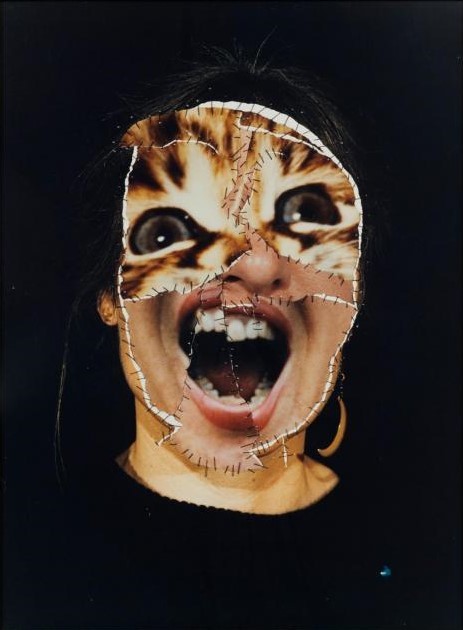
Annegret SOLTAU (b.1946) GRIMA – Selbst mit Katze (der Schrei) / GRIMA – Self with cat (the scream), 1986 C-print © DACS 2018. Courtesy of Richard Saltoun Gallery

It’s interesting to see the pre- modern history of collage (1550-1900) including silhouette portraiture, scrapbooks, early photomontage, botanical clippings, flapbooks, boxed/ dressed engravings and tinsel prints presented in the show. The presence of these works, combining craft practices with expanding knowledge and advancing technology, inform perception of later works. This is particularly true when the idea of traditional ‘female accomplishments’ is ripped apart and reconfigured, as in Annegret Soltau’s GRIMA- Selbst mit Katze (der Schrei) /GRIMA-Self with Cat (The Scream) (1986 C-print). Pauline Boty’s Untitled (c1964, Collage, gouache on paper) is a great metaphor for this type of agency, emergent in the work of unsung female artists throughout the exhibition. In Boty’s Untitled collage, use of Victorian engravings recalls the work of Max Ernst, divided and conquered by vivid blue gouache and a female hand, sharpened by red nail polish and poised to sever the head of a female child in period dress with a pair of scissors. In the foreground a promenade of exotically lush vegetation leads the eye to a vanishing point beneath a god-like hand of action. As Boty suggests in Ken Russell’s 1962 44 min film Pop Goes the Easel, her collages often capture a moment before something is about to happen, which may be humorous or tragic. Pop Art is often packaged in the gift shop as bright and shiny, succumbing to the very forces it seeks to expose, however Boty’s work presents a different slant on a movement which she helped found in Britain. The hand shown in this small collage amplifies the authenticity of her voice, asserts the role of the artist/ activist and subverts the traditional, belittling relationship between Craft and Fine Art, female artists and male ‘masters.’

Valentine Penrose La Strategie Militaire /Military Strategy (c1934, collage on paper) Penrose Collection, Sussex

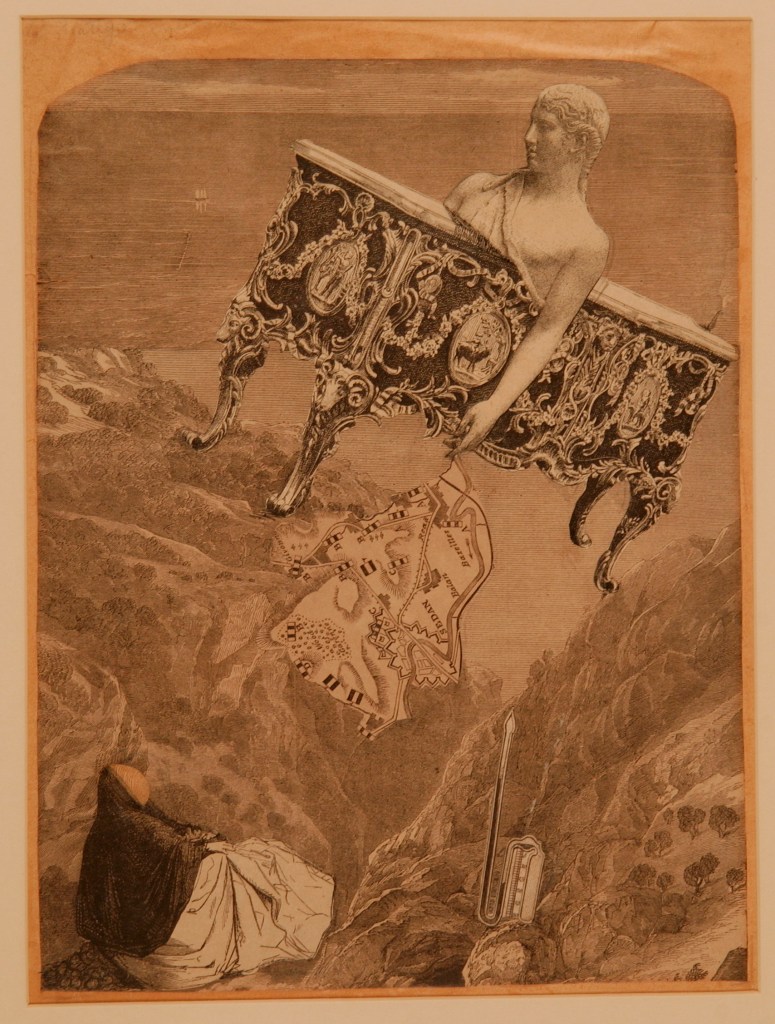
The subversive nature of collage also leaps from the open page of Surrealist Claude Cahun and Marcel Moore’s Aveux non avenus- Disavowals (1930). It’s a text that reimagines the autobiography / artist memoir in a non- linear way, fluidly testing ideas of gender and identity. Valentine Penrose’s collage book Dous des Feminines / Gifts of the Feminines (1951) is displayed in the same section, a deliberate counterfoil to Max Ernst’s collage novels on the part of the artist, centring on female relationships, sexuality and experience. Her nearby collage, La Stratégie Militaire / Military Strategy (c1934, collage on paper) sees the head and torso of a classical marble statue positioned inside a piece of ridiculously Baroque furniture, as if sitting in a bath. Hovering askew over a mountainous chasm, with the fragment of a map dangling from one finger, the traditional embodiment of power is rendered precarious, attended by a blank faced figure in robes gazing upwards towards authority. The composition lampoons its subject, but it is also a very knowing refraction of absurd inequality in the real world. Here, Surrealism isn’t escapist male fantasy, but heightened reality, exposing truth.

Edith Rimmington The Family Tree (1938, Photomontage with gouache) The Murray Family Collection, UK and USA

The Family Tree(1938) by British artist, poet and photographer Edith Rimmington (1902-1986) is another illuminating dreamscape in that respect. The use of photomontage and painting is seamless, delivering a powerful perspective on generations, extending to infinity on a jetty over dark, primordial waters. A snake is entwined around the left-hand line of a double link metal chain, not so much bound together as lain side by side. The presence of the serpent feels like an ironic reference to Eden’s mythic fall, male and female bound together in ‘the’ singular family tree of humanity. The eclipse which lights our way could be sun, moon or a pinhole camera, in a timeless progression of darkness and light. It’s an incredibly strong, mysterious composition that ignites the imagination and provokes curiosity about Rimmington’s oeuvre.  Given the year it was created, and the spirit of unrest prevalent in the whole image, this iron chain feels prophetically encoded. Disarming beauty and essential protest permeate this show and it’s an absolute pleasure to see so many works by relatively unknown artists announce themselves. Rimmington subverts expectations of the title/ subject to a remarkable degree, with an enviable command of the artform. Any backward notion of feminine accomplishment is eclipsed entirely by this work. The artist’s sense of agency, intuition and determination is palpable. That’s the joy of this show- reconnection with art empowered, in spite of the spin that surrounds us.

Cut and Paste: 400 Years of Collage Exhibition Catalogue. National Galleries of Scotland, Edinburgh 2019. Front cover Max Bucaille (1906-1996) Alice au pays de poissns et des marguerites, 1947. The Murray Family Collection UK and USA.

https://www.nationalgalleries.org/exhibition/cut-and-paste-400-years-collage

#NGSCutPaste