Anselm Kiefer

Royal Academy of Arts, London. 27 September – 14 December 2014.
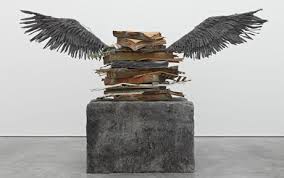
The language of birds

The Language of Birds (2013) Anselm Kiefer

The first major retrospective of Anselm Kiefer’s work in the UK is in a word, overwhelming.  Since first seeing his work in the flesh as part of the You Dig the Tunnel I’ll Hide the Soil exhibition held jointly at the White Cube, Hoxton Square and the basement of Shoreditch Town Hall in 2008, I have been in awe of this artist’s ever expanding capacity to confront the complexity of being human. I will never forget stumbling over uneven ground through a darkened space beneath Shoreditch Town Hall and into Kiefer’s installation of lead beds, ashes on photographic film reels and water inspired by Edgar Allan Poe’s The Fall of the House of Usher. The potency of malleable, poisonous lead and reels of human memory entwined in that decaying, labyrinthine space left an enduring imprint; a dark core of the imagination, pregnant with possibility. Whenever the opportunity presented itself to see his work I have followed; to Karfunkelfee, (White Cube, Mason’s Yard) and The Fertile Crescent, (White Cube, Hoxton Square) in 2009 and Il Mistero delle Cattedrali (White Cube, Bermondsey) in 2011 which occupied the entire 11,000 square feet of gallery space.  It takes a special kind of artist to command such a space and Il Mistero delle Cattedrali was one of the finest exhibitions I’ve ever seen, a revelation in terms of just how complete an artist’s vision can be when technique and ideas resoundingly equal each other.

Since the 1980’s Kiefer has created work on an industrial scale in a steel wool plant in Buchen and brickworks in Höpfingen, Germany, before moving to Barjac in the South of France in 1992 to create La Ribaute, a 200 acre studio complex on the site of an abandoned silk factory. Large scale greenhouses, barns containing house sized paintings, underground spaces, tunnels, towers and pavilions are laboratories, installation spaces and sites for what the artist describes as “reverse architecture” placing works back in the landscape. His other creative laboratory at Croissy-Beaubourg outside Paris, a 36,000 square metre former department store warehouse, is now his main studio/production space. Compared to these monumental spaces the RA does feel restrictive in addressing the sheer scale of Kiefer’s prolific oeuvre. However the exhibition provides a fantastic opportunity to view work of a more intimate scale such as Artist Books and Watercolors in relation to larger scale paintings, mixed media, sculptural and installation work, including new pieces created specifically for the exhibition space.

The effect of each successive room in this retrospective is cumulative and increasingly expansive; we can see the evolution of the artist’s work and iconography, his profound literacy and ability to transcend the self. The ego or artistic persona which defines so many contemporary artists and their work is absent. Kiefer has always understood that he, like the rest of us, are merely a blip in cosmic time and this context enables him to strip away creative practice to its most essential elements.  1000 years into the future if the human race still exists, his work will still speak as powerfully.  Its genius and true material is questioning and struggling towards meaning, a constant state of flux with creation and destruction as equal partners. It’s an Art which celebrates the connections a human mind can make, the mystery of life, death and its cyclical nature. It is ash and diamonds, immediately visceral, beautifully poetic and alive with contradictions.

Kiefer’s belief in Art as alchemy; placing “the phenomena of the world in another context” and in human “potential to achieve a higher state” are remarkably consistent throughout his work. “The real alchemist [Kiefer insists] is not interested in material things but in transubstantiation, in transforming the spirit”, a statement which relates directly to artistic intent. Born into the rubble of post war Germany Kiefer first dared to ask the question of himself; of what he would have done when confronted by the collapse of civilization and the contradiction of a culture that produced Dürer, Goethe and Beethoven being equally responsible for Auschwitz, Dachau and Buchenwald. Although his early imagery is clearly self-referential and culturally specific, the progressive distillation of the artist’s visual language powerfully communicates universal human concerns independent of time and place. The art critic and writer Robert Hughes described Kiefer’s work as testing “the moral imagination”, a quality which has been invested in its creation from the very beginning. Kiefer’s creative practice acknowledges that every age must come to terms with mythology and that “history is like clay”, it can be moulded, appropriated or wilfully distorted.

In his early work we see him grappling with what it is to be an artist, specifically a German Artist; a poisoned chalice after the appropriation of high Art and Culture in the service of Hitler’s Third Reich. In his Occupations and Heroic Symbols series Kiefer confronts what fellow German artist Joseph Beuys described as post war “visual amnesia” developing his own personal iconography of transformation, often depicted wearing his Father’s uniform.  In Heroic Symbol I 1969-70 (Oil and charcoal on linen, 260.5 x 150cm) the image is consciously bisected, presenting a duality of creativity and destruction. In the lower half of the painting the artist stands in the midst of a fire, smoke rising from an element of immolation into the white cloud above. The act of making a Nazi salute (banned in Germany in 1945) grounds the painting as an action of not forgetting the past. In the upper section of the painting, positioned in open blue sky is the sketched figure of the artist, a second self, hovering above the barren grey landscape with the true linen ground showing through, hands on hips, determined and resolute. Immediately reminiscent of Caspar David Friedrich’s 1818 painting Wanderer Above the Sea of Fog which positions the lone figure on a precipice, the figure of the artist, framed by cloud in a clarity of blue, rises physically and metaphorically above the salute. His nightshirt/smock suggests an aspirational dream space; however this isn’t a lofty expression of Romanticism but an artist standing on an ideological knife edge, deeply grounded in his cultural history and materials. Although some accused Kiefer of being a Neo Nazi when his Occupations and Heroic Symbols series were first exhibited, the painted surface of Heroic Symbol I is cracked and the composition actively dualistic. We are not presented with Fascistic certainty or a visual language of Neo-Classical absolutes and ideals. Kiefer’s methodology, like his imagery is intensely fluid and reflects the timeless human drive of trying to make sense of ourselves in relation to the world around us. His choice and handling of materials in later large scale paintings, sculptural and installation work, transformed by natural forces of sun, rain and seasons or by violent human action; a flamethrower, axe, hose pipe or acid, reflect this endless creative drive towards meaning.

Kiefer addresses the mythological and psychological associations of fire and forest, a wellspring of Germanic identity and storytelling in Man in the Forest (1971, Acrylic on Muslin, 174 x 189 cm). Here the artist stands in a nightshirt, holding a burning branch, the upright density of slender trees of the background bled into the foreground of the painting. The branch may be a torch or equally a cleansing fire to set the whole forest alight and burn it to the ground. Aglow with light washes of red and green a profound, surreal stillness pervades the work, casting the artist as protagonist and the viewer as witness. The human figure is positioned in a clearing, dwarfed by the forest of trees, becoming an everyman.
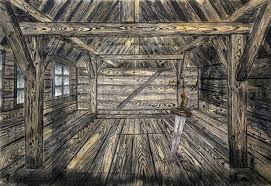
Nothung

Nothung (1973)

The textural and symbolic grain of the forest is explored further in Kiefer’s Attic Series of the early 1970’s. In Nothung (1973, Charcoal and oil on burlap with inserted cardboard drawing) we see an interior forest transformed into architecture, with heavy beams overhead suggestive of a Great Hall and an upright bloodied sword thrust into the floorboards. Kiefer uses linear perspective to draw the viewer into the space, a wooden bar across the altar like central panel of wall and two windows bled with rain to the left. This stain of blue extends into the roof around a banner of hand drawn text; “Ein schwert verhieß mir the Vater (Literally translated as “a sword promised me the Father”). Text is often used by Kiefer as a provocation, supporting or contradicting how an image is read. The reference to Nothung Siegfried’s sword from Wagner’s epic Ring Cycle; Der Ring des Nibelungen has its origins in ancient Norse mythology. However the idea of Siegfried as a pure Aryan hero of the German Fatherland and Hitler as self-proclaimed Father of the German people is inescapable and creates an image of the artist’s studio as a distinctly confrontational space. Kiefer’s exploration of his own identity in relation to the past is beginning to transcend the personal to reflect on the culture we chose to create and what it nurtures within us all.

In the triptych Parsifal I, II, III (1973 Oil and blood on paper and canvas) we are drawn deeper into the bare studio/attic space in a Grail-like quest. Blood stained joins of vertical panels echo trees in the forest, cast between order and chaos. The first panel depicts a white cot beneath a window with a single bar of shimmering light extending over the floor, dissipating into the foreground. The language of spears driven into the floorboards of the mid-section, broken swords and handwritten text creates a complex web of personal and collective associations. The viewer is effectively led into a space which like The Painter’s Studio (1980, Chalk, graphite pencil, acrylic and oil on photograph (1971) 58.5 x 68cm) and The Painter’s Studio (1980, Oil, acrylic and emulsion on photograph 58.5 x79cm) is transformational. In both images of The Painter’s Studio the architecture is seen engulfed in flames; there are no certainties or artistic props. We see steps leading upward to the closed door, marked with the recurrent symbol of an artist’s palette drawn onto the photograph in black like a cipher. No answers are presented but profound questions are asked both of the artist and the viewer about who we are, we’re we’ve been and where we are going, individually and as a species. Although the Attic Series is heavily laden, steeped in the cultural construction its own architecture, it also presents a dynamic testing ground of ideas and aspirations. The ordered timber structure links back to a forest of the collective mind, a place of refuge, rebirth, memories and nightmares.

The fertile imaginative ground of the forest becomes embedded and transformed in Ways of Worldly Wisdom: The Battle of Hermann (1980, Ink, acrylic paint and collage on paper, 290 x 500cm). A legendary and heroic figure tainted by Hitler’s cult of militant Nationalism, Arminius/Armin or Hermann defeated the Romans at the battle of Teutoburg Forest and was popularised through theatre and public sculpture in the 19th and early 20th Centuries. In Kiefer’s Ways of Worldly Wisdom woodcut portraits of German writers and thinkers are cast within a darkly gestural web or inferred framework of propagandist deceit. The forest is present in the background and in the grain of collaged woodcuts. This visual tradition of image making in Germany extending back to Dürer’s Northern Renaissance and the work of German Expressionists such as Nolde, Pechstien, Kirchner and Schmidt-Rottluff ,whose work was branded ”Degenerate” by the Nazi’s, is referenced in all its ambiguity. Woodcuts of the Die Brücke German Expressionist artists embraced the integrity and physicality of the image making process, of marks gouged from a raw block of wood and stark truths in black and white. Equally there can be no greater expression of High Culture or Fine Art than Dürer’s encoded and superbly executed woodcuts. However this cultural inheritance is also charged with knowledge of appropriation and the language of cultural supremacy.

The artist’s book; The Burning of the Rural District of Buchen IV (1975, Illustrated 56 page book with ferrous oxide and linseed oil on fragments of former paintings (oil on burlap) linen bound, 65 x 45 x 8cm) reduces the learned/Art object or repository of knowledge to an open page of blackened pigment, like charcoal remains of an ancient text saved from a great fire. Although such a work has specific historical associations, later sculptural works expand the frame of reference to a cosmic scale, introducing monumental stacks of lead books invested with the entire weight of human history, stacks of canvases, metal, rubble, pigment and ash like funeral pyres, the accumulation of millennia.
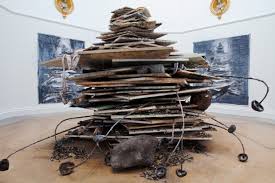
ages of the world

Ages of the World (2014)

Ages of the World (2014, Mixed media) a sculptural installation created for the domed Wohl Central Hall of the RA’s main galleries, is a superb example and a highlight of the exhibition.  Referencing “our planet’s evolution, the Romantic aspiration of Art, the poetry of ruins and the relationship of the individual [with] the deep time of the cosmos” the central structure is a vision of ordered chaos which the viewer orbits, following the curvature of the room. What immediately strikes the senses and draws the viewer intimately close are the smell of earth, oil and pigment and the bent heads of giant dead sunflowers laden with seeds protruding into the viewer’s space from lower evolutionary layers of time. Rocks and debris the ashen colour of comets, rolls of canvas and stacked paintings we cannot see, like closed books retaining their secrets, create an overwhelming sense that all humanity’s profound ignorance, knowledge and aspiration is contained in this single work. Kiefer creates an ironic dialogue with the surrounding architecture of white marble busts housed in gold leafed niches and the spherical vault of ceiling above. Two large scale photographs/ mixed media works hung like banners flank the main structure which from every angle appears as random composition perfected. The two dimensional images of accumulation and layered time  inform our reading of the work, but it is the towering sculpture itself which creates an overwhelming sense of what we are in human and cosmic terms. The effect is breath taking, laden with emotion and strangely uplifting, finding comfort of the mind in the mysterious enormity of the universe. Kiefer powerfully reminds us that “Art is an attempt to get to the very centre of truth. It never can, but it can get quite close”. Ages of the World is about as close as any artist or audience can get.

One of the surprises of the exhibition is a series of intimate, erotic watercolours on a ground of plaster, smooth as ivory skin. Cathedrals of France (2013, 18 page book with watercolour and pencil on plaster on cardboard, 75 x 58 x10cm) combines the ecstasies of the saints and exalted gothic architecture with a more earthly male gaze. Kiefer’s treatment of the female figure, bent back upon itself, surrendering to a cloud of blue or legs apart, juxtaposed with a vaulted doorway are obviously sexual. However this blatancy is tempered by the playfulness of a woman with a tiny cathedral in the palm of her hand or a reclining nude, contemplating a phallic tower on her lap, a curious prop rather than an object of male power. There is undeniable energy in these watercolours that reflects the mythology of Pre-Christian Roman Goddesses, transcending their holy and repressive architectural setting. Like the writings of Georges Bataille and Rodin’s intimate drawings of the female body Cathedrals of France could be viewed as pornography, however Kiefer’s fluid medium and invocation of Dionysian physicality resists this interpretation. These paintings present the duality of human desire and sexuality, both sacred and profane.

The extraordinary layering of materials in Kiefer’s monumental paintings incorporating straw, earth, flowers, ash, plaster, ceramic, metal, paint, charcoal and photographs are excavations of concentrated energy and precision, formal construction and accident. Photographs embed the moment within a painting and are often a starting point, gradually worked over with thick impasto pigments and found materials, cycles of time and natural elements. The sharp, heightened vanishing point perspective coupled with caked semi abstract surfaces in many of Kiefer’s early paintings encompass Apollonian and Dionysian aspects of the human condition described in Friedrich Nietzsche’s The Birth of Tragedy, having its origins in the Athenian theatre and philosophy of ancient Greece. Human drives towards reason, order versus restraint and instinct, irrationality and passion are always in a state of flux determining governance of an individual or an entire society. When Kiefer depicts the Interior of Speer’s Reich’s building (1981, Oil, acrylic, paper on canvas, 287.5 x 311cm) he inverts the idea of Neoclassical pillars, shining white marble and geometric order appropriated by the Nazis for their own ends in the decaying, blackened interior. How we see, our ethics, are our aesthetics and vice versa. Imagination, visual language and morality are inevitably entwined. Architecture is our physical built environment but it is also a construction of how we see ourselves.

Interior

Interior (1981)

In The Stairs (1982-83, Emulsion, shellac, straw and scorch marks on photographs (on document paper) on canvas, 330 x 185cm) the heightened perspective of the colonnade symbolically dwarfs the human aspiration of the ascending staircase. This idea is extended in To The Unknown Painter (1983, Oil, acrylic, emulsion, aquatic latex, straw and shellac on canvas, 208 x381cm) to the stalk-like figure of a lone individual/ artist seen in relation to the surrounding architecture beneath an oppressive ceiling of black sky. The full emotional weight of history can be felt in these paintings, however there is always light and transformation present in Kiefer’s work, methodology and in his use of impermanent materials.

Ash Flower (1983-1997, Oil, emulsion, acrylic paint, clay, ash, earth and dried sunflower on canvas, 382.3 x 761.4cm) presents a more linear, ethereal vision of human architecture in the central towering stalk rising above the dimensions of the canvas and extending into the cracked curvature of earth in the foreground of the painting. Here at the base we see the ambiguous structure of the flower merged in circular form with the man-made rectilinear ceiling space receding to infinity. Bloom and roots stand tall in three dimensions against the two dimensional ashen surface, extraordinarily delicate and resilient, naturally following the movement of the sun and the cyclical nature of the seasons. In spite of devastation the figurative sunflower, a recurrent object and symbol in Kiefer’s work, remains central to the composition and the artist’s existential world view. Even the dead head of the flower contains the possibility of new growth.

Ash Flower

Ash Flower (1983-1997)

The three dimensional/ sculptural element of Kiefer’s paintings is immediately striking, tactile and invites closer inspection.  In his homage to the poet  For Paul Celan, Ash Flower (2006, Oil, emulsion, acrylic, shellac and burnt books on canvas, 300 x 760 x 40cm) the high horizon line and perspective of ploughed furrows creates an immensity of space, punctuated by three dimensional burnt books which protrude from the surface of the painting and into the viewer’s consciousness. Blackened twigs stick out of the earth like the broken remnants of a human forest. The artist actively challenges perception of the painting as a two dimensional art object and rallies against the passivity of received images.  In the same way that poetry distils language, creating spaces for the reader’s imagination to wander into and timelessly remain; Kiefer’s visual language is similarly refined.

In the artist’s mixed media work For Ingeborg Bachmann: The Renowned Orders of the Night. (1987/2014, 240 x 500cm) lead becomes the canvas and we are presented with a densely caked, glittering surface that feels like an excavated slab of earth glinting with diamonds like a vast salt plain in the sun. What is precious and everyday are bound together in the light emanating from this predominantly grey work, rich with association. Kiefer moves beyond personal, literary references to encompass a more universal, poetically distilled sense of meaning in creativity. The sparkling surface could be interpreted as salt, a precious material for ritual purification, preservation of organic material and essential for human life. We may see in the pock marked surface a lunar/celestial association with stars, of looking to the heavens for navigation, spiritual guidance or poetic points of recognition and brilliance in an otherwise grey world. We may also see scattered diamonds; carbon atoms arranged in a face centred cubic structure or one of the most highly prized and valuable objects known to man.  The felt sense here is of precious objects of precision whose true value can only be seen in the context of deep time; a truth of diamonds, poetry and painting.

Kiefer’s The Secret Life of Plants For Robert Fludd I, II, III (1987/2014,Triptych, Mixed media, each panel, 190 x 140cm) creates a cosmic expanse of cracked earth, dark matter, glowing diamonds and the tracery of constellations; of what we are and what we aspire to be, expanded out of ruins and into the realms of possibility. Like Robert Fludd’s Utriusque Cosmi  (1617-1621) a volume split between human life on earth and the divine realm of the universe, Kiefer’s Art is a bridge between the two, sharing the English Physician’s spirit of enquiry. Fludd produced vast encyclopaedias including writings on alchemy, Kabbalism and astronomy, subjects traditionally considered unscientific and aligned with universal mysteries. Like all great artists Kiefer assimilates cultural, societal and mythological codes that reach back to the origins of Art in Shamanism.

osisrus and IsisOsiris and Isis (1985-87)

Kiefer’s monumental painting Osiris and Isis (1985-87, Acrylic and oil emulsion with additional three dimensional media, 381 x 560.1 x 16.5cm) displays his enduring fascination with ancient civilizations of the Fertile Crescent, Egypt and South America.  Here we see a vast pyramid with a circuitry board at the summit displayed as another artefact, linked by conductive copper wires to shards of pottery numbered as in an archaeological dig. It is the image of a ruin but also of potential rebirth, linked to the story of Isis gathering together the parts of her husband’s body strewn across the ancient Egyptian landscape in order to raise him from the dead. The presence of the moon invokes natural cycles of light, dark and tides of history. The human belief in progress and permanence is laid bare by the passage of time and the presence of earth, clay and dust into which we will all return. The gradations of the stepped architecture, realised in drips and rhythmic impasto are extraordinary and like its companion piece in the space For Ingeborg Bachmann: The Sand From the Urns (1998-2009, Acrylic, oil, shellac and sand on canvas, 290 x 560 x 7cm) it commands the entire room.

One of the most beautiful rooms in the exhibition is devoted to Kiefer in colour. Undoubtedly living and working in France has provided the light, distance and perspective necessary for the artist to transform frozen fields of “Blut and Boden” (Blood and Soil) into fertile fields of wheat, moving in enormous swathes of decaying yellow, green and ultramarine, reminiscent of the vitality and fatality Van Gogh. In the Morgenthau Series Kiefer references the 1944 plan by the US Treasury Secretary to convert a defeated Germany back to a pre-industrial agricultural country. There is joy and melancholy in these works, a yearning for the sublime in nature and within our own nature.  Kiefer reveals “creation and destruction [as] one and the same”, death and resurrection mixed in with the palette. L’Origine du monde(The Origin of the World, 2013, Acrylic, emulsion, oil, shellac, metal, plaster, gold leaf, volcanic stone and sediment of electrolysis on photograph mounted on canvas, 280 x 380 x 30cm.) references Courbet’s 1866 painting of a woman’s genitals seen in the rusted steel trap with a volcanic rock suspended inside. The terror and fecundity of Mother Earth, combine with Vincent’s colours of gold and ultramarine bisecting the sky and uniting the History of Western Art with our most basic human drives. Stalks of real wheat flail, part and fall, but the all-pervasive feeling is of life and vitality in the choice and handling of materials and in the ideological trajectory of the work. Kiefer is without doubt one of the most important and insightful artists alive today and this retrospective is a rare opportunity to be overwhelmed by a Contemporary Art exhibition.

www.royalacademy.org.uk

The 12th Inverness Film Festival

5th – 9th November, Eden Court Cinemas.

PA

The Inverness Film Festival is an event I look forward to every November because it always reveals unexpected discoveries and emerging new voices. Unlike larger festivals such as EIFF, it doesn’t have an army of staff, a massive budget or stars arranging themselves on a red carpet. The vision is vital and creative, at times wonderfully left field and incredibly focused on quality. Each successive year I find myself being challenged, excited and changed by what I see on screen and IFF 2014 was no exception. Record audience numbers show that I wasn’t alone in enjoying a truly international and exceptional programme selected by Festival Director and Eden Court Cinema Programmer Paul Taylor. The 12th Inverness Film Festival featured 34 films from 21 countries, 5 UK premieres and 17 Scottish premieres and the top three films voted for by the audience demonstrate a very healthy appetite for independent world cinema. Designed by Harris based artist Steve Dilworth, the 2014 IFF Audience Award went to Norwegian film Kon-Tiki directed by Joachim Ronning and Espen Sandberg, closely followed by New Zealand vampire mockumentary What We Do In The Shadows by Jamaine Clement and Taika Waititi and Difret by Ethiopian director Zeresenay Mehari, exploring the plight of women abducted into forced marriages in sub-Saharan Africa.

LEVIATHAN-NEW-300x161

There were many highlights both in the short and feature film categories and Andrey Zvyagintsev’s Leviathan screened on opening night was certainly one of them. Winner of best screenplay at the Cannes Film Festival, this absorbing multi-layered drama set on the edge of the Barents Sea in Northern Russia is defined by breath taking imagery, rich characterisation and fine performances. Leviathan is the story of Kolya (Aleksey Serebryakov) who lives with his wife IIya (Elena Lyadova) and teenage son on ancestral land that is illegally seized by the local mayor, supported by an equally corrupt court system. Kolya’s old friend Dimitri (Vladimir Vdovichenkov) travels from Moscow to defend him, fracturing the already failing relationship between Kolya and his wife. The opening sequence sets the tone of the film with the swell of the sea, the illumination of a distant lighthouse and music by Phillip Glass which expands and contracts in mesmerising waves. Michail Krichman’s magnificent camerawork lingers on a serpentine curve of wreckage, the ribs of marooned boats and a profound stillness of place. We immediately feel that this is a psychologically charged, inner landscape and throughout the film the natural environment mirrors the psychological and emotional state of the characters.

Interwoven with this human drama is a critique of Russian society; the corruption of church and state, together with the Old Testament story of Job who is tested by God and Satan. In one scene the camera focuses on a statue of Christ with the Latin inscription “Ecce Homo”, “Behold the Man”, the words uttered by Pontius Pilate before the crucifixion and are left in no doubt that Kolya is fated to suffer. We see from the initial hearing in the unfaltering recital of a court official an outcome preordained. A portrait of Putin in the mayor’s office, the priest’s complicit counsel and the way that the camera moves through the congregation during a righteous sermon all reveal the dominance of self-interest, greed and a society visibly in decay.

On a more personal level Kolya is tested with the loss of his home, family and declining health through drinking. He stands in the ruin of a church staring up into the hollow of the steeple, weathered, decaying icons around him and an overwhelming question of faith and truth rises from the depths to confront the audience. The sea monster or whale of the title is physically present when it surfaces before Ilya as she stands on a cliff and when Kolya’s son Roma sits perched on a rock beside a gigantic whale skeleton, we feel the enormity of his loss. Each character is contained within themselves and the camera brings the audience close to Kolya’s blue despair as the sea swirls beneath him. There is however light and humour in all this human misery; a succession of Russian presidential portraits used for target practice, the compassion of neighbours who adopt Roma and the exquisite natural light on land, sea and human faces. Leviathan is a superbly crafted, brilliantly perceptive and rewarding film and Zvyagintsev whose previous films include The Banishment and The Return is undeniably a major talent.

Mystery Movie La Distancia (The Distance) by Catalan Director Sergio Caballero visibly draws inspiration from Andrei Tarvoksky’s 1979 Sci Fi film Stalker, the films of David Lynch and the artist Joseph Beuys. Set in Siberia a trio of telepathic dwarves; Volkov, Baronsky and Schumeck are hired by an Austrian performance artist locked inside an abandoned power station to steal “The Distance” inside. Surreal, absurd and featuring a love story between a Japanese speaking, poetry reciting smoking bucket and a chimney, The Distance is an enjoyably different heist film which you feel compelled to keep watching because you’ve no idea what’s coming next. The incredible setting, placement of figures in the landscape and central figure of the performance artist provide the most intriguing aspects of the film. There are also more disturbing Lynch-like elements in the mix; the repeated playing of a cassette by the dwarves that sounds like a woman being raped and murdered simultaneously, the visceral dissection of a hare and some distinctly male humour that misses the mark. One gets the feeling that Caballero is trying too hard to be cryptically “out there”. Direct references to the action pieces of Joseph Beuys including his 1974 performance work I Like America and America Likes Me where he spent three days in a gallery interacting with a coyote and wrapped in felt and How To Explain Pictures to A Dead Hare (1965) where he coated his head in honey and gold leaf, whispering to the dead hare cradled in his arms and moving from image to image are consciously appropriated. Some details are altered, like the head of the artist covered in earth or mud instead of gold, but for anyone familiar with Beuys it is hard not to read him as a central character in the film- perhaps not as a person but as an action. Even the machine that the dwarves construct to break into the power station resembles Beuys’s sculptural work. For Beuys the hare, which he used repeatedly in his work, symbolised incarnation “which the hare really enacts-something a human can only do in the imagination. It burrows, building itself a home in the earth”. When Beuys used fluid or unstable materials such as honey which like human thought can become a living substance he also alluded to the potentially  “stale and morbid nature of thought” and the human tendency to over intellectualise. (An irony not lost on me as I write this paragraph.) What the dwarves discover hidden within the vault and the artist’s somewhat insidious comment as he says goodbye to the hare; “They’ve got ‘The Distance’, I’ll get inside today” feels like an action. In the spirit of Beuys this to me would seem to be the point of The Distance (if there is one). Cabellero’s style in all its absurdity presents a stream of fluid ideas and was certainly one of the most talked about films of the festival, completely polarising the audience. A boldly perfect choice for a Mystery Movie -if there was a Marmite film award it would definitely win.

WINTER-SLEEP-2-300x161

Moving from the ridiculous to the sublime Nuri Bilge Ceylan’s Winter Sleep is a quietly assured and stylistically mature drama by the director of Once Upon a Time in Anatolia, Climates and Uzak. The story centres on Aydin (Haluk Bilginer), a former actor who runs a small hotel in Anatolia, living with his young, estranged wife Nihal (Melisa Sözen) and his sister Necla (Demet Akbag), all of their paths “parted under one roof”. Like all of Ceylan’s films it unfolds at its own pace, gradually laying bare the tangled web of relationships between the three central characters and the wider community, their dependencies, resentments and flawed intentions. It is characterisation that drives the film and the three leads deliver superb performances. The landscape itself is also a dominant presence, a starkly beautiful expanse with human dwellings set inside mountains of earth. Ceylan cleverly frames the central character of Aydin in this place of retreat and revelation, his black coat set in isolation against the landscape. The opening sequence with Aydin’s silhouette seen against outside light through a window frame is telling and masterful. The camera slowly pans into the character’s dark headspace and during the next 196 mins we see his masks of intellectual and social superiority and his manipulations, particularly of his tenants and his wife. In many ways the relationship between Aydin and his recently divorced sister Necla is closest; “I wish my threshold of self-deception was as low as yours” she says wryly to her brother, although they too are entwined in their own power play.

Each of the characters is imprisoned in emotional confinement of their own making. Aydin uses his high ideals and morals as “virtues to crush and humiliate people”, however each relationship in its own way is dependent and neither of them are able to leave. His wife Nihal who has by her own admission wasted her best years withering away in fear is painfully attached to the idolisation of her husband and has bitterly grown to hate the person she has become. When revelations do come for Aydin they are in isolation, we hear through voiceover his self-satisfied thoughts that are never shared with his wife; they remain like the setup of an earlier scene, sitting on the opposite sides of the room beholding each other via a mirror which is both a truth and a lie. Ironically it is at this point that Aydin begins to write the book he has been unable to start. Ceylan is beautifully aware of the compositional power of the frame and often uses it as a window of the self, fractured, searching and illuminated. In one scene where Aydin enters a cave-like stable space, it is as if horse and man share the same frozen breath with reversals of positive/ negative space; Aydin in black, the horse which he eventually sets free in white. Part of Ceylan’s skill as a director is the investment in the psychological evolution of his characters on a purely visual level. There is extended dialogue between characters trapped within their own words but the most telling moments are largely silent, allowing the actors to fully inhabit their roles. There are big themes explored but in a characteristically quiet way; the nature of forgiveness, love, good and evil are played out in contemplative detail. As Necla suggests; “the product will match its maker”. Winter Sleep is a perfectly poised, complex drama and a worthy winner of the Palme d’Or at the 2014 Cannes Film Festival.

HEALING-2-300x148

The UK premiere of Australian Director Craig Monahan’s third feature Healing was one of the feel good highlights of the programme; a sensitive exploration of the human capacity for rehabilitation and forgiveness set in a minimum security prison farm in rural Victoria. Matt Perry (Hugo Weaving), a prison guard and case worker, comes to the aid of an Iranian prisoner Viktor Khadem (Don Hany) who is reaching the end of his sentence for murder. Inspired by a raptor rehabilitation programme run by Victoria’s state prison authority and Healesville Sanctuary, Monahan and co-writer Allison Nisselle deliver a moving story of loss and redemption. Although the emotive symbolism of broken wings and flight is laboured at times, the film is a unique prison drama in its refreshing, compassionate treatment of both inmates and prison guards. The performances by veteran stage and screen actor Hugo Weaving and Don Hany (best known for his roles in Australian TV series Underbelly and White Collar Blue) are outstanding.  Oscar winning Australian cinematographer Andrew Lesnie (Bran Nue Day, The Lovely Bones, The Lord of the Rings trilogy) is perfectly attuned to the natural light and wide open spaces of the Victorian countryside which is another star of the film along with the rescued owls, falcons and eagles.

SILENT_ADVENTURES-OF-PRINCE-ACHMED-300x161

A Sunday afternoon Silent Film Double Bill with live music by Forrester Pyke was another great pleasure of the festival. Based on stories from the Arabian Nights Lotte Reinigers 1926 The Adventures of Prince Achmed was an utterly enchanting and joyful experience. Reinigers early animation in bold colour and black silhouette is brilliant example of pure simplicity and sophisticated, elegant design. This enthralling shadow play taps directly into the ancient origins of storytelling in flickering firelight and on cave walls. The characters are sublimely drawn, morphing before our eyes into demons, witches and fantastical creatures. In many ways magic lantern shows and early moving images were acts of conjuring; combining theatre, magic and illumination. The silent era is a wellspring of inspiration and innovation from a time when cinematic techniques were still being invented. There is no better way of experiencing this type of film than on a big screen with live music. The immediacy of improvisation, the building of tension and the enhancement of the emotional arc of the story and its characters are all qualities which came to the fore in Forrester Pyke’s  performance. The darkened space we enter into collectively allows imagination to take flight. Although no complete copy of the film survives, The Adventures of Prince Achmed clearly demonstrates the creative potency and pure visual storytelling of the silent era which continues to inspire contemporary audiences and filmmakers alike. This would have been the perfect opportunity to explore the craft of shadow play and animation through workshops as part of a cinema education programme.

SILENT_THE-UNKNOWN-300x161

Reinigers magical tale was followed by Tod Browning’s equally engrossing feature The Unknown (1927)starring the great Lon Chaney as Alonzo the Armless, a circus knife thrower and shooter who falls in love with Nanon (Joan Crawford), the daughter of the circus Ringmaster who despises him. Nanon, who cannot stand to be touched or held by any man, is pursued by Malabar the Strongman but Alonzo is determined to keep her himself with murderous consequences. It is one of cinema’s most bizarre love triangles due to Alonzo’s secret and how he ultimately tries to win her love. There are elements of fetishism, burlesque and a whole lot of Freudian symbolism going on which will no doubt continue to fascinate, making The Unknown an enduring cult classic. What remains above all else is the genius of Chaney “the man of a thousand faces” as a master of human expression. As the only 35mm film screened at the festival and with live piano accompaniment it was an absolute privilege to see and discover this film for the first time, presented in the best possible way. It is rare to see a 35mm print in most independent/ Arthouse cinemas and non-existent at multiplexes, but whenever I have the chance of seeing a film in this format it affirms the quality of light and depth of field that makes it truly unique and largely unequalled in the digital age. The marks on a print become part of its history and part of the collective storytelling. The film was thought lost until it was rediscovered at the Cinematheque Francaise in the late 1960’s, found in one of hundreds of cans of film in their collection marked l’inconnu ,French for “unknown”. It is an example of the enduring qualities of celluloid which is still the most stable cinematic medium we have.

IFF has a strong tradition of showcasing Scottish short films and those with a local connection, highlighting the need for increased national support to facilitate the transition from shorts to feature filmmaking. It was gratifying to see increased audiences for all three selected short film screenings. Some of the highlights from the shorts programme included; Monkey Love Experiments directed by Ainslie Henderson and Will Anderson, Ian Waugh’s As He Lay Falling, Cara Connolly and Martin Clark’s Exchange and Mart, Douglas McDowall’s A Time For Freedom, Adam Stafford’s No Hope For Men Below, Rosie Reed Hillman’s Caileach, Jamie Magnus Stone’s Orbit Ever After and A Film Is A Film Is A Film by Eva Von Schweinitz.

Director Adam Stafford’s No Hope for Men Below (UK, 2013, 11mins) is a stunningly composed short with poetry in Scots dialect by Janet Paisley commemorating the 1923 Redding Pit disaster.  The opening black screen and anguished female voice is immediately compelling and as the story unfolds the imagery is superbly edited with sound in a way that sharpens our senses and flows with the rhythm of the spoken word. Shot in heightened black and white, we see pit black water sparkling with light, then turbulent and threatening as we move underground to claustrophobic chambers; a group of men illuminated eating their last bread, the face of a man who has written his final words to his family and bodies compacted together in a last embrace. The sound of breath in the dark brings the audience closer to the reality of the pit and the grief of those left behind. Stafford’s film is an incredibly muscular and compact 11 mins where poetry is created verbally and visually in perfect synthesis.

Rosie Reed Hillman’s Caileach (UK, 2014, 13 mins) is a wonderful and inspiring portrait of 86 year old Morag and her life in Licksto on the Isle of Harris. Hillman’s sensitive direction conveys the spirit and character of her subject, together with an acute sense of place.  “I can’t describe myself” Morag says, “I am me”, however the camera succeeds in capturing her spirited approach to life; through her everyday routines, interactions with her beloved sheep and contemplation of family photographs in the house she was born in, belonging to five previous generations. Whatever fears we hold about aging and death, in Morag we see not a Caileach (Old Woman) in decline, but a strong, independent and fearless individual facing her remaining years and mortality with assurance, grace and dignity. “It is a privilege to grow old” she says. “Many are denied it”. “I’m not afraid, perfect love casts out fear.” A single shot of a winding Harris road meeting a rainbow conveys visually, in perfect symmetry, that eternal optimism and an acceptance of being part of an essential cycle of life and death.

In Jamie Magnus Stone’s delightful and imaginative Orbit Ever After (Ireland/UK, 2013, 20 mins) Nigel, who lives with his quirky family on a ramshackle spaceship, sees a girl spinning round the earth the wrong way through his telescope and is instantly smitten. Trapped in different orbits they must find a way to communicate and reach each other. Stone’s inventive, whimsical and ultimately Romantic mediation on the need to leap into moments of connection and happiness to be truly alive (even if there’s a chance that you will burn up on re-entry) is positively brimming with warmth and humour.

Directed by screenwriter and filmmaker Douglas McDowall A Time of Freedom (UK, 2014, 20 mins) examines the tradition of the Boujloud, a pagan festival held in the Souss Valley in Southern Morocco. The three day ritual celebration of dancing, singing and masquerading has ancient roots in the Berker tradition and the central figure of the goat man or Bilmawm. Participants wear sheep or goat skins to invoke the power of the sacrificial animal, touching or hitting members of the crowd to impart good omens.  Although the role of the festival has changed over time, coexisting with Islam and becoming an economic driver in the area as a carnival, what is communicated in interviews with participants is the enduring need for ritual in contemporary life. Masks allow people to be and do what they wouldn’t ordinarily as part of a highly regulated society. McDowall’s editing, cinematography by Mike Webster and original music by Omar Afif and Joost Oud are skilfully interwoven as we follow individual stories, then move through the crowd as spectators and participants. What is fascinating and encouraging is the passionate, joyful embracing of this tradition by the younger generation as a connection to the ancestors, an affirmation of identity, social cohesion and perhaps most importantly in a modern context, the individual and collective release of suppressed emotion. The felt sense of participation in the Boujloud is very much linked to the health of the individual and society, with several of the interviewees commenting that if they didn’t wear the skins they just didn’t feel right or had physical symptoms.  Although the festival is culturally specific, it has global implications in terms of what we chose to embrace and what keeps us whole, individually and collectively. There are moments when Webster’s camera lingers on groups and individuals in the crowd, where time is slowed and we see glimpses of the Bilmawn as something deep within us. Since McDowall’s first short film The Wishing Well, screened at the Inverness Film Festival in 2008, there has clearly been significant development in the filmmaker’s style and process, resulting in this very promising short.

A-FILM-IS-A-FILM-IS-A-300x161

Directed by Eva Von Schweinitz A Film Is A Film Is A Film (USA, 2013, 16mins) is a thoughtful meditation on the disappearance of celluloid film and the takeover of digital projection worldwide. Drawn to becoming a projectionist by the “Romantic notion” of “making magic” as a “backstage performer”, “secret agent” and “master of the booth”, Von Schweinitz gently and playfully considers the link between how we watch films and how we see. A decade of experience as a projectionist and her work as a filmmaker; experimenting with bleaching, scratching, burying and painting onto film reveals the nature and true value of celluloid.  The “precision”, “attentiveness” and skill of the projectionist which is so dependent on a tactile relationship and understanding of film has been largely replaced by the push of a button. With DCP initiated by the major studios forcing the abandonment of making and watching 35mm film the “Death of Film” has been proclaimed by many. In New York City there are about 40 film projectors left in cinemas. Von Schweinitz doesn’t offer a didactic case for the preservation of film as a medium; however her own creative approach as a filmmaker succeeds as a powerful argument for why we need it. Inspired by experimental filmmaker Stan Brakhage (1933-2003) who placed the wings of moths and files between film, explored handheld camera techniques, painted directly onto film, used collage , multiple exposures and in camera editing Von Schweinitz asks a pertinent question; “how could you put the wings of a fly on an SD card?” The physicality of film, the way it ages, the way every print is scarred during its life, speaks to who and what we are as human beings. The flickering light of the projector, what Von Schweinitz describes as “moments of unknowingness” in the dark, like the natural process of a human eye blinking takes us  into the unknown, “embracing the unfamiliar and the now”. This isn’t simply nostalgia for a vanishing Art; Film, like digital media is a choice and to lose it completely would be an incalculable loss. It’s like not making oil paint anymore, simply because watercolours are cheaper and earn the warehouse a higher profit. There is sadness in this film visiting old mausoleum-like theatres, the camera focusing on what feels like a human stain on the floor where an old projector has been ripped out to make way for the latest digital model, but this is equalled by love and passion for the medium which is the best possible argument for why we still need it as part of contemporary culture.

PASSION-300x161

“Is there anything greater than to do the things you are passionate about until the end of your life?” asks Director Binder Jigjid in Byamba Sakhya’s wonderfully uplifting and thoughtful documentary Passion, following Jigjid across the vastness of Mongolia as he tries to distribute and screen his latest film Human Traffic.  The challenging, magnificent landscapes of Mongolia aren’t simply a backdrop but a vital element in the expansive creative vision of both directors and the dialogue between them provides a window on the world. As we travel with them from village to village the fascinating history of Mongolian cinema is revealed including the work of Jigjid’s Father, a pioneering director. We visit the abandoned film studios that once employed hundreds of people during a time of national film production and distribution through state run cinemas under Soviet control and censorship. Jigjid reflects on contemporary society overwhelmed by the increasingly global free market to the point where it “cannot distinguish between what is art and what is business” and where “Success {is} dependent on promotion not quality”.  The beauty of this film lies in Sakhya’s gentle insistence that “this film is about you” and in the sparkling eyes, humility and profound understanding of Binder Jigjid as a director and as a human being. “Where is the boundary between passion and greed? he asks of himself as a filmmaker and of the audience as consumers. “Creating good Art means you have to be truthful with yourself”. This beautiful documentary brings that core question of human intention and aspiration brilliantly into focus.

THE-TRIBE-300x161

IFF continued its strong tradition of showcasing the work of the world’s most promising first feature directors and this year’s selection presented some significant highlights. Director Myroslav Slaboshpytskiy’s debut feature The Tribe is a powerfully arresting and thoroughly immersive experience set in a boarding school for the deaf. Performed in sign language without any subtitles, voiceover or music, the film completely subverts the default position of mainstream cinematic storytelling; namely to tell the audience everything. Typically dialogue and musical cues tell us how to read and feel about the characters and their story. Here Slaboshpytskiy makes us watch film differently; denying sound (apart from naturally occurring actions like footsteps) and heightening our visual/ gestural readings of tension, tenderness and violence. For the majority of the audience who don’t use or understand sign language, what we are left with is something purer in terms of human expression through cinema, but also something harsher; a cold and uncompromising vision of an alienated world where you either exploit others or be exploited yourself. Like all gang cultures the code is silence and the need to belong, especially amongst adolescents, is painfully universal. The Tribe transcends its own subcultural language by making the viewer feel as viscerally raw and isolated as its characters. Editor and cinematographer Valentyn Vasyanovych first keeps the audience at a distance, then moves to handheld immediacy as we follow a new pupil’s induction into an underground world of prostitution and organised crime. Often our view is that of another student sitting at the back of a class or following behind with the pack like a new recruit. The untrained acting is intensely physical and there are scenes that are unflinchingly honest and emotionally alienating in their depiction of sex, prostitution, violence and abortion. But that’s exactly the point. By far the most unsettling element is the world that Slaboshpytskiy’s depicts; the institutional microcosm and its decaying walls reflect a wider reality. Although there are glimmers of innocence and intimacy in the main character Sergeu (Grigoriy Fesenko) this soon turns to possessive, explosive rage. Winner of the Critics Week Grand Prize, the France 4 Visionary Award, the Gan Foundation Support for Distribution and the Golden Camera award at the 2014 Cannes Film Festival this is a bleak but intensely promising first film for both the director and cinematographer.

VIKTORIA-300x161

Maya Vitkova’s strikingly accomplished first feature Viktoria was another extraordinary highlight of the festival. The whole question of nurturing, the central relationships between mothers and daughters over three generations and the rise and fall of communism in Bulgaria are examined in a complex story which is as epic as it is personal. Dedicated to the director’s Mother and semi-autobiographical, Vitkova’s story is infused with political satire, absurdist humour and a deep sense of loss – not just for the individual but for an entire country. Librarian Boryana (Irmena Chichikova) is determined not to have children and dreams of escaping to America. Despite all her efforts at thwarting pregnancy she gives birth to a baby girl (Viktoria) without a belly button or umbilical cord, a symbolic lack of any real connection between mother and child. This medical miracle on Victory Day draws unrelenting attention from the authorities. She becomes the Socialist regime’s “Baby of the Decade”, with a direct line to the Party leader making it impossible for her mother to flee the country. Played at age 9 by Daria Vitkova, then later by Kalina Vitkova, Viktoria grows up spoilt by Party indulgence, universally applauded by those in power and those who have none, her entire self-worth determined by the state. With the collapse of Communism in 1989 the child’s entire world comes crashing down, she is no longer special or adored, remaining unwanted and resented by her mother and increasingly isolated. The lack of a belly button that once singled her out for special treatment only serves to alienate her further. As she matures as a young woman in a new post-communist state Viktoria becomes a nurturing influence on her grandmother Dima (Mariana Krumova), a Party faithful who is presented initially as a judgemental, draconian force in the home, destroying her daughter Boryana’s contraband Coke bottles and statue of liberty cigarette lighter with a mallet. In Dima we see that freedom is relative and exacts a price; loss of certainty, purpose, meaning and identity result in her mental breakdown. It is only after Dima’s death that the tortured figure of her daughter Boryana, so distant and painfully unfulfilled, finds some point of connection as she tends her mother’s lifeless body. There is hope however amongst all the sorrow communicated by a new dawn and in the postcard Boryana receives from her daughter. It seems that for Viktoria the future holds more promise of human fulfilment than was possible for preceding generations.

Vitkova’s treatment of her subject is political and poetic. The director cleverly utilises news footage, juxtaposing world events; acts of revolution, conflict and resistance for historical context and to suggest an ever expanding field of reference. But the most significant stylistic development is the director’s ability to explore her characters’ psychological and emotional states through eloquent, dreamlike imagery. It is in this visual language that the Vitkova really finds her voice. The most beautiful, insightful and memorable images in the film are universally the most poignant. Trapped by a child she never wanted Boryana is unable to produce milk, a recurrent source of symbolic imagery throughout the film; a nipple exploding with milk she can’t express, unwanted rations of milk from Dima spilt on the ground and bubbling in the soil like acid, milk flowing from the body and finally a torrent like tears in cleansing rain. One of the most affecting sequences in the film is a dream of the child and her mother in a swimming pool, Boryana cradles Viktoria in her arms and for the first time they really see each other. The look they exchange is of unconditional love and acceptance, a state denied in waking life. Cinematographer Krum Rodriguez works from a subdued, clinical palette to convey a sterile environment, punctuated by red with all its political, cultural and emotional associations. A display of drawings and photographs in Viktoria’s bedroom reads as a red tree collage of party allegiance rather than a display of familial connections or imaginative play. In another sequence an umbilical cord grows like a tree root out of the sleeping Viktoria, becoming the line to the Party leader’s telephone. Elements of the surreal in these sequences achieve a heightened sense of reality and emotional truth. High crane shots are used to great effect in relation to the human figure, particularly to delineate the relationship between the individual and the collective. But the camera is equally attuned to the intimacy of relationships and their powerful estrangement in close-up. At the time of writing Viktoria does not have UK distribution, an example of the important role film festivals have in bringing the work of emerging artists/directors wider attention and attracting future investment in their evolving work.

www.invernessfilmfestival.com

Finding Vivian Maier

finding_vivian_maier_xlg

In an era of the selfie and social mass media where every moment of daily personal life is on public display in an endless, narcissistic parade of mediocrity, the photography of Vivian Maier is a dazzling discovery. The fascination with a woman who by reputation led a life closed to others, did not seek to share her work with the world and had no interest in courting fame isn’t how we expect a Great Artist , or even the average Joe with a Smartphone to behave. The story of John Maloof Finding Vivian Maier in this documentary is an unfolding puzzle; a detective story and journey of fortune we would all like to project ourselves into. The chance find of a box filled with negatives at an auction, the global platform of Flickr and the democracy of Google searches made finding Maier possible and seemingly within the reach of everyone. Maloof’s tenacity and obsession to uncover the artist’s life and work is the driving force of the film, working through storage lockers of her life, chasing leads through receipts and images, trying to piece together the woman and the artist. Establishing the Maloof Collection which now contains 90% of her archive, touring exhibitions, producing publications, prints, and sharing her remarkable images with the world online has no doubt saved the artist’s work from obscurity and potential destruction. The commercial aspect of sharing the work is also essential in revealing the vast collection of undeveloped film Maier left behind. A letter to a French film developer found in her possessions reveals that she did want to print the vast “pile” of material and that she recognised her work was “good”. Maier was intensely prolific, leaving behind 2000 undeveloped Black & White films, 700 undeveloped colour films, 100,000 negatives, 8mm and 16mm films, audio recordings and collectibles. The reluctance of major museums to acknowledge the artist as part of a canon of Great Artists/Photographers like Henri Cartier-Bresson, Eugene Atget, Lisette Model, Helen Levitt, Diane Arbus and Robert Frank or become involved in the archiving process is perhaps due( as Maloof suggests) to the vast amount of undeveloped material that she never had the chance to see and edit herself. Even though many photographers don’t print their own work the choice of what to print usually lies with the creator of the image and is part of the authenticity of the edition. It is thrilling to contemplate the scanning of negatives and development of film that will one day reveal the full breadth and depth of Maier’s oeuvre. Whether she intended it or not, her work is now in the public domain on a scale that in the 20th Century would have been unfathomable.

The enigma of the artist is a central preoccupation in John Maloof and Charlie Siskels’ documentary and in the public imagination. The testimonies of former employers and childhood recollections of Maier as a nanny are frequently contradictory, as memories often are; a complex and fluid narrative of perceived facts, remembrance, imagination and embellishment, becoming legend. By the end of the film I was craving more of the insight offered by the beautifully perceptive Joel Meyerowitz (the only Artist/Photographer interviewed in the film) and a return to the primary source of Maier’s images. This insistence on Maier as an unknowable enigma is something of a red herring when we return to her original work. Like all Great Artists/Photographers and unlike the average Joe with a Smartphone she didn’t just take photos. She needed to make images and was compelled to do so, honing her grasp of the frame, time, herself and the outside world in the process, grappling with what it is to be human. What makes her work so extraordinary isn’t the visible absence of human connection but the abundance of connections within it. Maier’s compositions demonstrate acute awareness of self and human relationships; she made people on the margins of society resoundingly visible, had a conscience in relation to social inequality and the courage to confront her own shadow self. As Joel Meyerowitz suggests, she was seeing how close she could get with every shot. In her work there is beauty, deprivation, humour, irony, delight, moments of trust, genuine exchange and always a wellspring of curiosity.

The universal human need to document, commemorate, celebrate and memorialise moments of recognition in our lives has always been entwined with the transience of human life and mortality in the Art of Photography. Describing herself as “sort of a spy” Maier recorded off guard moments; people with all their artifice and vulnerabilities, including her own. Her image of Audrey Hepburn at the Chicago premiere of My Fair Lady at the Palace Theatre, October 23, 1964 (Maloof Collection, Street Portfolio 3, VM19XXW02129-11-MC) reduces the world around the star to a blur, her expression wishing herself away from the limelight and capturing a universal human experience of levelling loneliness. Maier was a master of composition and her self-portraits are amongst the most complex and revealing of the genre. Self Portrait, 1954 (Maloof Collection, Self Portraits Portfolio, VM1954W00130-07-MC) is an image of multiple reflections and framed layers of association. At first we are drawn to the gaunt reflection of Maier’s face and torso in a silver tray, part of a store window display; the cold heightened tone of metal and held gaze, like a prisoner behind bars, immediately drawing the eye to the centre of the image. The security mesh across the window presents a psychological dimension, the certainty of the foreground out of focus and the core of the image/self in sharp reflection. Her expression is blankly penetrating and melancholic; a hint of resignation in the downturned corner of the mouth, aiming for steadfastness but plainly vulnerable. Maier’s Rolleiflex camera held at chest height is just visible; a lens, within a reflection, within a window within the still frame. Another reflection of her torso in the store window with her head cropped off presents a disembodied and dispossessed, but arrestingly calculated image; a line of closed black curtain providing the evasive ground for the exploration. The image is uneasily direct, the polished silver at odds with the thin face we see contemplating herself and fortune’s wheel in reflection. In framing this shot, Maier also simultaneously holds the gaze of the viewer, caught in a moment and for all time. In this moment the artist records and transcends herself. In the act of seeing the viewer becomes aware of the universality and the intricate layers of intimacy and defence that make us human.

Self Portrait May 5th, 1955 (Maloof Collection, Self Portraits Portfolio) is an image of incredible depth which lays bare the act of seeing through the eye/lens. The artist stands confidently, hands on hips, directly meeting the viewer’s gaze with the piercing precision of mirrored perspective, extending the reach of the shot to a heightened state of awareness. The alignment of mirrors creates a scene which is brilliantly focused and simultaneously flooded with expansive, illuminating light. The tonality in Maier is the light and dark of the human soul. The presence of the shadow self as observer perhaps reflects Maier’s occupation on the edge of family life and the isolation pursuit of seeing can bring. It reminds me of a lyric from Stephen Sondheim’s Sunday in the Park With George where the painter Seurat reflects on the emotional state of creativity, watching the rest of the world through a window as “the only way to see”. In Self Portrait 1955 (The Maloof Collection, Self Portraits Portfolio, VM1955W02784-03-MC) Maier’s distinctive silhouette in a dated hat and oversized coat are part of the shadow bisecting the composition, part of the city largely unseen. Human presence in absence or in psychologically framed objects is a fascinating element in Maier’s work. In New York, NY (Maloof Collection, Street Portfolio 2, VM19XXW04205-09-MC) the artist captures still drifting smoke from an abandoned chair blackened by fire, charred but standing defiantly on the street corner beside a neighbouring trash can. It’s a moment of truth and unexpected beauty in discarded found material, the detritus of people’s physical, emotional and psychological lives.

In Self Portrait, 1954 (Maloof Collection, Self Portraits Portfolio, VM1954W00106-05-MC) a horseshoe crab is positioned at the centre of the artist’s shadow torso, a carapace of hardened protection where the heart should be. In Undated (Maloof Collection, Self Portraits Portfolio, VM19XXW03470-06-MG) we see a pile of fallen leaves occupying the same position, an acknowledgement of cycles of growth and decay which affect us all. Maier’s reputed aversion to physical contact, insistence on padlocked rooms where she stayed and hoarding behaviour; accumulating boxes and boxes of material, creating rooms stacked with newspapers like padding with narrow walkways between, suggests Obsessive Compulsive and lifelong coping behaviours in response to loss and trauma. Although much is spoken of Maier’s aversion to human society and relationships, she is described as “a loner”, “a spinster”, “childless”, a distinctly feminine figure of loneliness; her images reveal many points of connection between the artist and the human subjects she photographed. The absence of marriage, children and romantic relationships is a fixation unique to discussion of female artists and obscures consideration of the true value and depth of their work. Examining Maier’s original work in detail is infinitely more insightful and revealing than the multiple testimonies of people who thought they knew her. Maier was a defiant survivor, fiercely intelligent and visually literate; this is abundantly clear in her work. She managed to carve out an existence through an occupation that gave her a roof over her head and the relative freedom to continue to take photographs. The relationship with her employers was always precarious, dependent on the benevolence and understanding of the families she worked for; her contribution to family life, largely invisible and poorly paid. Her identification with people on the margins of society and in poverty is incredibly articulate and true. Typically shot from chest height the human figure in the Street Portfolios of the Maloof Collection elevate the human figure from a position of disadvantage and dispossession to a position of dignity, self-possession and power. There is the sense of the artist meeting the gaze of the subject and acknowledging the presence of the other that is immediately tangible. In those moments Maier wasn’t hiding behind her camera, there is an openness and warmth communicated in her work that is absolutely invested in life and human empathy. The Street Portfolios are filled with examples of the artist meeting the gaze of her human subjects with equality; acknowledging the unique qualities of the individual, regardless of class, age, race or circumstance. Undated (Maloof Collection, Street Portfolio 2, VM19XXWO3160-03-MC), an image of a young woman leaning out of a car window is illuminated by the warmth of her smile in exchange with the artist and the viewer. May 1953, New York, NY (Maloof Collection, Street Portfolio 1, VM1953W03398-08-MC) communicates a moment of intimacy, poignancy and exposure, an elderly man’s life experience written in his eyes meeting the photographer’s. Composed with arresting grace and radiating inner dignity Maier’s image of an elderly woman; May 16 1957, Chicago, IL (Maloof Collection, Street Portfolio 3, VM1957TW03435-10-MC) is another beautiful example of the connection made primarily through the eye and then the lens. Her image of a young girl Undated (Maloof Collection, Street Portfolio 2, VMPIXXW03160-05-MC) standing with her arms folded in a defensive stance; dirty face, tousled hair and tears in her eyes is an image of youth, age and streetwise experience reflecting the human subject and the photographer. In the background a store window full of lifeless adult sized gloves are juxtaposed with the stature of the young girl, her expression and demeanour strikingly assured beyond her years, defiantly strong yet emotionally fragile.

Maier had a highly observant and ironic eye for framing the relationships between human beings in all their complexity. There are moments of tenderness such as April 7, 1960 (Maloof Collection, Street 1 Portfolio, M196W03443-04-MC) where she captures an elderly couple who have fallen asleep on a bus; his hat sheltering her face which is nestled in the hollow of his shoulder, an image of habitual comfort and unconscious affection. In July 27 1954, New York, NY (Maloof Collection, Street Portfolio 3,VM1954W03415-04-MC) we see only the patterns and textures of clothing and the entwined hands of a couple from behind, the contrasting skin of their forearms revealing their relativity to each other. In terms of a public display of affection caught on camera the image subverts expectations. Another image of a couple in what is presumably a Central Park horse drawn carriage; March 27, 1953, New York, NY (Maloof Collection, Street Portfolio 1, VM1953W00564-03-MC) is ironically pristine in its framing. In close up it could easily be a fairytale scene from a Vogue photo shoot, an immaculately dressed young woman inclines her head towards her handsome companion, listening intently to what he is saying. The view however is at a distance, Maier pulls back so that we see the confines of the black carriage and the company sign on the door that reads; “Safety”, “Comfort” and “Service”. In December21, 1961, Chicago, IL. (Maloof Collection, Street Portfolio 1, VM1961W00847-03-WC) we see a group of bystanders gathered around a woman who has collapsed on the street, being tended to by police officers. Within this group one woman puts her hand to her face in shock, her brow furrowed with concern, another looks down and seems to see herself in the fallen figure. Two others look away into the distance, thinking of something else. The emotional trajectories in this work are fascinating, complex and contradictory. Maier was drawn to such scenes on the street like a journalist or war photographer. Like all great Street Photographers she simultaneously achieves necessary distance and human connection.

Maier captured human tragedy, accidents, violence, abject poverty and people, especially children in states of emotional distress; visual headlines for all that human beings are capable of. But there is also undeniable humour, delight and joy in her images. In Jan 1956 (Maloof Collection, Street Portfolio 1,VM1956W03408-10-MC) a pair of shoes amongst a line of canned sliced peaches peek out from beneath the curtain of a shop window, 1960. Chicago,IL (Maloof Collection, Street Portfolio 1, VM1968-9W03408-10-MC) captures the expression of an expectant poodle seemingly waiting for a call beneath a payphone and the colour shot Undated (Maloof Collection, Colour Portfolio, VM19XXZ06928-20-MC) of someone half disappeared into a hedge is comically surreal. The wonderful Self Portrait, New York, February 3 ,1955 (Maloof Collection, Self Portraits Portfolio, VM1955W03420-50-MC)of Maier smiling in the reflection of a tilted mirror being placed onto a removal truck is another shining example of her imagination, playfulness and wit. Even with the human subject removed Maier’s compositions are filled with beauty, light and dark. 1963. Chicago, IL (Maloof Collection, Street Portfolio 3, VM1963W00765-11-MC) is a supremely balanced composition; a central elongated puddle reflecting neon signage in the distance, drawing the eye into its depth and luminosity. Framing the image at the top of photograph is a sign that invites the viewer to “Come Fly With Me”. Maier’s compositional skills are richly evidenced in more abstract works such as September 1956 (Maloof Collection, Street Portfolio 3, VM1956W03430-06-MC) where her eye framing the side of a building with its exposed brickwork delivers a perfect composition of line, tone and texture that would be the envy of any painter. There can be no doubt when looking at her work that she deserves a place alongside the world’s greatest Artists/Photographers. When we return to her images we see not a closed person or a crazed personality, but someone who understood her medium and human beings equally with conscience and awareness. Unfortunately ownership of Maier’s estate is currently being contested by a long lost relative in France and the question of who owns copyright could mean years of litigation, preventing her work from being reproduced or shown in galleries. Whoever gains possession of Maier’s estate, the preservation and restoration of her work must continue. Although the story of Finding Vivian Maier began as “a riddle, wrapped in a mystery, inside an enigma” as more of Maier’s undeveloped film is revealed we must begin to reassess its value, quality and depth in the context of world Art History rather than the limitations of fame and fortune that the define the Contemporary Art World.

www.findingvivianmaier.com

Danish Diaspora – Scotland Seen Through Danish Eyes.

Danish Cultural Institute, Edinburgh.

1 August to 28 September 2014 and touring in 2015.

Amongst the madness and sensory overload of the Edinburgh Fringe I had the pleasure to be blissfully still in the Danish Cultural Institute’s gallery space for a wonderful exhibition of work by Lotte Glob, Lise Bech, Lillian Busch, Mette Fruergaard and Nickolai Globe. What struck me immediately was the sense of a living tradition of ancient Craft skills fused with Fine Art disciplines and striking Contemporary Design. What is so exciting about this show is the way that traditional Crafts such as Ceramics, Weaving, Gold and Silversmithing incorporate elements of the Scottish landscape to transform the viewer’s perception of place and genre. Each artist reveals the integrity of handmade objects as part of a tradition of seeing ourselves in relation to our chosen environment; tapping into a deep seam of knowledge and indigenous understanding of place and materials.  This is an expansive show in terms of what Craft can be, blurring the lines between Applied and Fine Arts, reflecting the dynamically fluid relationship between the two in many artist’s studios.

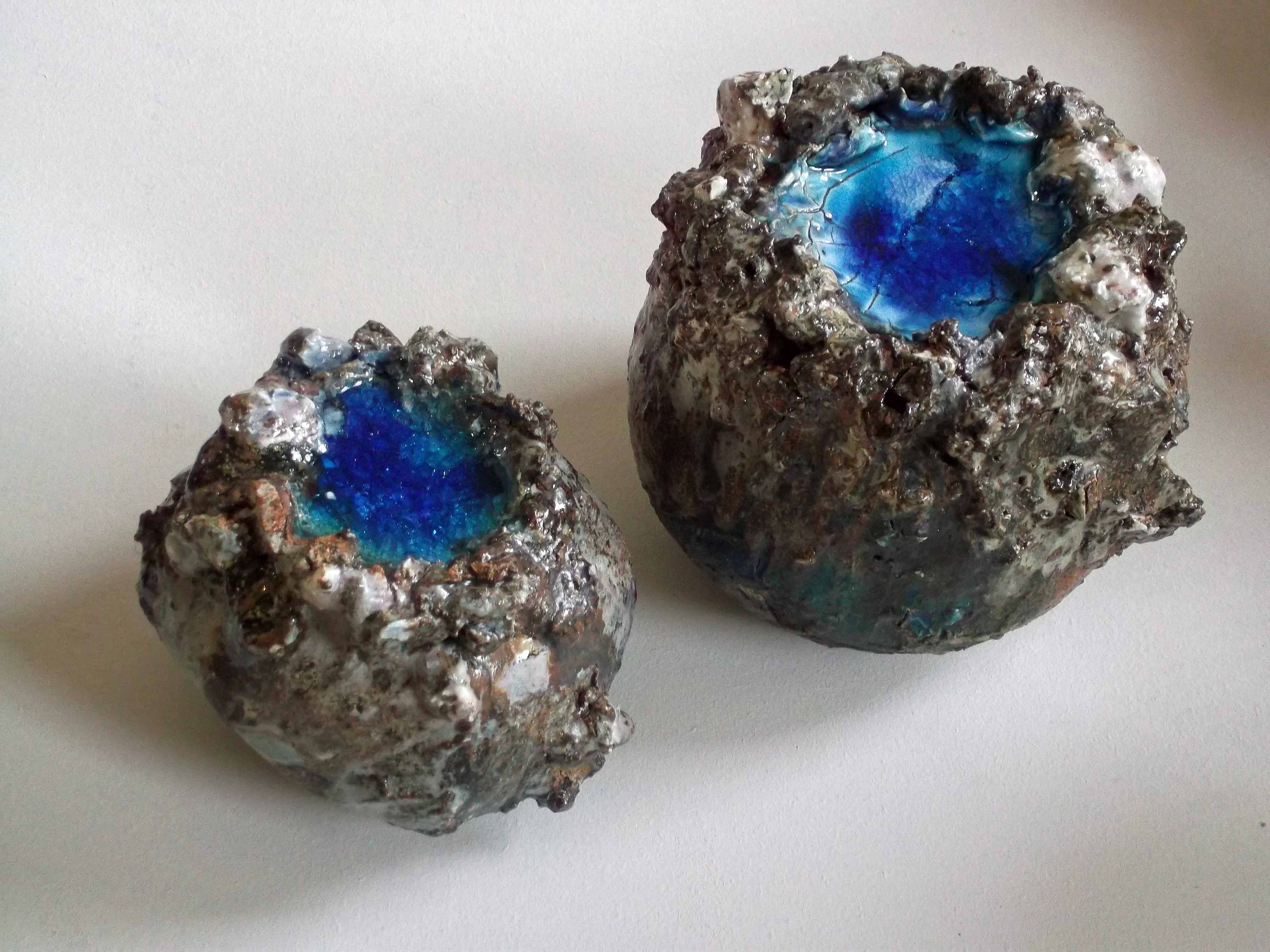
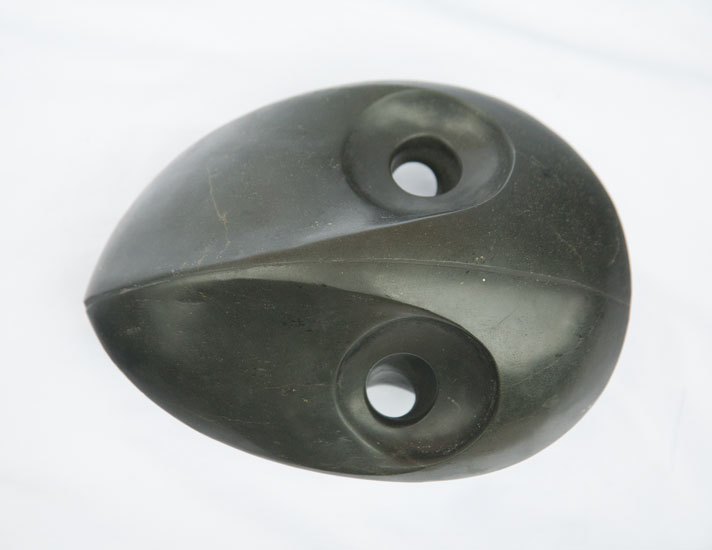
Lotte Glob Moon Pool Lotte Glob Rock Eyes

Lotte Glob, Moon Pool,Rock Eyes

Displayed on one wall Lotte Glob’s superb sequence of sculptural plates are of a cosmic scale in the imagination. In form and feeling Moon Pool seems to encompass the entire world and its eternal cycles. Crater Pool with its iridescent ultramarine core is another magnificent example. The use of materials and handling of glazes create an imaginative space of deep time; molten stone dripping into the centre, colours and textures evocative of ice, fire and millennia of Geological change. Glob’s work is forged physically and spiritually from the landscape. It is made of that land, from rocks and sediments gathered from the mountainous Scottish Highlands, home to the artist since 1968. In the beautiful and mysterious free standing sculptures Rock Eyes and Boulder Eyes we can sense a human eye and mind perceiving the landscape; the land and collective memory staring back at us, a tangible connection to a long history of seeing and making. Glob’s work presents a symbiotic relationship between Art and Life. There is tremendous respect for natural, primordial forces communicated in her work that never fails to inspire. She is an artist living consciously in her chosen environment, with tenacity, joy and a lifetime’s experience in every work. In the Western canon Creativity is often defined in terms of masculine energy and egotism. Lotte Glob’s work is a more expansive exchange that redefines our relationship with the natural world and the role of creativity in our lives. Many of the artist’s works are returned to the landscape, placed in lochans and on mountain paths, a natural gallery. At her sculpture croft on the shores of Loch Eriboll she has created “a place for discovering…, contemplating and enjoying a point in the universe” consistent with her life’s work.

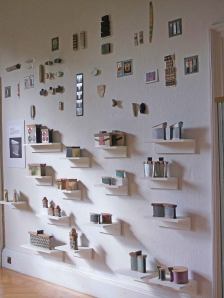
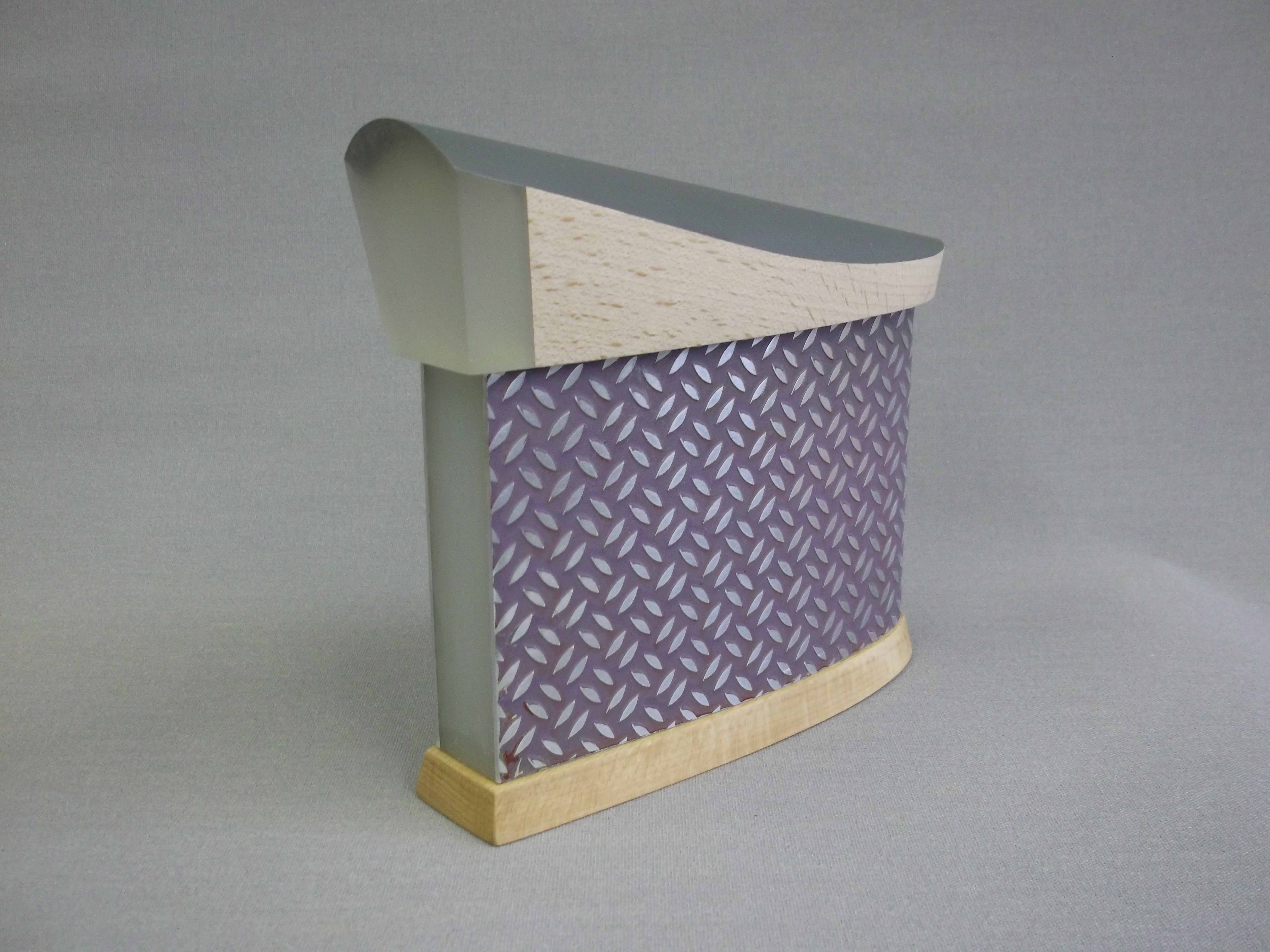
mette-fruergaard-wall-boxes- Mette fruergaard, box, aluminium,beech and resin

Boxes by Mette Fruergaard

Mette Fruergaard’s finely crafted boxes seamlessly combine materials such as wood, aluminium, copper, bone, resin and concrete in a union of form and function. Many of these are almost architectural in form, an unexpectedly beautiful fusion of organic and industrial design consistent with the Danish tradition but with the subtle accents of colour and light typical of the changing Scottish seasons. Fruergaard-Jensen’s “silent language of materials” is also revealed in selected pieces hung above the main display of boxes which invite the viewer to contemplate the tactile beauty of raw materials; the powdery midnight patina of a lump of  charcoal or the playful suggestion of a lion in wood grain. Using found and recycled materials highly finished surfaces are contrasted with textures formed by time and weather.

Lise-Bech-Venus-and-Mars-dancing2Lise-Bech-Venus-and-Mars-dancing1

Lise Bech- Venus and Mars Dancing (2), Venus and Mars Dancing (1).

Lise Bech’s basketry immediately invokes a world of Iron Age Crannogs; functional forms of creels, platters and cauldrons melded with expressive, asymmetrical, contemporary form. The scents of natural materials like willow are part of experiencing this work, creating powerful associations across time, transporting the viewer beyond the city gallery space and into the countryside. The rhythm of the weave feels as central to this Craft as the natural cycles of growth and harvest that provide raw materials for Bech’s Art. The wall piece Venus and Mars Dancing (Lath & Willow) evokes an eternal pattern of mythology and creative energies, masculine and feminine. Celtic Coil Cauldron (Salix p. Dicky Meadows) has its own distinctive energy, defying functionality as a poetic object woven from multiple traditions. Bech’s basketry aligns itself to a state of being in relation to the landscape; a return to Craft as a signifier of social and cultural cohesion, rooted in the earth. Its ancestry is simultaneously Viking, Celtic and in terms of why human beings need to create in the first place, universal in origin. What many contemporary Artists/ Makers bring to our attention is the rhythm of a living Art that connects us to the natural environment. Both in the making and experiencing of the work there is a meditative element in play, a powerful antidote to an age of mass attention deficit and unprecedented technological and social change.

Lilian-Busch-Bangle-silvergold-diamonds

Bangle by Lilian Busch

Lillian Busch’s jewellery also provides points of recognition and delight on an intimate scale; worn on the body, close to the skin. Bangle (46.Silver, 9 & 18 ct Gold, Diamonds) in its incredibly subtle use of gems could be likened to a pin prick of light seen through a dewdrop. The unexpected oxidised finish of this piece invites closer inspection in its sensitive rendering of materials. Unlike the usual use of sparkling diamonds and shiny metals to proclaim wealth and status, Busch’s work doesn’t reveal itself immediately but allows its richness and beauty to unfold. Inspired in early life by the Danish jeweller Ingeborg Mølsted, Busch’s designs incorporate ancient forms like the Torque from Viking and Bronze Age jewellery. Neckpiece (34. (9ct Gold, Jade, Silver, Rubber, Bayonet Clasp) feels almost ceremonial in function; an inventive combination of precious traditional and everyday industrial materials to create an intimate object of adornment and human connection.

Nickolai-Globe-Mantle3

Detail from the Mantle Series by Nickolai Globe

Nickolai Globe’s high fired ceramics of earthenware, porcelain, stoneware and minerals are arresting for their elemental, physical embodiment of natural forces. Ova for example with its volcanically ashen surface feels like an egg of creation and primitive shield, there at the beginning of all human life; protective and expansive, microscopic and cosmic in its associations. Vessel Core with its stalactite- like form and finger marked surface could be a geological sample or the record of an entire species and its core beliefs. There is a blurring of lines between the naturally formed and man-made structures in Globe’s work which is immersive and intriguing. Relic reads like a naturally occurring piece of fossilised earth marked by the tracks of an unknown species, it is impossible to know where the hand of nature and the hand of the artist begin and end. Similarly the boat-like vessel Kronos with its ridged formation like eroded sandstone is both immediately tactile and physical, but also  an excavation of collective archeology. The artist’s series of sculptures Mantle; 3, 4, 5 & 6 present the raw physicality of a living crust of rock and earth being formed, twisting and turning, ancient forces suspended in time. Blackened by the fires of creative energy it is also the mythologies we cloak ourselves in. There is reverence for the natural world in this work together with reverence for the artist as maker in pieces such as Ferrous Manus. Globe’s Art reflects his work with COBRA Group ceramic artist Erik Nyholm in Denmark, rooted in the folkloric tradition and Thanakupi , renowned ceramic artist and Aboriginal Elder from the Cape York Pennisula, Queensland, Australia, in its exploration of ancestral narratives and indigenous understanding of the earth.

Exploring the relationship between natural and man-made forms is a major strength in the work of Artists, Designers and Architects from both the Danish and Scottish traditions in terms of continuity and innovation. Historically this visual literacy has been recognised in a European, rather than a National or UK context which is why exhibitions like this one are so important as part of a process of cultural reappraisal on an international stage. The work in this exhibition represents a state of being in relation to Craft; part of a living, breathing  tradition rather than a revival or a memorial to ways of seeing long past. As an ex-pat Australian I am fascinated by the cultural migration of people and ideas, how visual language, mythologies and narratives evolve, fuelled by people, place and memory. What “Danish eyes” bring to our understanding of the land I also call home is dynamically charged, full of subtlety and complex associations. It is uniquely of its place and universally global in scope, bringing us closer to the vital spark of why human beings need to make Art in the first place- to make sense of the world and ourselves within it.

Danish DiasporaScotland Seen Through Danish Eyes

At the Danish Cultural Institute, Edinburgh until 28th September, then touring in 2015 to;

Peter Potter Gallery, 2 February – 28 March 2015

Rozelle Hopuse Gallery, 11 April – 17 May

Highland Regional Museums, 1 June – 28 August

Bonhoga Gallery, Shetland, 12 September – 25 October

www.dancult.co.uk

Artist’s websites;

www.lotteglob.co.uk

http://mettefruergaardjensen.com

http://bechbaskets.net

http://lillianbusch.com

www.missionhousestudio.blogspot.co.uk

John Byrne Sitting Ducks

14 June – 19 October, Scottish National Portrait Gallery.

1-29 November, Inverness Museum & Art Gallery.

3495_01

John Byrne American Boy (Oil on Plywood, 1971).

I recently attended a talk by James Hall at the Inverness Book Festival promoting his latest work; The Self Portrait, A Cultural History and emerged incredibly incensed and frustrated. Much like the proliferation of selfies all over the net, the scope of the talk amounted to scratching at surfaces, the emphasis on narcissism, costumed props and the artist displaying their genius. When I look at a Rembrandt self-portrait I don’t see an artist proclaiming his genius to the world, although artistic genius is certainly present. What brings people to his work time and again is its honesty and humanity. The artist painted himself unrelentingly warts and all, vulnerable, aging and fallible. It is a face onto which we may project ourselves. What makes Rembrandt great is that in the self-portrait he transcends time and himself, he communicates the universality of human experience. To look at Albrecht Dürer’s famous self portrait of 1500 and see only a Christ- like figure completely misses the complexity and contradiction of the image. When I saw this work in Munich a few years ago after a lifetime seeing it in reproduction, what struck me most was the intimacy of scale and expression. It is invested with tremendous subtlety, a face conveying age in spite of youth and myriad of expression. The artist’s hand points resoundingly to the centre of his chest. It’s the ultimate “I am” statement by any artist or human being in any century, an image of self-determination and self -possession, resolute and uncompromising. Equally Dürer’s eyes communicate a deep sadness and knowing of the limitations of what it is to be human. It is simultaneously an image of divine aspiration and earth bound mortality, timeless in relevance.

When I had the pleasure of seeing John Byrne’s exhibition Sitting Ducks at the Scottish National Portrait Gallery this week I also perceived an artist and a man, acutely aware of what complex and contradictory beings we are, both to ourselves and to each other. Typically Byrne caricatures himself in many of his self-portraits, he isn’t about celebrating himself but revealing all that we are by default. Some of the most beautiful works in the exhibition are also the most uneasy, ambiguous and unflattering.

In an early work Self Portrait with Red Palette (Oil and Acrylic on Plywood, 1974/5) Byrne’s flawless composition is matched with uncertainty. The diptych is an expanded space of vivid turquoise, the artist pushed into the right panel, steadfastly meeting the viewer’s gaze, red palette in one hand, cigarette in the other. The shadow cast by the figure is mirrored by the shadow of a black palette on the floor like another self, the edge of the palette disappearing tonally like the elusive nature of the painter’s art. A later work Self Portrait on White (Oil on Board, 2012) shows the artist pushed to the bottom of the frame, with what feels like a dead weight of white ground above. It is an image of self and of the human condition of aging, confrontational in its honesty, the exposure of white revealing strength, resilience and ultimate frailty.

John Byrne - Self Portrait on white

Self Portrait on White (Oil on Board, 2012).

In Self Portrait in Camouflage Jacket (2001) the artist’s face is emotionally in shadow, eyes rolled back heavenwards, two palettes hung round his neck like dog tags.  A white palette hangs in front while the other black, rectangular and smeared with paint hangs behind it, the whole image infused with conflict and vulnerability. The camouflage pattern merges with the recurrent motif of thorns, a snake coiled round the artist’s arm, his hand upturned in the foreground as if begging the viewer for human recognition. A pen pierces the artist’s breast, a tear in the flesh like the open wound of a confessional canvas, an internalised, psychological war being waged at cost to the individual. Awareness demanding its price. Byrne’s Self Portrait (Oil on Canvas, 1988) depicts a moment of reflection and distortion which lies at the heart of all portraiture, playing with certainties of self, painted object and genre in Magritte-like fashion in Ceci n’est pas un Auto PortraitThis is Not a Self Portrait (mixed Media on Paper 2003).

In his portraits Byrne demonstrates dazzling sensitivity and superb draughtsmanship. John With Saxophone (The Artist’s Son), (Graphite and Pencil on Paper, 1986), Celie Watching Television (the Artist’s Daughter), (Pastel on Paper, 1972) and Portrait of Honor, 19 May, (Pastel on Paper, 2001) are particularly fine examples. Standing in a dress of soft pink the watchful stare of the artist’s daughter feels like a person in the process of becoming, the outlines of her feet and large shoes spilling into the viewer’s space at the edge of the picture frame. It is a deeply personal and universal image of innocence and recognition. Has she just stopped crying? We can’t be certain, but we can see and feel a growth of awareness, a shift in perception- in the artist, the subject and in the mind of the viewer.

John Byrne - Honor

Portrait of Honor, 19 May (Pastel on Paper, 2001)

A Pair of Drawings; Honor and Monkey (Artist’s Daughter) and Xavier and Cat (Artist’s Son) (Watercolour and Crayon on Paper, 1999) return to a naïve handling of the figure seen in American Boy (Oil on Plywood, 1971). Both children are doll like, in oversized oriental costumed dress, half pyjamas, half ceremonial, flanked by hostile animals baring their teeth directly at the viewer’s gaze. As an image of childhood there is primitivism in the stage of development and in the treatment of the figure, the personalities of both children still being formed subject to immature, instinctual drives and emotions. They are fascinating drawings with a wealth of associations and ambiguities, lovingly observed in all their truth. The same may be said of Janine With Flowers (The Artist’s Wife) (Oil on Canvas, 2010) a Kahloesque vision where roses and thorns equally define the sitter.

Coinciding with Sitting Ducks at the Scottish National Portrait Gallery, Dead End at Bourne Fine Art, Dundas St, Edinburgh until 1st September celebrates Byrne’s prolific work and his unique, evolving iconography. In The Huntsman and the Snowy Owl (Casein on Paper) the figure appears blinded by the moon, pushed to the edge of the image, trying to see. Acidic yellow light illuminates the hollows of the uneven ground on which he stands, framed by a signature cloud and a bare, thorn like tree, at once brutal and poetic. In Big Selfie (Casein on Paper) Byrne’s age and experience are written in the hollows of his eyes, his still quizzical hair and smoke from his cigarette drawing elusive forms in the air. Unlike most selfies the image isn’t composed to flatter or project the ego of its maker for viral mass consumption. At 74 Byrne continues to do what he has always done, peering into the core of ourselves.

Short film introduction to the John Byrne Sitting Ducks exhibition featuring works referenced above:

 http://www.nationalgalleries.org/whatson/exhibitions/john-byrne/john-byrne-film

All images and film link by kind permission of the National Galleries of Scotland.

Eight Sculptors & Their Drawings

Eight Sculptors and their Drawings

15th August to 13th September , Kilmorack Gallery, by Beauly.

It is always exciting to see an exhibition that expands your ideas about what a medium can be. Eight Sculptors and their Drawings featuring work by Mary Bourne, Helen Denerley, Steve Dilworth, Leonie Gibbs, Lotte Glob, Gerald Laing, Will Maclean and George Wylie combines the immediacy of an artist’s first response with the permanence, distillation, monumentality and intimacy of multidimensional sculptural objects. The best works in the show move beyond sculpture/ the Art object and are very much about the living, creative act of making and experiencing work in more than three dimensions.

etchingLotte Glob’s etching “Walking the Faroese Cliffs” (Above) with its shaded chasms and figurative rock formations jutting into the sky feels like a timeless, primordial landscape. The strength of her drawings is consistent with her approach to ceramic sculpture; a fusion of elements drawn directly from the landscape, forged by water, earth, fire and air. “Walking the Faroese Cliffs” conveys the artist’s essential relationship with the landscape, the living skin of the earth and the knowing of countless generations. A suite of pastel and charcoal drawings; “Rocks Watching You”, “Boulder Land”, “Rocks Never Lie” and “Meeting on a Hillside” are infused with tremendous strength and vibrant energy. It is a joy to see the assured hand and unique vision of the artist resoundingly present in both her drawings and sculptural work. Glob’s fused books, created from raw elements from the land and ceramic are sealed shut from the eye but ever expansive in the imagination. “Book of the Bog People” is a particularly fine example which feels as though it has been excavated from the earth, encased in sediment millennia deep,tapping into a seam of collective memory. “Geologist’s Diary” evokes an entire landscape is its molten form of fused stones, mountains and lochs. Glob’s work powerfully communicates the multidimensional experience of being in the landscape; physically, spiritually, intellectually and emotionally, rather than merely seeing, owning or inhabiting it. Her work is a potent reminder of the power of natural forces and of human creativity as a source of connection and renewal.

Geologists-diary

Lotte Glob Geologist’s Diary(Mixed Media)

Steve Dilworth’s “Beaked Bird” (Bronze ed 2 of 5) is a beautifully balanced and poised structure of interlocking forms, both masculine and feminine. It is a seamless and sensual work, pivoting on ambiguity, the hollows and contours of form evocative of a seed or stage of evolution of some as yet undiscovered species. Dilworth transforms our conception of sculpture as an object with the act of making and seeing a transformative process. This can be sensed and felt in “Swift” (Harris Stone and Swift) an exquisitely crafted hand held sculptural object, mask and bird like in form and powerfully ritualistic in its centre of gravity. Hollows on the underside connect with your fingers, it is an object meant to be held with the weight at its core bound to the centre of the viewer/participant like a divining rod. The rhythmic asymmetry of its design and sweeping incised central curve are supremely elegant, engaging with flight of the imagination. The intimate scale of the object is monumental in its associations. It is birth, death and becoming in a single object, with the inner and outer forms of equal value and importance. The energies and origins of the artist’s chosen materials drawn from the landscape are held within.  It is wonderful to see the immediacy of the artist’s sketches nearby and the distillation of form and ideas realised in bronze and stone.

During an interview in 2006 when I asked what drew him initially to sculpture he replied; “I’m an atheist and an anti-theist. Art has replaced all of that spiritual side. So what it is to me is to try to make some sort of sense of what is a nonsensical place- of what we are. It is just exploring that and trying to understand. I don’t really see it as sculpture parse, but as objects and that’s what I make…For me the fantastic thing about making objects is that you’re making real things, they’re not about something, they’re not pretending to be something else, they are actually what they are- what it is in its entirety, whether you can see it or not.”

Beaked Bird

Steve Dilworth Beaked Bird (Bronze ed 2 of 5)

swift

Steve Dilworth Swift (Harris Stone and Swift)

A subtle and insightful artist, Mary Bourne’s “Many Moons” (Granite) are a moving sequence of form and light in gently contouring granite. The tonal exposure of light in carving the stone is part of this dynamic, each lunar phase providing a moment of contemplation and transition. “One Loch Two Days” (Granite) presents oblong bodies of water with the emotional weight of the choppy, turbulent surface of one and the smoothed calm of the other. These gestural marks in stone are mirrored in Bourne’s calligraphic ink drawings “Wood on Coreen Hills 1 & 2” which are striking in their simplicity and grace. Bourne conveys the movement of timeless elements with enviable economy.

Well known for her ingenious wildlife sculptures in scrap metal, drawing is an integral part of Helen Denerley’s practice. “Two Cows”, “Knee Study”, “Harris Hawk” (Charcoal) and “Female Nude” (Ink on paper) reveal her keen observation of line and form. In “Female Nude” Denerley reduces the figure to a few essential lines, communicating the attitude, character and physicality of the figure stripped back to its essential energetic core. It is a quality often to be found in her animal sculptures, which are fleshed out by the viewer led by line and small, finely tuned details that animate the structure. Rather than a solid body there is a space for the viewer to dive into, fuelled by the spirit and movement of the animal.

Like many of his box constructions Will Maclean’s “Barents Box” (Mixed Media) is a cabinet of human memory and inward navigation, composed of found objects many layers deep. Discarded materials and objects are enshrined and revealed in all their tactile beauty.  “Transom” (Mixed media) with fragments and objects embedded in the distressed surface of wood worn by time, human hands and the sea, is almost figurative in its three part structure; appearing like a standing figure with outstretched arms or wings. The white paint of the Plimsoll line anchors the object above and below, while the concave hollow at the centre feels like a space for the mind to dwell. “Black Vessel Foundering” (Mixed Media) simultaneously emerging out of and sinking into a heavy, black rectangular base is a vessel pared down and skeletal in form, with doll like torso’s embedded in the cross sections. It is a psychologically tense piece of work, anchored to a dark space of the viewer’s own imagining. Maclean’s expansively spartan drawing “Chief Officer’s Log” (Mixed Media) suspended on a ground of white, contains a fragment of history embedded in the surface of the drawing and  a trajectory of written text across the viewer’s horizon line. The circular focal point and outline of a submarine plumb depths of pure white.

Transom

Will Maclean Transom (Mixed Media)

Black-Vessel-foutdering

Will Maclean Black Vessel Foundering (Mixed Media)

Gerald Laing’s witty pencil on paper drawing “One more cup of coffee for I go” with just the legs and elegantly heeled feet of the female guest visible, pares down drawn lines to lead the viewer to a space beyond the page where we are free to imagine the sitter. “Studies for Dreaming” (Pencil drawing on paper) reveal Laing’s observant eye, distilled beautifully into the angular geometry of Galina VIII (Bronze, ed 4 of 10). “Hijacker”(1978, Bronze ed 5 of 10) is another intriguing work, both as an image of femininity and a reference to the militant Baader Meinhof group. “Twentieth Century Monument” (Bronze and Stainless Steel) feels like a mausoleum for Western Culture in its fusion of traditional bronze and industrial stainless steel.

Eight Sculptors and their Drawings is an exciting celebration of some of the country’s finest artists, each with their unique insights, energy and process. Far from the image of an elevated remote object on a plinth this show resoundingly presents a living art form of multiple dimensions.

All images by kind permission of Kilmorack Gallery http://www.kilmorackgallery.co.uk

Let’s start at the very beginning….

I remember when I was growing up being fortunate enough to live in a place with a state run Art Gallery, part of a cultural quarter in the centre of Perth, Western Australia. It was a large, modern building, a cool retreat from the blindingly hot summer and unforgiving light, spacious, expansive and full of exciting discoveries. You could walk in at any time and see a selection of Western Australian Artists, Australian Artists and the latest international touring blockbuster. In those walls I saw my first Van Gogh, Frida Kahlo, Albert Tucker, Charles Blackman and so many others.

One of the images that left its mark was Howard Taylor’s 1959 Double Self Portrait, an image that I kept being magnetically drawn to and still am. It is an arresting image, an uncompromising eternal stare and a frame within a frame for seeing the world. It introduced me to the idea of images as windows to the wider world and into ourselves. Whatever the medium and whatever the age, great Art alters our perception somehow. It’s what I hope for every time I go to a show, that spark of recognition and an expansion of what I thought I knew.

I hope that as this blog unfolds it will celebrate shifts in perception and unsung heroes; artists who help us see and discover the world anew, from blazing impasto canvases, cast bronze and painting with light, to the black out illumination of the cinema.

Howard Taylor Double Self Portrait 1959